
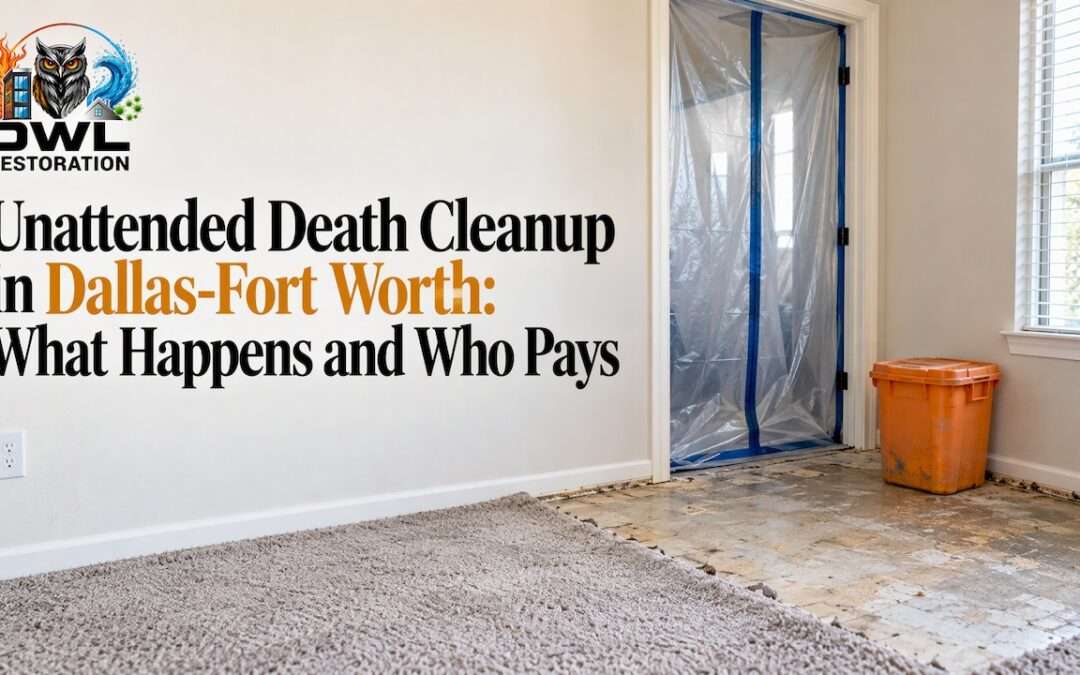
Unattended death cleanup is the professional removal of biological contamination, odor and damaged materials after someone dies alone and is not found for some time. It starts only after police and the medical examiner have released the scene, and it is work for trained technicians, not for family members, tenants or building staff. If the property is in Dallas, Tarrant, Ellis or Johnson County, our biohazard cleanup team responds 24/7 and works with your insurance company directly, so you are not handling a claim while you are grieving or managing a building.
TL;DR
- Call 911 first. Cleanup begins only after authorities release the scene, and you should not enter or clean a scene yourself.
- Time matters: body fluids soak into subfloors, padding and drywall, and odor spreads through the HVAC system the longer the scene waits.
- Handling human remains and the fluids they leave behind carries real exposure risks, which is why OSHA sets rules for the people who do this work.
- Cost depends on how long the person was undiscovered, how far fluids spread and what has to be removed and rebuilt. Insurance sometimes pays, so document everything before work starts.
- We cover the full path: cleanup, contents pack-out, mold concerns and reconstruction, for homes and commercial buildings.
Table of Contents
- What counts as an unattended death
- Why this is not a cleaning job for you or your staff
- What to do before cleanup begins
- How a professional cleanup works
- Mold after a death scene
- What affects the price
- Does homeowners insurance cover it?
- How to choose a trauma cleanup company
- Our perspective
- Need help now?
- FAQ
- Sources
What counts as an unattended death
An unattended death is one where nobody was present and the body was not found right away. It can be a homeowner who lived alone, a tenant in an apartment, or a person in a vacant unit or an office after hours. The legal and medical side belongs to law enforcement and the medical examiner. What is left behind belongs to you: blood and other body fluids, tissue, insects, strong odor, and sometimes materials that can no longer be saved.
The longer the time before discovery, the more the scene spreads. Within a day or two the effects may be limited to the spot where the person lay. After a week or more, fluids can pass through carpet and pad into the subfloor, and odor settles into drywall, upholstery and clothing. Heat makes it worse. In a Texas summer with the AC off, a few days can do damage that would take weeks in a cooler month.
Why this is not a cleaning job for you or your staff
It is natural to want to spare a family member or a tenant the sight of it. Resist the urge. Two separate things are going on.
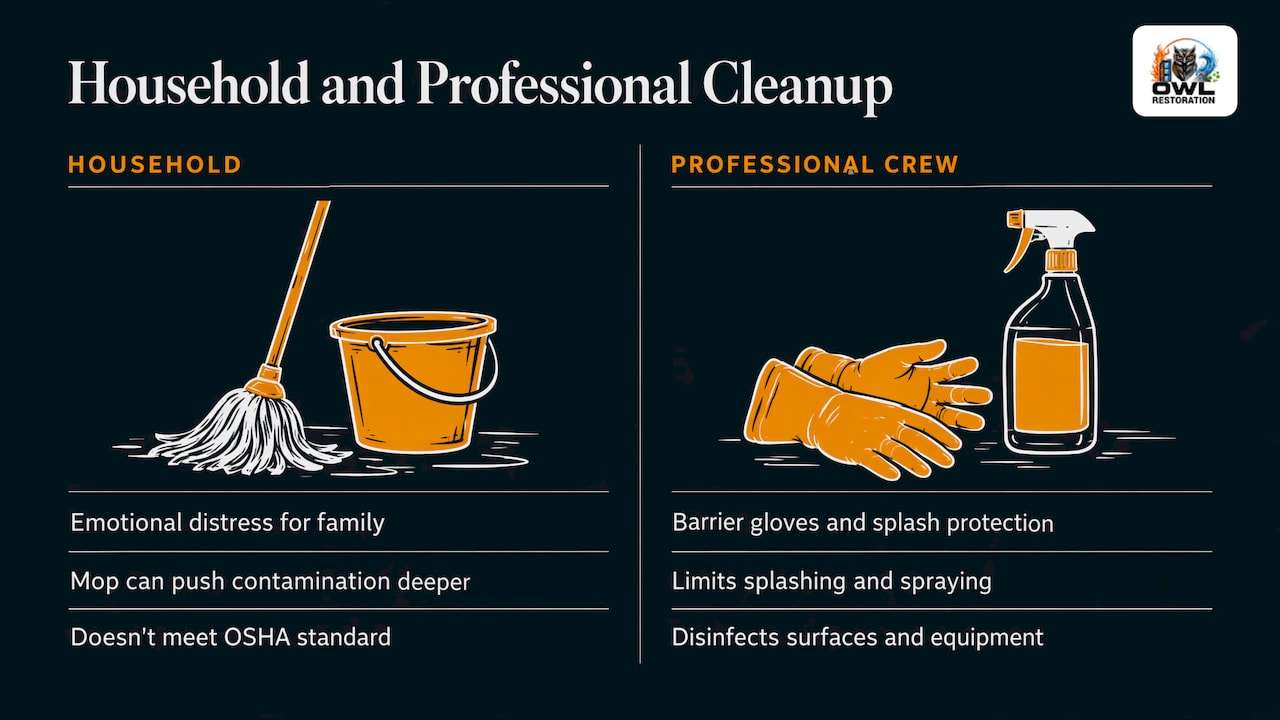
First, the emotional load. A death scene is distressing to see and to smell, and that memory does not wash out. Families and property managers are better served leaving the room to professionals.
Second, the health risk. OSHA’s guidance for people who handle human remains says that people merely near remains face no direct contagion risk and that the smell of decay is not itself a public health hazard. It also says that workers who handle remains or contaminated materials may be exposed to bloodborne viruses such as hepatitis and HIV and to bacteria that cause diarrheal disease. The same publication recommends barrier gloves, splash protection, hand hygiene and hepatitis B vaccination for those workers, along with disinfecting vehicles and equipment.
That is the line between a household and a professional crew. Employers whose workers face blood or other potentially infectious materials must follow OSHA’s Bloodborne Pathogens Standard, which requires that contaminated surfaces and equipment be decontaminated with an appropriate disinfectant and that procedures be done in a way that limits splashing and spraying. Household cleaners and a mop do not meet that standard, and they can push contamination deeper into the structure.
What to do before cleanup begins
The first hours are about safety, authority and documentation. Here is the order we would follow.
- Call 911. If you suspect someone has died inside, do not go further than you must. Police and the medical examiner handle the death itself, and the scene is not yours to disturb.
- Stay out of the affected area. Keep children, pets and other occupants away. Close the door to the room if you can do it without touching anything.
- Do not run fans or open the HVAC to “air it out.” Moving air spreads odor into clean parts of the building. Leave the system as it is until a restoration crew advises you.
- Do not throw things away. Carpet, furniture, bedding and personal items may be part of an insurance claim and may hold sentimental value. Let the crew sort what can be saved.
- Photograph from the doorway only if it is safe and appropriate, and keep the police report number and the date of discovery. Your insurer will ask for both.
- Call your insurance company and a restoration contractor the same day. Early notice protects your claim, and early work limits the spread.
For property managers and business owners, add two steps: notify the owner or the corporate office, and keep the surrounding units or rooms closed to tenants and staff until the crew has assessed the building.
How a professional cleanup works
The industry follows a recognized sequence, and understanding it helps you read an estimate. Exact scope depends on the scene, and our crew sets it after an on-site assessment.
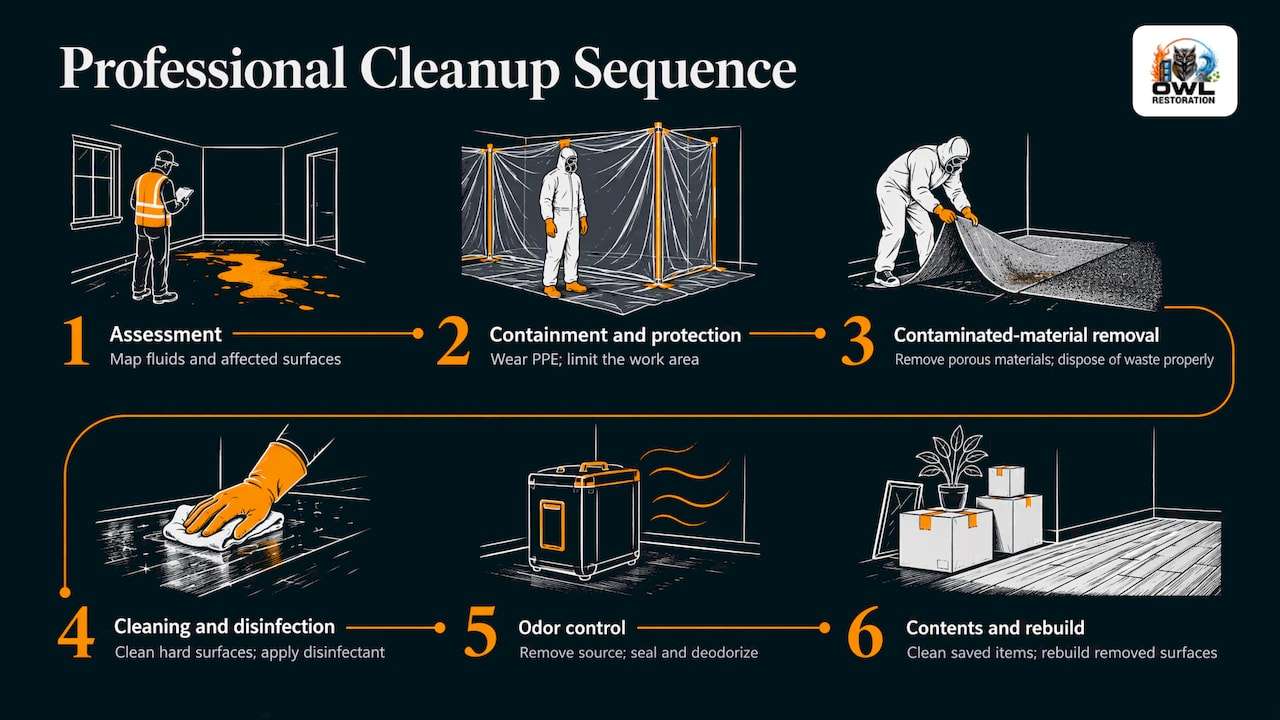
Assessment. The crew walks the scene to see where fluids went and what they touched: surface, padding, subfloor, walls, even the ceiling below. This sets the scope of removal.
Containment and protection. Technicians wear protective equipment and limit the work area so contamination does not travel through the building.
Removal of contaminated materials. Soaked carpet, pad, mattresses and porous furniture usually cannot be disinfected and have to be removed. Contaminated waste must be handled and disposed of properly. In Texas, rules from the state’s environmental and health agencies govern how regulated medical waste is stored and treated, which is one reason this is not ordinary trash. Untreated biohazardous waste held in post-collection storage for more than 72 hours has to be kept refrigerated at 45 degrees F or lower.
Cleaning and disinfection. Hard surfaces are cleaned and then treated with an appropriate disinfectant, as the Bloodborne Pathogens Standard calls for.
Odor control. Odor lives in materials, not just in the air. Removing the source comes first. Sealing and deodorizing follow, and sometimes materials that still hold odor must come out.
Contents. Belongings that can be saved are cleaned. Our contents pack-out service moves items out of the affected space so they are protected while the work is done.
Rebuild. When flooring, subfloor or drywall has been removed, the space needs to be put back together. We handle reconstruction and build-back too, so the same company that opens up the scene can close it.
Mold after a death scene
Moisture from body fluids, plus warm Texas air and a closed-up house, can set the stage for mold in the affected materials. If a scene has sat for a long time, or if there was also a plumbing leak or a flood, mold may be part of the problem. In that case, testing tells you whether it is there and where. Our residential mold testing and inspection is $600, commercial is $975, and additional samples are $75 per sample residential and $95 commercial. If mold is found, our mold remediation service covers the removal, and our residential Mold Remediation Protocol is $1000. See the mold testing page for details. A commercial protocol price is not published, so we quote it after we see the building.
What affects the price
No honest contractor can quote an unattended death cleanup over the phone without knowing the scene. These are the factors that move the number:
- Time since death. The longer the delay, the farther fluids and odor spread, and the more material comes out.
- Surfaces involved. Tile and sealed concrete clean up far more easily than carpet, pad, wood subfloor or upholstered furniture.
- Size of the affected area. One room is a different job than a hallway, a floor and the room below.
- Odor and air handling. If odor has reached ductwork or neighboring spaces, the scope grows.
- Contents. Items to be saved, cleaned and stored add to the work.
- Rebuild. Replacing flooring, subfloor and drywall is a separate phase from cleanup. If you are choosing replacement flooring, tile or finishes, a flooring and finish materials supplier can help you choose and specify materials for a residential or commercial rebuild.
We do not publish a fixed price for biohazard cleanup because the scene decides it. Our page on crime scene cleanup cost explains what you will pay and who covers it. Beyond that, an itemized estimate after an on-site look is the right way to compare any bid: it should list labor, removal, disposal, deodorizing and what is excluded.
Does homeowners insurance cover it?
Sometimes, and it depends on your policy. Cleanup after a death is not a simple yes or no, because death itself is not a named peril, and some policies contain pollution exclusions or limits on vacant properties that insurers may raise. Because policies differ, read your declarations page and call your agent right away. Ask specifically about biohazard or trauma cleanup coverage, any sublimit, your deductible and any vacancy condition.
For a landlord or business, a commercial property policy may respond differently from a homeowners policy. A property manager should notify the owner’s carrier at once.
What you can do to help your claim is straightforward: keep the police report number, photos taken from a safe position, the date of discovery, and every estimate and invoice. We work with your insurance company directly, so the paperwork flows between the contractor and the adjuster rather than landing on you.
How to choose a trauma cleanup company
Whatever company you call, a few checks apply. Ask whether technicians follow OSHA’s Bloodborne Pathogens Standard, whether the company carries liability insurance, how it disposes of contaminated waste, and whether it will give you an itemized written estimate. Also ask whether it handles contents, odor and rebuild, because splitting a death scene among three contractors means three schedules and three bills.
We are a DFW company with certified professionals, 24/7 rapid response, and a single path from mitigation to reconstruction for homes and commercial properties. Our page on trauma scene cleanup explains who handles what, and the blood cleanup page describes what to expect on site.
Our perspective
Most people who call us after an unattended death have never seen anything like it, and they are calling from the worst day of a year. The first thing we want them to know is that none of the cleanup is theirs to do.
What we focus on is speed and completeness. A scene gets worse by the hour, so we answer around the clock across Dallas, Tarrant, Ellis and Johnson counties. We also try to take the other burdens off your plate: the insurance coordination, the packing out of belongings, and the rebuild when walls and floors have to come out.
If you manage a property, the same applies. Tenants and staff should not have to live with the odor or wonder what happened. One call gets a crew moving, and one team can take it from first response to a finished room.
Dustin
Need help now?
If you are standing in this situation, we can start as soon as authorities release the scene. Our biohazard cleanup covers removal, disinfection and odor control, and the same team can pack out contents, address mold and rebuild. Start at our biohazard cleanup page or call us any hour.
If the incident also involved fire or water, see our fire damage restoration and water damage restoration services.
FAQ
Is a dead body a biohazard?
OSHA says people simply near human remains face no direct contagion risk, but people who handle remains or contaminated materials can be exposed to bloodborne viruses and certain bacteria. That is why the fluids and the materials they soaked into are treated as biohazards and handled by trained crews.
Who calls the cleanup company after an unattended death?
The homeowner, the family, the landlord or the property manager does, once police and the medical examiner have released the scene. Call as early as you can, since the contractor can plan the work and begin the insurance steps while the scene is being released.
Can I clean it myself to save money?
We advise against it. Contaminated fluids reach below the surface, and protective equipment, disinfection and proper waste handling are part of the job. A professional crew also documents the work for your insurer, which protects your claim.
How long does cleanup take?
It depends on the scene. A limited area may take a day or so, while a scene with fluids in the subfloor, odor in the structure and rebuild work takes longer. We give a timeline after the on-site assessment.
Sources
- OSHA: Health and Safety Recommendations for Personnel Who Handle Human Remains
- OSHA: Bloodborne Pathogens Standard, 29 CFR 1910.1030
- Medical Waste Regulations in Texas