

An insurance restoration company is the contractor that stops the damage, dries and cleans the property, documents the loss and, if it also rebuilds, repairs it, while you deal with your insurer. The best choice is one that handles mitigation through reconstruction under one roof and talks directly with your insurance company. That is what we do at Owl Restoration for water, fire and mold losses across Dallas, Tarrant, Ellis and Johnson counties.
TL;DR
- A restoration company works for you, not your insurer, and you choose it. Few policies require a referred vendor.
- Start emergency mitigation right away and document everything first: photos, video, receipts.
- Water and mold clock: drying within 24 to 48 hours is what the EPA and CDC point to for preventing mold.
- If a claim is denied, the contract you signed makes you responsible for the bill, so read it before signing.
- One company from mitigation to build-back means fewer handoffs and a cleaner claim file.
Table of Contents
- What a restoration company does, and what your insurer does
- The four phases of a water loss
- What to do before the crew arrives
- How the claim moves from damage to payment
- What you may owe
- How to choose a restoration company
- Mold testing and your claim
- Who this fits: homes, businesses and property managers
- Our perspective
- Get help with a loss in DFW
- FAQ
- Sources
What a restoration company does, and what your insurer does
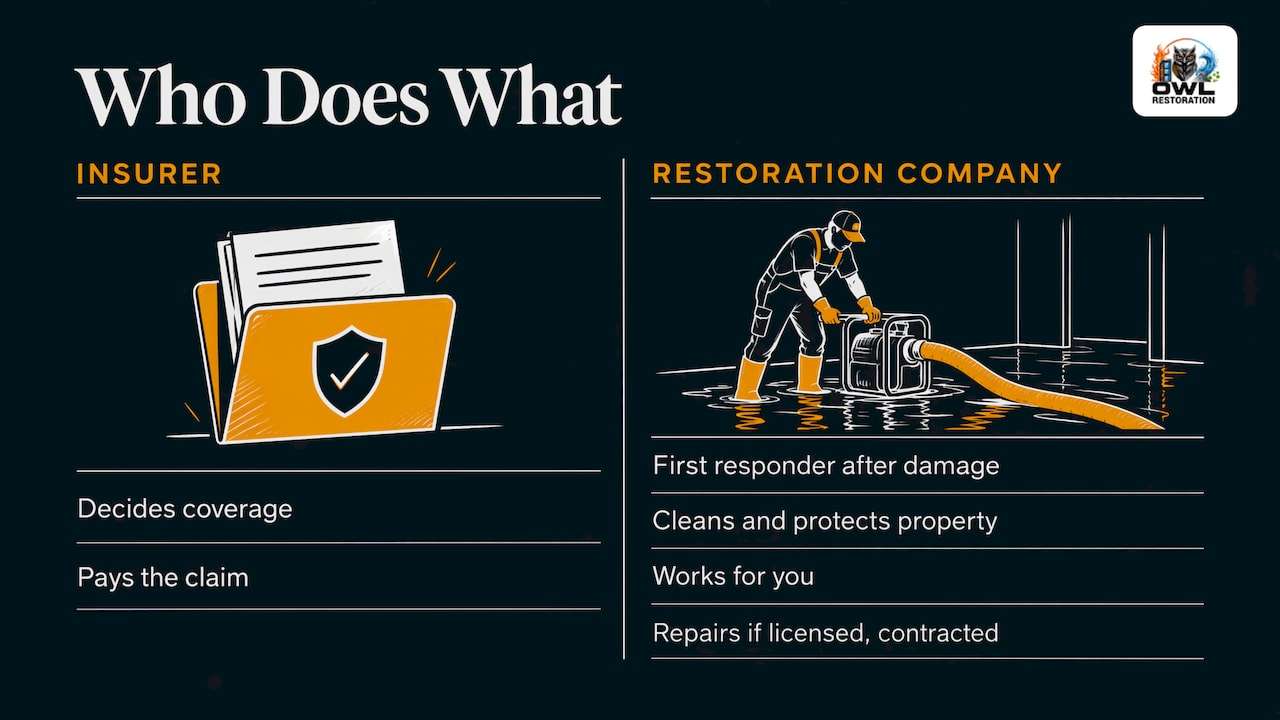
The two roles are different. The insurer decides coverage and pays the claim. The restoration company is usually the first responder after floods, fires, water damage and sewage backups: it cleans up and protects the home and its contents to prevent further damage. According to the Maryland Attorney General’s consumer guide, it repairs the home only if it is licensed for home improvements and separately contracted to do so.
The same guide is clear on who the company answers to: even when the insurer places the call, the restoration company works for you. You decide how the property is cleaned, you sign the contract, and service problems go to the contractor, not the insurer.
That is why a company that does the whole job matters. Our services cover water damage, fire damage, mold testing and remediation, biohazard cleanup, contents pack-out and reconstruction for homes and commercial properties, with direct insurance claims assistance and 24/7 rapid response.
The four phases of a water loss
Insurers split water losses into four phases, and each is priced differently, according to Genre’s 2026 guide for insurers:
- Emergency services: find and stop the water source.
- Mitigation: protect the property by boarding up, tarping, removing wet drywall or flooring, making temporary repairs and shutting off utilities.
- Remediation: cleaning and sanitizing, removing mold and making structural repairs once bulk moisture is gone.
- Restoration: repairs that return the property to its pre-loss condition.
The terms get used interchangeably, and mixing them up is how invoice surprises happen. Ask any contractor which phase each line item belongs to. Our water damage restoration and reconstruction and build-back work spans these phases, so the scope stays in one place.
What to do before the crew arrives
Once everyone is safe, protect the property and the evidence. Pulling from FEMA, the National Flood Insurance Program and the Minnesota Department of Commerce:
- Check for structural damage before going in, and turn off electricity and water if it is safe to reach the shutoffs.
- Photograph and video every room before cleanup, including appliance make, model and serial numbers.
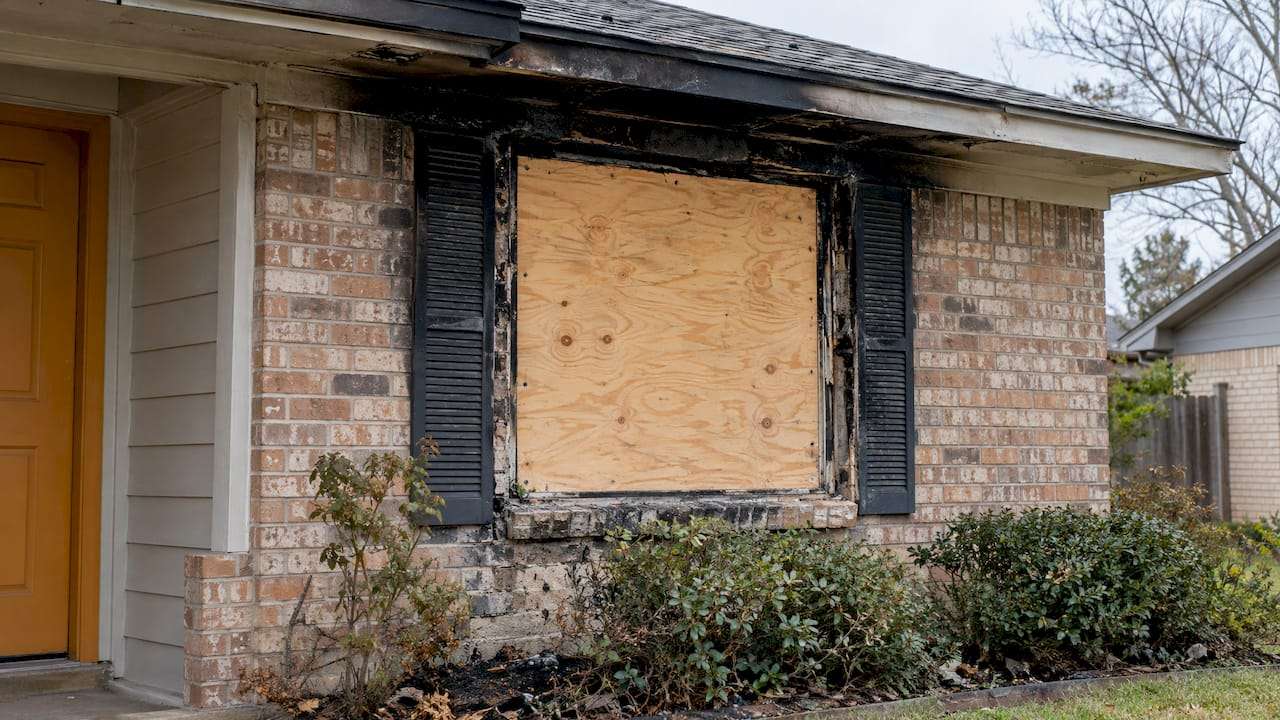
- Make temporary repairs such as tarping a roof or boarding a window. Minnesota’s guidance warns that additional damage may not be covered otherwise.
- Keep receipts for materials and emergency costs.
- Do not throw things out, apart from spoiled food, until the adjuster has seen them.
The NFIP checklist adds that its policies do not cover mold damage, so drying belongings quickly matters. Marsh’s claims guide frames the standard as the “reasonable person” test: act as you would if you had no insurance, and be able to explain why to the adjuster.
For step-by-step detail, see our 48-hour water damage action plan and our guide to fire and smoke restoration. If a fire has left the structure open, a board-up service secures it.
Good records also help beyond the claim. If you ever decide to sell a damaged property, a documented loss history helps; this guide to selling a damaged house as-is shows how that process looks in California.
How the claim moves from damage to payment
- Report the loss. Call your insurer or agent as soon as you can.
- Mitigate. Emergency work starts without waiting for approval. Per the PIA’s 2026 claims timeline, water mitigation and securing a structure after a tree or fire are among the few services allowed without prior approval in vendor-program claims.
- Scope and estimate. The full repair scope can take weeks to be reviewed by the insurer and adjuster. A contractor who documents moisture readings and materials carefully shortens that review.
- Settlement. The CFPB explains that insurers pay replacement cost (today’s prices for similar materials) or actual cash value (which accounts for age and condition). With a mortgage, the check typically names both you and the lender, and funds are released in stages as work is inspected.
- Repairs and final payment.
We coordinate directly with insurance companies, which takes the back-and-forth off your plate during a stressful stretch.
What you may owe
You pay the deductible, which can be a flat amount or a percentage of the insured value. The Maryland Insurance Administration gives the example of 2% of a $250,000 home, which is $5,000. Under replacement cost coverage, the insurer may first pay actual cash value, then release the “recoverable depreciation” once you show the repairs were made.
Contractors typically charge overhead and profit of 10% and 10%. United Policyholders notes that this is a known expense, and that an estimate from a qualified local contractor who visited the site is generally the most reliable basis for settlement.
The Maryland guide also points out that if a claim is denied, the signed contract makes you responsible for the contractor’s bill. Read the contract and know what your policy covers before work begins.
How to choose a restoration company
The Restoration Industry Association says very few policies require a referred or approved company. You are entitled to hire a reputable, licensed and insured firm yourself. Use these criteria:
| What to look for | Why it matters |
|---|---|
| Fast, 24/7 response | Drying within 24 to 48 hours is what keeps mold from starting |
| Certified technicians | Equipment and technique decide how much can be saved |
| Mitigation through rebuild in one company | Fewer handoffs, one scope, one point of contact |
| Direct insurer coordination | Less paperwork for you |
| Written estimate and clear contract | The NFIP advises checking estimates with your insurance provider before signing |
| Local knowledge | Texas storms, foundation shifts and older plumbing are daily work in DFW |
Our positioning is built on exactly these: rapid response, certified professionals, insurance claims handling and local DFW expertise, from emergency restoration to full reconstruction.
Mold testing and your claim
The EPA notes that when mold is visible, sampling is usually unnecessary, and that surface sampling can help show whether an area was adequately cleaned. The CDC says visual inspection is more reliable than air sampling and that wetted materials should be dried or removed within 48 hours. The Minnesota Department of Health adds that testing can document that cleanup met expectations or justify remediation costs.
That is where testing earns its place in a claim: a documented before and after. Our published prices are $600 for a residential mold test and inspection and $975 for a commercial one, with additional samples at $75 (residential) and $95 (commercial) each. Our residential mold remediation protocol is $1,000. Details are on our mold testing page, and our mold remediation service covers the cleanup itself.
Who this fits: homes, businesses and property managers
Homeowners need a clean claim file and a dry house. Business owners and property managers need the same, plus speed, because every day of downtime costs money. We serve residential and commercial properties, and contents pack-out moves belongings out of the affected area so work can proceed while they are protected.
Our perspective
Most people call their insurer first and a contractor second. We would flip that: once everyone is safe, get the water stopped and the drying started, document as you go, then report the claim. Delay is what turns a water loss into a mold loss.
What makes our approach different is that one team follows the loss from the first extraction through reconstruction, and we coordinate directly with your insurance company. You are not explaining the same damage to three vendors.
You pick the contractor. We would like you to pick one who can show the full job, from mitigation to build-back, in a single scope.
Dustin
Get help with a loss in DFW
If you have water, fire or mold damage in Dallas, Tarrant, Ellis or Johnson County, our team responds around the clock and works with your insurer from day one. Start with our 24/7 emergency restoration page.
FAQ
Do I have to use the restoration company my insurer recommends?
No. The Restoration Industry Association says very few policies require a referred company, and the Maryland Attorney General states you are not obligated to use the one your insurer calls. You can hire a reputable, licensed and insured firm of your choice.
Who pays the restoration company?
If the claim is covered, most settlements cover the cleanup cost. If it is denied, the contract you signed makes you responsible. The deductible is always yours.
How fast should drying start?
The EPA and CDC both point to drying or removing wet materials within 24 to 48 hours to prevent mold. Start the call to a restoration company as soon as the property is safe.
Do I need mold testing after water damage?
Not if mold is visible, according to the EPA. Testing is useful for documenting that cleanup met expectations or for supporting remediation costs. A visual inspection comes first.
Sources
- Maryland Attorney General: consumer guide on restoration companies
- Genre: managing water damage claims costs
- FEMA: don’t wait to clean up or make repairs
- National Flood Insurance Program: flood recovery checklist
- Minnesota Department of Commerce: residential insurance claim tips
- Marsh: managing the property insurance claims process
- PIA: timeline of the restoration claims process
- CFPB: how home insurance companies pay out claims
- Maryland Insurance Administration: post-disaster claims
- United Policyholders: property damage claims FAQ
- Restoration Industry Association: tips for homeowners
- EPA: mold testing or sampling
- CDC/NIOSH: mold, testing and remediation
- Minnesota Department of Health: testing for mold