

If blood or other body fluids have been left behind after an accident, injury, unattended death or crime, hire a trained biohazard crew to clean it. Do not scrub it yourself. Blood can carry pathogens, it soaks into porous materials like carpet, drywall and subfloor, and a surface that looks clean can still be contaminated. Professionals contain the area, remove and dispose of contaminated material, disinfect, and confirm the result. This guide explains how that works, who is responsible for arranging it, what it tends to cost, how insurance fits in, and what to do while you wait.
TL;DR
- Professional blood cleanup means containment, removal of contaminated materials, regulated waste disposal, disinfection and a final check. It is more than wiping up a spill.
- In most cases the property owner arranges and pays for cleanup once police release the scene. Homeowners and business policies may help, depending on the cause and the wording.
- Until the crew arrives, keep people and pets out, do not use household cleaners on large or soaked-in areas, and never handle sharps with bare hands.
- Look for a company with trained, certified staff, 24/7 response, clear documentation and experience working with insurers.
- We handle biohazard cleanup across Dallas-Fort Worth and coordinate directly with insurance companies.
Table of Contents
- What a blood cleanup service does, and when you need one
- What to do before the cleanup team arrives
- How professional blood cleanup works, step by step
- Rules and standards that shape the work
- Who is responsible for arranging and paying for cleanup
- What blood cleanup costs and whether insurance helps
- When blood cleanup overlaps with water, fire or mold damage
- How to choose a blood cleanup company
- Our approach in Dallas-Fort Worth
- Our perspective
- FAQ
- Sources
What a blood cleanup service does, and when you need one
A blood cleanup service removes blood, body fluids and other potentially infectious materials from a property and returns the space to a safe, sanitary condition. The industry also calls this biohazard remediation, trauma cleaning or forensic cleanup. According to a general overview of the field, these terms cover far more than crime scenes. The situations include accidents, suicide or attempted suicide, homicide, decomposition after an unattended death, industrial accidents, infectious disease contamination and animal biohazards.
In practice, homeowners, landlords, business owners and property managers call for help after:
- A serious injury or fall that left blood on floors, walls or furniture
- A death in the home or workplace, especially when the person was not found right away
- A crime or suicide, once law enforcement has released the scene
- A workplace accident in a shop, warehouse, restaurant or clinic
- Contamination from an animal, or from a rental tenant who left behind biohazard waste
The rule of thumb: if the blood has soaked into something porous, covers more than a small, easily wiped surface, or came from an incident you would rather not be near, call a professional. A small, dried spill on a hard surface is a different matter, covered below.
What to do before the cleanup team arrives
Your first job is to keep people safe and leave the area undisturbed. Some steps apply to every situation:
- Make sure the scene is released. If police, a medical examiner or another agency is involved, cleanup cannot start until they say the property is released. The industry standard for trauma cleanup assumes the scene has already been released by law enforcement or regulatory agencies.
- Keep everyone out. Close the door to the room. Keep children, pets and visitors away. Do not walk through the area, since blood is easily tracked onto shoes and into other rooms.
- Do not turn on fans or HVAC to “air it out.” Professionals close HVAC vents as part of containment, so moving air around spreads the problem.
- Do not throw soiled items in the household trash. Regulated waste has its own disposal rules.
- Call a 24/7 provider. Describe what happened, where the blood is, what materials it reached, and whether the scene has been released.
If you must deal with a small spill yourself
Sometimes a minor spill happens at home and you need to act. The CDC says to use standard precautions and assume blood and body fluids are contaminated. The Florida Department of Health publishes a home-cleanup sheet for biomedical waste. It is Florida guidance, but the basic precautions are sensible anywhere. It recommends wearing:
- Rubber gloves
- Glasses or goggles
- A mask
- A large shirt or plastic bag over your clothes
It also suggests using tongs or pliers for sharp items, cat litter or dry pool chlorine to absorb liquid, and plastic bags for soiled items. Sharps go in a hard plastic or metal container with a tightly secured lid reinforced with heavy-duty tape. The same sheet suggests wiping the area with a mix of one-half cup of household bleach to one gallon of water.
That guidance is for contained household situations. It is not a plan for a soaked carpet, a stained mattress or a room where someone died. For those, stop and call a crew.
If you are exposed
If blood gets on your skin, the CDC advises rinsing with large amounts of water or saline for several minutes and washing with soap and water. It also says to report the exposure promptly, because treatment might need to begin right away. Talk to a doctor or urgent care provider about the risks of hepatitis B, HIV and other bloodborne pathogens, and whether post-exposure treatment makes sense. Do not wait to see if symptoms develop.
How professional blood cleanup works, step by step
Every job differs, but a well-run crew follows the same arc.
1. Assessment
Before any cleaning begins, a technician walks the scene and plans the work. Trade guidance describes a site-specific risk assessment that identifies biohazard levels, safety hazards and the PPE needed. It looks at bloodborne pathogens, porous versus non-porous materials, and any structural damage. This is when the crew learns how far the blood traveled. Blood often runs under baseboards, through seams in flooring and into subfloor.
2. Containment
The crew protects the rest of the property. The same trade source lists plastic barriers, HEPA air filtration with negative-pressure zones, closed HVAC vents and dedicated equipment that is disinfected or discarded afterward. The goal is to keep contamination from reaching clean rooms, neighbors or tenants.
3. Removal of contaminated materials
Porous materials that absorbed blood, such as carpet, padding, mattresses, upholstery and sometimes drywall or subfloor, are cut out and removed. Non-porous surfaces such as tile, sealed concrete and metal can usually be cleaned in place. The newest industry standard clarifies that contents and structural items affected by blood do not necessarily need to be replaced and can often be restored to a safe, sanitary and usable condition. Ask your crew which items can be saved and which cannot, and why.
4. Cleaning and disinfection
Visible blood is removed first, then surfaces are treated with an appropriate disinfectant. OSHA’s bloodborne pathogens rule requires decontaminating surfaces with an appropriate disinfectant after contact with blood or other potentially infectious material. Crews work from the cleanest area toward the most contaminated and treat the edges and hidden spots as carefully as the obvious stain.
5. Waste packaging and disposal
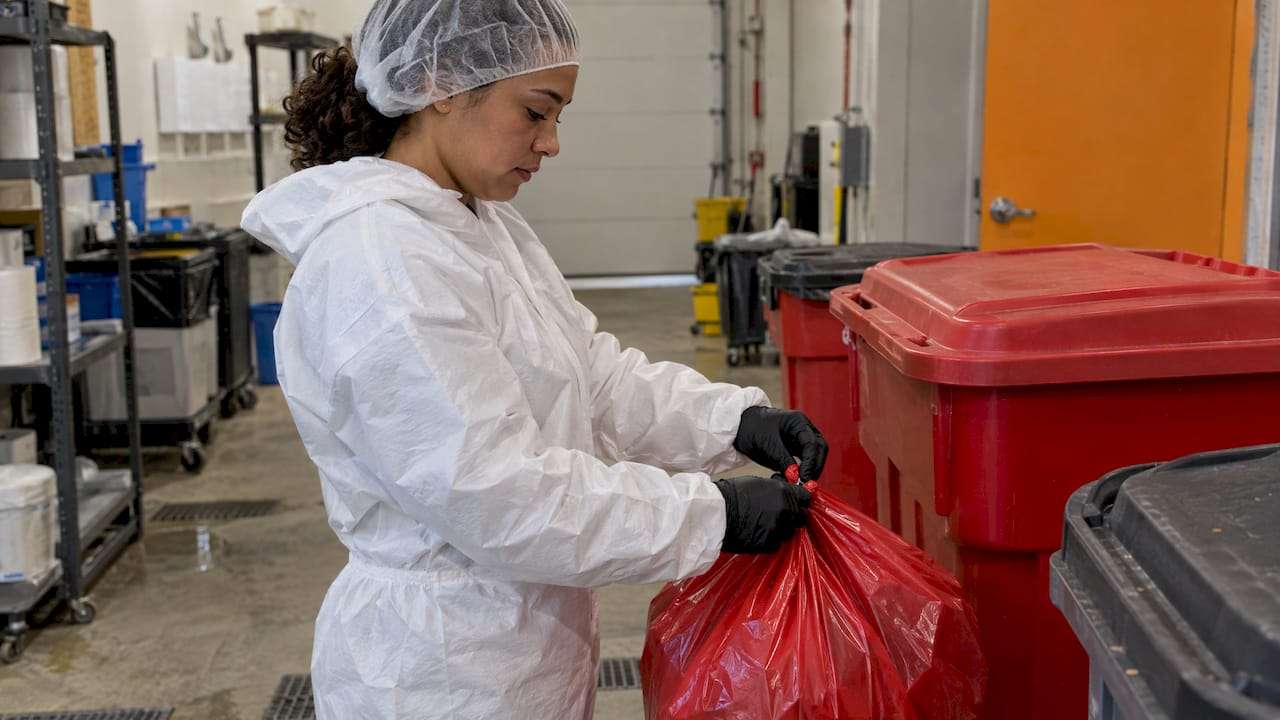
Biohazard waste is not tossed in a dumpster. It is bagged, labeled, transported and disposed of under federal, state and local regulations, typically in red biohazard bags and rigid containers. Ask for documentation of how it was handled.
6. Confirmation and rebuild
The work ends with a confirmation that cleaning is complete. The IICRC’s S540 standard for trauma and crime scene cleanup addresses confirmation of cleaning along with safety and health, antimicrobial technology, inspection, structural and contents remediation, and regulated waste disposal. If walls, flooring or subfloor were removed, the property needs repair. That is where a company that also does reconstruction and build-back saves you from hiring and scheduling a second contractor.
Rules and standards that shape the work
Two references come up repeatedly in this field.
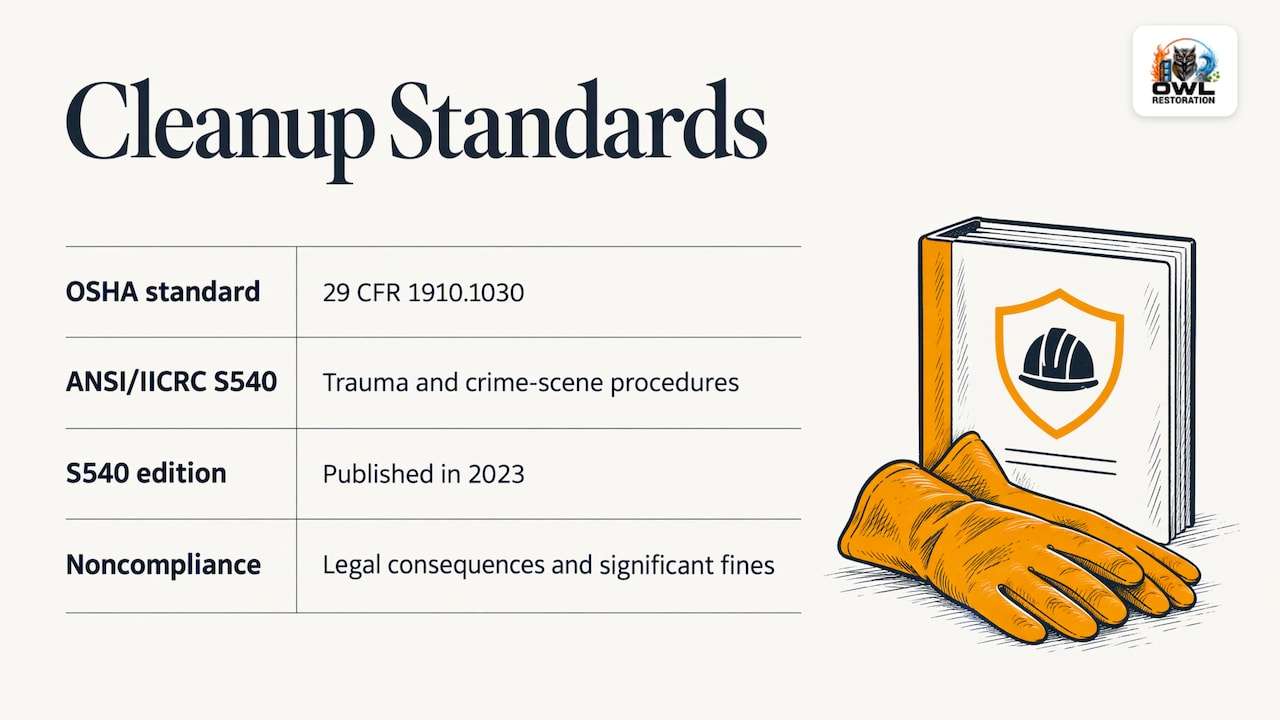
OSHA’s Bloodborne Pathogens Standard (29 CFR 1910.1030). It applies to occupational exposure to blood and other potentially infectious materials. Among other things, it calls for Universal Precautions, engineering and work practice controls, PPE and handwashing facilities. Employers must keep the worksite clean and sanitary, decontaminate equipment and surfaces after contact with blood, and dispose of regulated waste according to applicable federal, state and local rules. In plain terms, a crew that enters your property should be trained, protected and following written procedures.
ANSI/IICRC S540. The second edition of this standard was published in 2023 by the IICRC. It sets out the procedures and precautions for trauma and crime scene cleanup regardless of surface, item or location. It also clarifies the responsibilities of the worker, certified technician, project manager and company management.
Why this matters to you: trade reporting notes that failing to follow DOT, OSHA and state-specific rules can lead to legal consequences and significant fines. A cleaner who treats blood like ordinary dirt is a liability for you as the property owner as well as for the cleaner.
Who is responsible for arranging and paying for cleanup
Police investigate and then leave. When detectives and forensic teams finish, they release the scene to whoever owns or controls the property. One legal explainer puts it simply: any blood or residue left behind becomes the property owner’s problem. It adds that owners almost always bear the financial responsibility.
A few practical consequences:
- Homeowners arrange cleanup themselves. If a family member died or was injured at home, you do not have to start on the day it happens. A professional can be scheduled once the scene is released and you are ready.
- Landlords and property managers generally arrange cleanup of a trauma scene on their private property. New York City’s 311 service states that the owner or landlord must arrange it, and for public property you contact the agency responsible. Texas rules and lease terms vary, so check your lease and local requirements.
- Business owners should treat a blood incident as a workplace safety issue as well as a cleanup. Employees and customers need to be kept out of the area, and the cleanup should be done by trained people, not by staff with a mop.
What blood cleanup costs and whether insurance helps
Price depends on how much material is affected, what it soaked into, the type of contamination and how much needs to be rebuilt. We do not publish a flat price for biohazard work, because a contained spill on tile and a soaked mattress and subfloor are very different jobs. A written estimate after an on-site look is the honest way to price it.
For context, general industry figures reported in the US put crime scene and after-death cleaning at $200 to $600 per hour depending on severity, with a single-room blood cleanup often reported in the $1,000 to $4,000 range. Extensive projects that need structural remediation and restoration can reach far higher, up to about $25,000. These are general estimates, not our prices.
Does insurance cover it?
Often, in part, and it depends on your policy. Reported guidance says homeowners insurance may cover biohazard cleanup when contamination results from a sudden, accidental event or a covered peril such as a crime or vandalism. The standard ISO HO-3 form includes a pollutant cleanup and removal provision of $10,000 per occurrence, though the same form’s pollution exclusion can complicate claims because its broad definition of pollutants may reach biological contamination.
What to do with that:
- Read your declarations page and ask your agent specifically about biohazard, trauma and pollutant cleanup.
- Photograph and document the scene before work begins, if it is safe and appropriate to do so.
- Call your carrier early and ask what they need from a contractor.
- Choose a contractor used to claims paperwork. Our team coordinates directly with insurance companies, which keeps the process moving while you deal with everything else.
Commercial property and general liability policies have their own terms, so business owners should call their broker before work begins.
When blood cleanup overlaps with water, fire or mold damage
Blood is rarely the only problem. A burst pipe in a home where an accident occurred, a fire where someone was injured, or a property left closed up after an unattended death can all involve more than one kind of damage. Moisture that sits in a closed structure invites mold growth, so a scene that has gone unnoticed for days may need mold remediation too. If a fire caused the injury, fire damage restoration and cleanup of the contaminated area can be coordinated. If water was used to wash the area or a line has leaked, water damage restoration fits in the same schedule.
This is a real advantage of a full-service restoration company. One project manager, one point of contact for your insurer, and a single plan from mitigation through contents pack-out and rebuild.
How to choose a blood cleanup company
You are probably making this call on one of the worst days of your year. These criteria help you decide quickly.
| What to look for | Why it matters |
|---|---|
| 24/7 availability | Blood and decomposition get worse with time, odor spreads, and you need someone who answers at night. |
| Trained, certified technicians | Standards like OSHA’s and the IICRC’s assign specific responsibilities to workers, technicians and managers. |
| A clear process | You should hear about assessment, containment, removal, disinfection, disposal and confirmation. |
| Documentation | Waste handling records and a written scope help with insurance and with your own peace of mind. |
| Insurance coordination | Direct communication with your carrier reduces back-and-forth and delays. |
| Rebuild capability | If drywall or flooring comes out, the same company can restore the space. |
| Discretion | The crew should be respectful, since the scene may involve a loved one or a coworker. |
A word on what to avoid: a general janitorial, carpet-cleaning or housekeeping service is not set up for biohazards. As one general overview notes, what separates a registered trauma practitioner from a general cleaning service is the regulatory framework around handling hazardous material for a fee.
Our approach in Dallas-Fort Worth
We are Owl Restoration, a restoration company serving the Dallas-Fort Worth area, including Tarrant, Ellis, Johnson and Dallas counties. We respond around the clock to water, fire and mold emergencies, and our biohazard cleanup service uses the same discipline: certified professionals, advanced techniques and equipment, and a plan that runs from initial mitigation to full reconstruction.
If you are in Mansfield, Midlothian or Arlington, our crews cover your area too. Our 24/7 emergency line is the quickest way to start, and our contents pack-out service can safely move belongings out of the affected area while work is underway.
For homeowners and business owners, we describe the scope in writing, explain what must be removed and what can be saved, and work with your insurer so you are not translating between two parties.

Need help now? Contact Owl Restoration to reach our emergency team, describe the situation, and get a plan for safe cleanup.
Our perspective
Most people who call us about blood have never had to. They are often in shock, and they are wondering whether they can just handle it. We understand that instinct, and we answer it the same way every time: the visible stain is the smallest part of the problem. What soaks into carpet, padding, grout lines and subfloor is what stays behind, along with the risk and the smell.
That is why we think cleanup works best when it is done by a single accountable team. A crew that contains the area, removes what has to go, disinfects, documents and then helps rebuild means you are not coordinating three vendors during a crisis. In Dallas-Fort Worth we also see how often blood is only one part of the picture, with water, fire or mold damage on the same property. A full-service restoration company is built for exactly that.
Our advice: call early, do not clean a trauma scene yourself, and keep your insurance carrier in the loop. We will handle the hard part and the paperwork, and we will treat the property and the people connected to it with respect.
Dustin
FAQ
What is forensic cleaning?
Forensic cleaning is another name for biohazard or trauma cleanup. It covers removal of blood, body fluids and other potentially infectious materials after an incident. Crime scenes are only one of many situations that call for it, which also include accidents, unattended deaths and infectious disease contamination.
Can I clean blood myself?
For a tiny, contained spill on a hard surface, public health guidance describes protective gear and a diluted bleach wipe-down, as in the Florida Department of Health’s home cleanup sheet. For anything that soaked into porous materials, covers a larger area, or involved a death or serious injury, hire a trained crew. If you are exposed, rinse right away and talk to a medical provider.
Who calls the cleanup company after a death or crime?
The property owner or the person in control of the property, after law enforcement releases the scene. Police do not clean up after an investigation. Family members often ask us to speak with the owner or landlord so they do not have to manage it.
Will insurance pay for blood cleanup?
It can, depending on the cause and your policy language. Coverage may apply when the contamination comes from a sudden, accidental event or a covered peril, but pollution exclusions can complicate claims. Call your agent and carrier early, and our team will work with them directly.
How fast can a crew get to my property?
We provide 24/7 rapid response across Dallas-Fort Worth. Call our emergency line, explain the situation, and we will schedule an assessment so the work can begin once the scene is released.
Sources
- Florida Department of Health: home cleanup of biomedical waste
- OSHA: 29 CFR 1910.1030, Bloodborne pathogens
- CDC: Blood and Body Fluid Exposure
- C&R Magazine: ANSI/IICRC S540 Standard for Trauma and Crime Scene Cleanup
- R&R Magazine: Crime Scene Cleanup compliance
- NYC311: Trauma Scene Cleanup
- Who Pays Crime Scene Cleanup Costs
- Does Homeowners Insurance Cover Crime Scene Cleanup?
- Does Homeowners Insurance Cover Biohazard Cleanup?
- Crime scene cleanup overview