
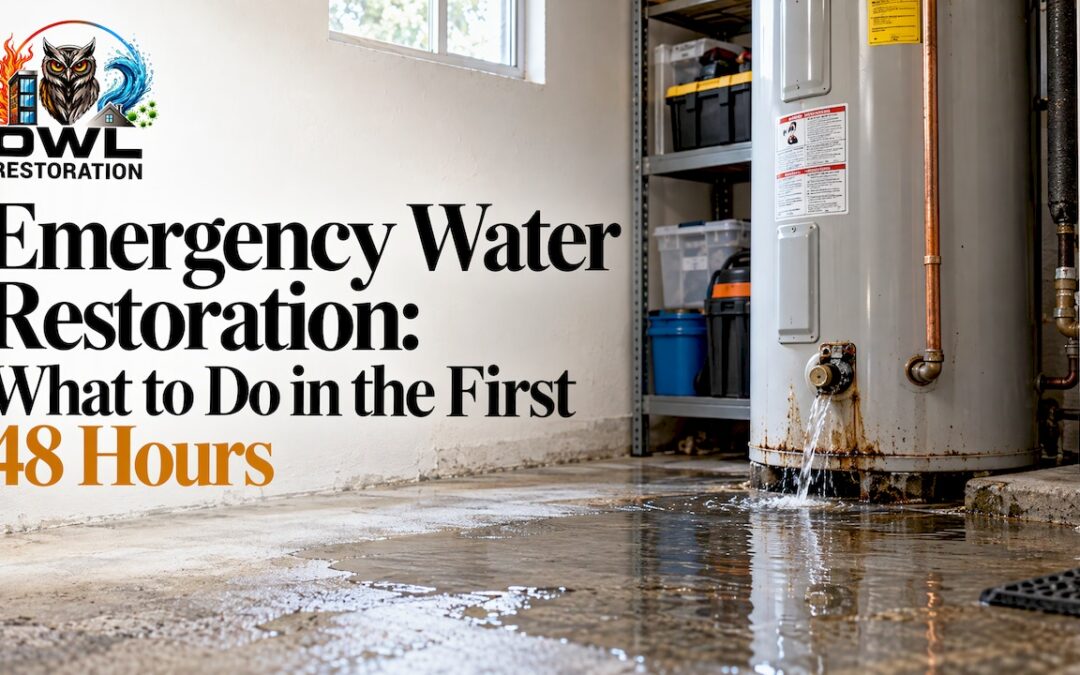
Emergency water restoration is a race against mold and structural damage: the work that matters most (stopping the source, extracting water, and starting to dry) has to happen within the first day or two. If you are in Tarrant, Dallas, Ellis or Johnson County, we respond around the clock and handle the whole job, from mitigation to rebuild, including the paperwork with your insurer. This guide covers what to do right now, what professionals do, what it costs and how a claim works.
TL;DR
- Stop the water at the source, shut off power to wet areas, and photograph everything before you clean.
- Porous materials that stay wet past 24 to 48 hours risk mold, so drying has to start immediately.
- Restoration is a sequence: extraction, drying, cleaning, then repair. Skipping drying is what turns a leak into a rebuild.
- Typical costs run from about $1,500 for a small flood to $35,000 or more for severe damage, driven by how long water sat and how contaminated it is.
- Call early. We work directly with insurance companies and respond 24/7 across DFW.
Table of Contents
- What to do in the first hour
- Why the first 24 to 48 hours decide the outcome
- What emergency water restoration involves
- Can you handle it yourself?
- When water damage becomes a mold problem
- What emergency water restoration costs
- Working with your insurance company
- Who needs this most: homeowners, businesses and property managers
- Our perspective
- Get help now
- FAQ
- Sources
What to do in the first hour
Your first moves are about safety, then about limiting damage. FEMA advises turning off the main electrical power and water until a professional confirms the home is safe, never using electrical tools or appliances while standing in water, and leaving at once and calling the fire department if you smell gas or hear hissing.
Then work through this order:
- Stop the source. Shut off the plumbing supply, redirect water, and catch drips with tarps or buckets, as the Massachusetts quick-reference guide for water damage describes.
- Protect people. In a business or rental building, move staff, tenants and visitors away and block access to wet areas with signs or barriers.
- Lift what you can. Remove electronics and porous items from the wet path.
- Document before cleanup. Take photos and video of the damage and of appliance serial numbers. The National Flood Insurance Program checklist asks for this before you start cleaning.
- Call a restoration company. The sooner drying begins, the more material is saved. Our 24/7 emergency line is staffed for exactly this moment, and our first-48-hours flood cleanup guide goes deeper on the sequence.
If water came from a sewage backup or floodwater, treat it as contaminated. The University of Nebraska Extension classes floodwater residues as grey or black water that can carry bacteria, sewage and pesticides, and recommends an N-95 or better respirator and protective clothing. Do not wade in without protection.
Why the first 24 to 48 hours decide the outcome
Moisture is the clock. Per the Massachusetts guidance, porous materials should be dried with fans and heat within 24 to 48 hours of getting wet, and wallboard that is not dried in that window should be cut out and discarded. The U.S. Department of the Interior’s mold guide says to assume mold growth if a flooded home, furniture included, was not dried within 24 to 48 hours.
FEMA’s NFIP Claims Handbook makes the same point from the claims side: starting cleanup immediately limits further damage and improves the chance of saving materials. It also notes that remediation resources can be limited after a major flood, so contacting a reputable company early matters.
In North Texas that matters year-round: a burst pipe in a winter freeze, a failed water heater, a supply-line leak behind a wall or storm water through a roof all start the same clock.

What emergency water restoration involves
A proper job follows a sequence. Each step depends on the one before it.
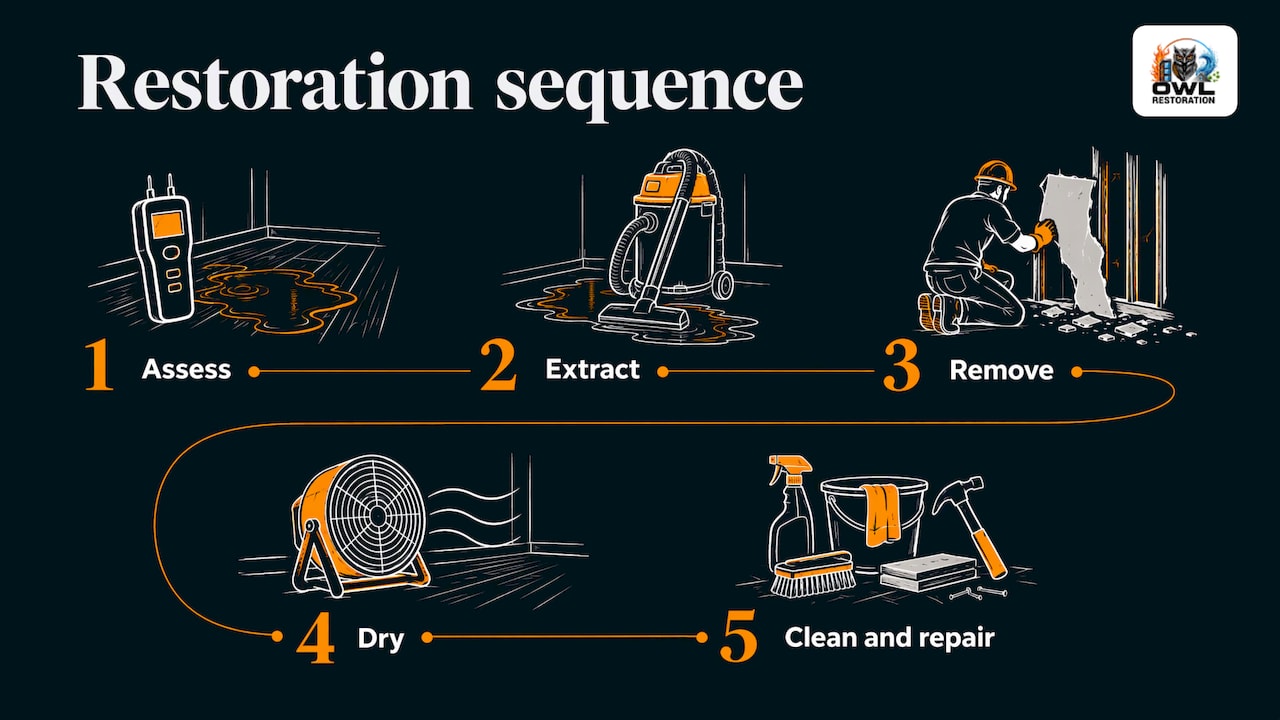
1. Assessment and water category
The crew finds the source, maps how far moisture has traveled, and identifies whether the water is clean, grey or black. Contamination changes the work: sewage-category jobs involve more removal and disinfection, and cost more.
2. Extraction
Standing water is pumped or vacuumed out. In a flooded basement, the American Red Cross advises removing roughly one-third of the water per day, because pumping it all out too fast can let pressure from saturated soil collapse basement walls. This is a good example of a step that goes wrong when done in a hurry without experience.
3. Removal of unsalvageable materials
Drywall and insulation that touched floodwater come out, along with soaked carpet padding and other materials that cannot be cleaned or disinfected. FEMA lists drywall, insulation, food and medicine exposed to floodwater as items to throw away.
4. Structural drying
This is the longest and most overlooked phase. The Red Cross notes that structural elements can take weeks or months to dry before drywall and carpet are replaced. Surfaces that feel dry can still hold moisture, which is why drying is monitored rather than guessed at. Our water damage restoration service uses professional equipment for this phase.
5. Cleaning, contents and repair
Salvageable belongings can be packed out and cleaned off site through our contents pack-out service. When walls, floors or ceilings need rebuilding, we carry the job through reconstruction, so one team handles the project from mitigation to build-back. For a leak that has reached the ceiling, see our guide to ceiling water damage repair.
Can you handle it yourself?
A small, clean spill that you dry within a day is a household task. Anything beyond that carries risks that are easy to get wrong:
- Fans on existing mold. The Interior Department guide warns that fans can spread spores once mold has started.
- Mixing cleaners. Never mix bleach with ammonia. The Nebraska Extension guide adds that bleach with vinegar also gives off toxic gases, and that many disinfectants need 15 to 20 minutes of wet contact time to work.
- Painting over it. Painting or caulking does not stop mold; the moisture problem has to be fixed first.
- Hidden moisture. Water inside walls and under floors is invisible, and that is where mold starts.
The NFIP handbook also recommends using a licensed, trained remediation company and warns that unqualified services may charge for work that is ineffective. Our team is certified, and we explain the scope of work before it begins.
When water damage becomes a mold problem
Mold can begin growing within 24 to 48 hours of a water event. The EPA’s rule of thumb, as summarized there, is that healthy adults can usually clean surface mold smaller than about 10 square feet (roughly 3 by 3 feet); larger areas call for a contractor with mold experience. The Nebraska guide gives the same 3-by-3-foot line for professional help.
Professional assessment also makes sense when:
- you smell mustiness but cannot see the source,
- the HVAC system was exposed to water,
- someone in the household has asthma, allergies or another breathing condition (FEMA notes health risks may increase for these groups), or
- the building is a business with tenants or staff.
Our mold testing and inspection is $600 for a residential property and $975 for a commercial one. Additional samples are $75 each residential and $95 each commercial. The residential Mold Remediation Protocol is $1,000. Commercial remediation protocol pricing is quoted on request. Our mold remediation team handles the cleanup itself.
What emergency water restoration costs
Published ranges vary by job. RestoreAdvisor’s 2026 cost guide reports flood restoration typically at $1,500 to $35,000, broken down like this:
| Scenario | Typical range |
|---|---|
| Small basement flood | $1,500 to $5,000 |
| Moderate single-floor flood | $5,000 to $15,000 |
| Major multi-room flood | $15,000 to $35,000 |
| Severe whole-home structural damage | $35,000 to $75,000+ |
The same source lists the main cost drivers: how long water sat before extraction, contamination category (sewage jobs commonly add 15% to 25%), the size of the area that must be removed, drying time and contents pack-out. Delay is the one driver you control. We do not publish a flat price for water damage restoration because scope depends on those factors; we scope each job on site.
Working with your insurance company
Most sudden, accidental water losses such as a burst pipe are often covered by insurance, while gradual leaks frequently are not. Policies differ, so read yours or call your agent.
What helps a claim:
- Document first. Photograph and film the damage before cleanup, as the Interior Department guide instructs, and contact your insurer promptly.
- Make temporary repairs and keep receipts. The Wisconsin Office of the Commissioner of Insurance advises protecting the property and saving receipts, but waiting for the adjuster before permanent repairs. It also notes that insurers pay reasonable additional living expenses if you must relocate, and that a proof of loss form must be returned within 60 days when requested.
- Know your flood coverage. Flood damage is covered only under a separate flood policy. The NFIP checklist notes that NFIP policies do not cover mold, another reason to dry quickly.
We coordinate directly with insurance companies, which takes the back-and-forth off your plate while crews are already drying your property. Renters and landlords can read who pays in our guide to water damage in an apartment, and commercial owners can see our commercial restoration services.
Who needs this most: homeowners, businesses and property managers
Homeowners usually need speed and a single point of contact. Business owners need to limit downtime and protect inventory, and property managers need coordination across units. A restoration company that covers extraction, drying, pack-out and rebuild lets each of them make one call instead of managing four contractors.
Our perspective
Most of the damage we are called to is avoidable in the first two days. The leak itself is rarely what costs the most. The hours of moisture sitting in drywall, subfloor and insulation are what do it.
That is why we built our work around fast response across DFW and a full-service path: mitigation, drying, pack-out and reconstruction under one roof, with direct coordination with your insurer. Handing a property to one accountable team means nobody has to guess who is responsible for the next step.
If you are standing in water right now, make the call first and photograph while the crew is on the way.
Dustin
Get help now
If water is in your home or business in Tarrant, Dallas, Ellis or Johnson County, call us. We respond 24/7 and address water, fire and mold damage within 24 to 48 hours. Start at our water damage restoration page or see all restoration services in Dallas-Fort Worth.
We also serve local communities such as Mansfield and Midlothian.
FAQ
How fast should I call after water damage?
Immediately. Mold can start within 24 to 48 hours, and materials that stay wet longer are more likely to need replacement. Shut off the water source, photograph the damage, and call a restoration company while you do.
How much does emergency water damage restoration cost?
Published ranges run from about $1,500 for a small basement flood to $35,000 or more for severe damage, according to RestoreAdvisor. Contamination, how long water sat and drying time drive the price. Your insurance may cover sudden losses.
Can I dry out the water myself?
For a small, clean spill dried within a day, yes. For larger or contaminated water, hidden moisture and mold risk make professional extraction and monitored drying the safer path. Never run fans over existing mold or mix cleaning chemicals.
What should I throw away after a flood?
FEMA says to discard items that absorbed water and cannot be cleaned or disinfected, including drywall and insulation that touched floodwater and any food, drinks and medicine exposed to it. Photograph items before disposal for your claim.
Do I need mold testing after water damage?
Consider it if water sat for more than 48 hours, you smell mustiness, or mold covers more than roughly 10 square feet. Our mold testing covers residential and commercial properties.
Sources
- Tips for returning home safely after a disaster, FEMA
- Quick reference: water damage response in buildings, Mass.gov
- Flood Recovery Checklist, National Flood Insurance Program
- NFIP Claims Handbook, FEMA
- Disaster Cleanup & Repair For Your Home, American Red Cross
- Homeowner’s and Renter’s Guide to Mold Cleanup After Disasters, U.S. Department of the Interior
- Entering and Cleaning Up Flooded Homes, University of Nebraska Extension
- Consumer’s Guide to Settling Property Insurance Claims, Wisconsin OCI
- Flood Water Damage: What to Do & What It Costs, RestoreAdvisor
- When Is Mold Remediation Required? EPA’s 10 Sq Ft Rule, RestoreAdvisor
- Mold From Water Damage: What Homeowners Should Know, InspectandTest