

Trauma scene cleanup is the professional removal of blood, bodily fluids and contaminated materials after a death, injury or violent incident, followed by disinfection and lawful disposal. It is not a job for household cleaners, and it is not something an owner should attempt alone. If the scene is in Dallas-Fort Worth, our biohazard cleanup team responds 24/7 and works with your insurance company directly, so you are not managing a contractor, a claim and a family crisis at the same time.
This guide is for homeowners, business owners and property managers who have just found themselves responsible for a scene like this. It explains what the work covers, how a proper cleanup runs, what the rules are, what it costs, and how insurance fits in.
TL;DR
- Trauma scene cleanup covers blood, bodily fluids, pathological waste, sharps and the carpet, drywall and bedding they contaminate, and it follows the ANSI/IICRC S540 Standard.
- Cleanup starts only after law enforcement or the relevant agency has released the scene.
- A proper job has a risk assessment, containment, cleaning, hospital-grade disinfection, regulated waste disposal and a final verification.
- Cost depends on severity and how far contamination spread, and standard homeowners policies can complicate biohazard claims, so document before cleanup and talk to your insurer early.
- We handle biohazard cleanup across Dallas, Tarrant, Ellis and Johnson counties and coordinate directly with insurers.
Table of Contents
- What counts as a trauma scene
- What to do in the first hours
- How a trauma scene is cleaned, step by step
- The rules that govern the work
- What trauma scene cleanup costs
- Insurance and who pays
- Residential, commercial and rental properties
- What our team does
- Getting help in Dallas-Fort Worth
- FAQ
- Sources
What counts as a trauma scene
A trauma scene is any property where a traumatic event has left biological material behind. That includes unattended deaths, suicides, homicides, serious accidents and violent crimes. The material is not only what you can see. According to an industry trade publication, biohazardous waste includes blood and bodily fluids, pathological waste, sharps and contaminated materials such as carpet, drywall and bedding, and the work is governed by the ANSI/IICRC S540 Standard.
That last point matters for a practical reason. Blood and other body fluids can carry pathogens, and they soak into porous materials: subfloor, padding, mattress, grout, the back of a wall. A surface that looks clean can still be contaminated underneath. This is why wiping a scene down with household disinfectant fails. It treats what is visible and leaves what is not, and it exposes whoever is doing the wiping.
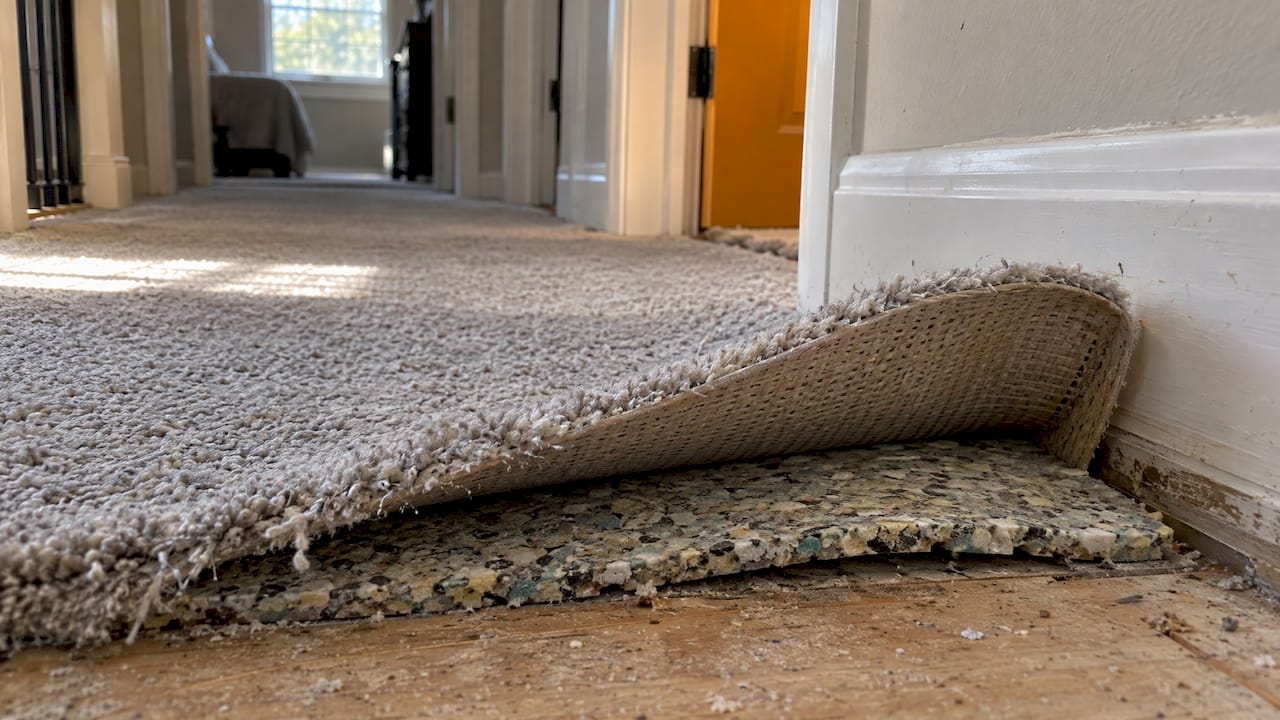
The same goes for odor. Decomposition after an unattended death spreads through a building’s air and soft materials. Odor that lingers is usually a sign that contaminated material is still in place, not a sign that the room needs more air freshener.
What to do in the first hours
You usually have less control over the first hours than you want, and that is fine. What matters is the order.
- Wait for the release. Law enforcement, the medical examiner or another agency may need the scene first. The S540 Standard itself assumes every scene has been released by law enforcement or regulatory agencies before cleanup begins. Ask the officer on site when you can re-enter and when a contractor can start.
- Stay out of the affected area. Do not touch, move or try to clean anything. Keep children and pets away. Close the door to the room if you can do so without touching contaminated surfaces.
- Do not use a household vacuum or a bleach mixture. Both can spread contamination through the air or across surfaces.
- Photograph from the doorway, once it is safe and you are permitted to. Insurers value records made before cleanup. More on that below.
- Call a professional. For a Dallas-Fort Worth property, that call can come to us at any hour.
If anyone who entered the scene has a cut, a splash to the eyes or mouth, or any direct contact with blood, they should contact a doctor promptly. That is a medical question, not a cleaning one.
How a trauma scene is cleaned, step by step
The sequence below follows the process described in industry guidance on crime scene cleanup. Each step shows what it takes and where shortcuts go wrong.
1. Risk assessment
The job begins with a site-specific assessment of biohazard levels, other safety hazards and the protective equipment the crew needs. Without it, nobody knows how far the material traveled or what else is in the room, such as sharps, chemicals or structural damage. Skipping it is how crews and occupants end up exposed.
2. Containment
Containment keeps contamination from moving to clean areas. It uses plastic barriers, HEPA air filtration with negative-pressure zones, and closed HVAC vents. The HVAC step is the one most often overlooked by amateurs: an open vent can carry airborne particles into every room of a house or every suite of a building.
3. Removal and cleaning
Organic matter is cleaned first with detergent or enzymatic cleaners. Disinfectant does not work well on a surface still coated with blood, so cleaning has to come before disinfecting. Porous items that cannot be thoroughly cleaned are removed and treated as waste.
Not everything has to go. The S540 update notes that contents and structural items affected by blood and other potentially infectious material do not necessarily need to be replaced and can often be restored to a safe, sanitary and usable condition. For a family, that can mean keeping furniture and belongings that matter. Where items need to leave the property while work continues, our contents pack-out service is one way to protect them.
4. Disinfection
Surfaces are disinfected with EPA-registered, hospital-grade products applied according to the label’s dwell time, which is the period a product must stay wet on a surface to work. Wiping it off early defeats the purpose. This is one of the clearest differences between professional work and a bottle from the grocery store.
5. Waste handling
What cannot be cleaned is bagged, labeled, transported and disposed of as regulated medical waste. In Texas, the TCEQ’s guidance for generators of medical waste says bagged waste must go in a rigid, leak-resistant container, and generators need a signed shipping receipt from a registered transporter, with shipment records kept for three years. Putting contaminated carpet or a mattress out with the household trash is not a lawful option.
6. Verification
Final checks include a visual inspection, ATP swab testing (a quick test that detects residual organic matter) and a walkthrough with the client. Industry practice also distinguishes between two levels of checking. A post-remediation evaluation is done by the cleaning technician, and a post-remediation verification by an Indoor Environmental Professional when the law or a contract requires it. If your lender, lease or insurer requires independent verification, say so at the start.
7. Structural repair
Once the scene is clean, material that had to be removed (flooring, drywall, subfloor) needs to be rebuilt. This is where many owners find themselves hiring a second contractor. Our reconstruction and build-back service takes the property from mitigation through to rebuild under one roof.
The rules that govern the work
The rules are layered, and most of them protect workers and the public.
Worker safety. OSHA’s Bloodborne Pathogens Standard requires employers to limit exposure to blood-borne pathogens as much as possible, and cleanup companies are expected to have an exposure control plan before trauma-scene work. The first principle of trauma cleanup, as one industry source puts it, is protecting technicians and the public from exposure.
Industry standard. The ANSI/IICRC S540 Standard, second edition published December 15, 2023, describes procedures for trauma and crime scene cleanup. It covers twelve components, including safety and health, antimicrobial biocide technology, inspection, equipment, structural and contents remediation, regulated waste handling and confirmation of cleaning.
Waste disposal. Medical waste disposal in Texas falls under TCEQ rules, as above.
State licensing. Some states license trauma cleanup specifically. Georgia requires registration of trauma scene waste practitioners, including background checks and liability insurance, and California has its own enforcement program for trauma scene waste. Other states, New Jersey among them, have bills pending. If you read a company’s website from another state, its credentials may be written for that state’s rules, not Texas.
Whatever the state, a few questions are fair to put to any provider before work starts: Which standard do you follow? Who handles and documents the waste? Is the crew trained for bloodborne pathogens? A confident company answers all three without hesitation.
What trauma scene cleanup costs
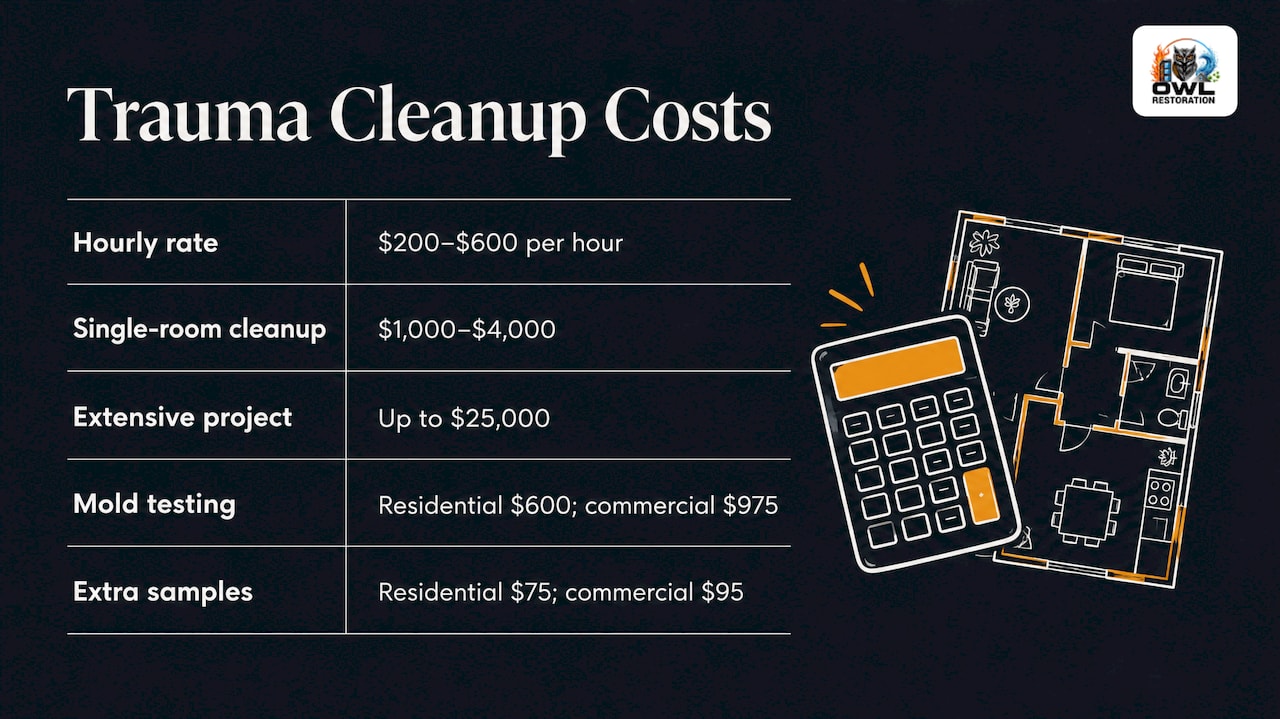
Price depends on the size of the scene, how deeply fluids penetrated, how much has to be removed and rebuilt, and how long the scene sat before discovery. One insurance explainer reports that hourly rates for crime scene and after-death cleaning commonly run from $200 to $600, that a single-room blood cleanup might cost $1,000 to $4,000, and that extensive projects needing structural remediation can reach $25,000. Treat these as a general range, not a quote.
An unattended death in a hot Texas home is a different job from a contained incident in a tiled bathroom. Fluids that reach subfloor, insulation or HVAC ducts multiply the scope. We do not publish a price for biohazard cleanup, because the scene defines the job; contact us with the situation and we will take it from there.
Two related costs are worth knowing if smell or moisture is part of the picture. If the incident was followed by water or fire, or if moisture is feeding mold in the affected area, we also offer water damage restoration and mold testing and inspection. Residential mold testing and inspection is $600, commercial is $975, and additional samples are $75 (residential) or $95 (commercial) each.
Insurance and who pays
Insurance coverage for trauma scene cleanup is not automatic, and it is the question owners most often get wrong.
The standard homeowners form, ISO HO-3, contains a pollution exclusion that can complicate biohazard claims, since it excludes costs to test for, clean up, remove or neutralize pollutants. Whether a particular loss is covered depends on your policy wording, the cause of the loss and how the insurer classifies it. Read your policy, and ask your agent or adjuster the question directly instead of assuming.
Some states also run victim compensation programs that may help with certain expenses after qualifying crimes. Eligibility, deadlines, documentation and payment limits vary by state. If the incident was a crime, ask the investigating agency or a victim advocate whether your state’s program applies to you.
Document before anything is touched
Insurer guidance consistently says the same thing: take wide and close-up photos, record video if possible, list damaged belongings, save receipts and keep notes of what happened and what temporary steps you took. For a trauma scene, apply that with care:
- Photograph only after the scene is released and it is safe to do so, and only from areas that are not contaminated.
- Do not enter a contaminated room just for a photograph. The contractor’s pre-work documentation can fill gaps.
- Keep the police report number, the date and time of release, and any notes from the officer or medical examiner.
- Keep every invoice, including those for waste disposal and any temporary lodging.
- Report the loss to your insurer promptly and ask which documents they want.
We coordinate directly with insurance companies, which means the adjuster talks to the crew doing the work and not only to you. In a week when you are dealing with a death or a violent event, that is one fewer set of phone calls.
Residential, commercial and rental properties
The work is the same on paper, but the situation differs by who you are.
Homeowners often face the most personal version of the problem. The priorities are privacy, speed and getting back to a livable home. Ask what can be restored and what must be replaced, since the standard recognizes that many items can be restored.
Business owners need the space back in service and may have employees, customers and landlords to inform. Contamination in a shared HVAC system is a serious concern in a commercial building, so containment details matter. Our commercial restoration work covers businesses across the DFW area.
Property managers often face an unattended death in a unit, with neighbors, a lease and an owner involved. Speed and documentation matter here: a written record of what was found, what was removed and how waste left the property protects the owner and the management company alike.
What our team does
We think trauma scene cleanup should feel like one phone call. When something like this happens at a home or business in the Dallas-Fort Worth area, owners are not choosing between cleanup companies as a hobby. They are in shock, they have an insurer to call, and they want the place made safe.
That is why we handle the job from the first response to the last repair. Our certified professionals respond around the clock, we deal with the insurance company directly, and if the scene needs flooring, drywall or subfloor rebuilt, we do the build-back too. One team, one point of contact, no handoff between a cleaner and a contractor who have never worked together.
Biohazard work should not be improvised. The standard exists because blood and body fluids travel into places you cannot see, and the people entering the room need to be protected. We would rather an owner call us at the first sign of a scene than try to be brave about it.
Dustin
Getting help in Dallas-Fort Worth
Owl Restoration serves Dallas, Tarrant, Ellis and Johnson counties with emergency restoration for water, fire, mold and biohazard incidents, for residential and commercial properties. Our biohazard cleanup page explains the service, and if you would also like to see how we approach related work, our guide to blood cleanup services describes what to expect.
Once the scene has been released, call us any time of day. We can begin the assessment, coordinate with your insurer and explain each step before work starts.
If the incident also involved a fire, fire damage restoration and smoke odor removal can be handled alongside the biohazard work. Start at our main site to reach the team.
FAQ
Can I clean up a trauma scene myself?
We strongly advise against it. Blood and body fluids can carry pathogens, and they soak into porous materials where household products do not reach. Regulated waste also has to be packaged, transported and disposed of under specific rules, and OSHA’s bloodborne pathogen rules exist to limit exposure for workers. Call a professional crew instead.
How long does trauma scene cleanup take?
It depends on the size of the scene and how much material must be removed. A contained area can take a day or less, while a scene with structural contamination takes longer and may need rebuilding afterward. We respond 24/7 and will explain the timeline once we have assessed the property.
Does homeowners insurance cover trauma scene cleanup?
Sometimes. The standard HO-3 form has a pollution exclusion that can affect biohazard claims, so coverage depends on your policy wording and the cause of the loss. Report the loss promptly, ask your insurer exactly what applies, and keep photos, the police report number and every invoice. We coordinate directly with insurers on claims.
Is the scene safe to enter once police leave?
No. Release by law enforcement means the investigation no longer needs the scene. It does not mean the scene is clean or safe. Keep out of the affected area until a trained crew has completed the cleanup and verification.
Sources
- Crime Scene Cleanup: Is This Part of Your Services? (R&R Magazine)
- New Standard Published: ANSI/IICRC S540 Standard for Trauma and Crime Scene Cleanup (SCRT)
- S540 (IICRC)
- The Principles of Trauma and Crime Scene Cleanup
- Crime scene cleanup (Wikipedia)
- Texas Regulations on Medical Waste (TCEQ RG-001)
- Rules and Regulations of the State of Georgia, Department 550
- Does Homeowners Insurance Cover Crime Scene Cleanup? (Legal Clarity)
- CalVCB Basic Fact Sheet
- How to Document Home Damage for an Insurance Claim (Amica)