

The most reliable signs of water damage are stains with ring-shaped edges, peeling or bubbling paint, warped or soft flooring, a musty smell, visible mold and a water bill that climbs without a change in how you use water. Much of the damage happens out of sight, so by the time you see it, moisture has often been at work for a while. If you find any of these in a Dallas-Fort Worth home or building, our team at Owl Restoration responds around the clock and can tell you how far the water has traveled.
TL;DR
- Look for stains with rings, bubbling or peeling paint, cupped or buckled floors, soft drywall, a musty odor and mold, especially in corners, closets, basements and under sinks.
- Hidden leaks show up as smells, higher water bills and small changes in texture before they show up as puddles.
- Wet materials that are not dried within 24 to 48 hours can start growing mold, so speed matters more than certainty about the cause.
- Fix the moisture source first. Mold comes back wherever the moisture does.
- Large affected areas, sewage, floodwater or anything near electrical systems call for a professional, not a weekend project.
Table of Contents
- Why water damage is easy to miss
- The visible signs, room by room
- Early and hidden signs you can catch before the wall shows it
- New damage or old damage?
- How to check when nothing is obvious
- What the signs can and cannot tell you
- What to do when you find signs
- Who this matters for
- When mold is part of the picture
- When to call us
- Our perspective
- FAQ
- Sources
Why water damage is easy to miss
Water rarely stays where it starts. The EPA’s moisture guidance frames building moisture problems around where the water comes from and how it moves: liquid leaks, wicking through porous materials, and vapor carried by humid air. That is why a stain on a ceiling can sit several feet from the pipe that caused it, and why damage can build behind wallpaper or under flooring with no running water in sight.
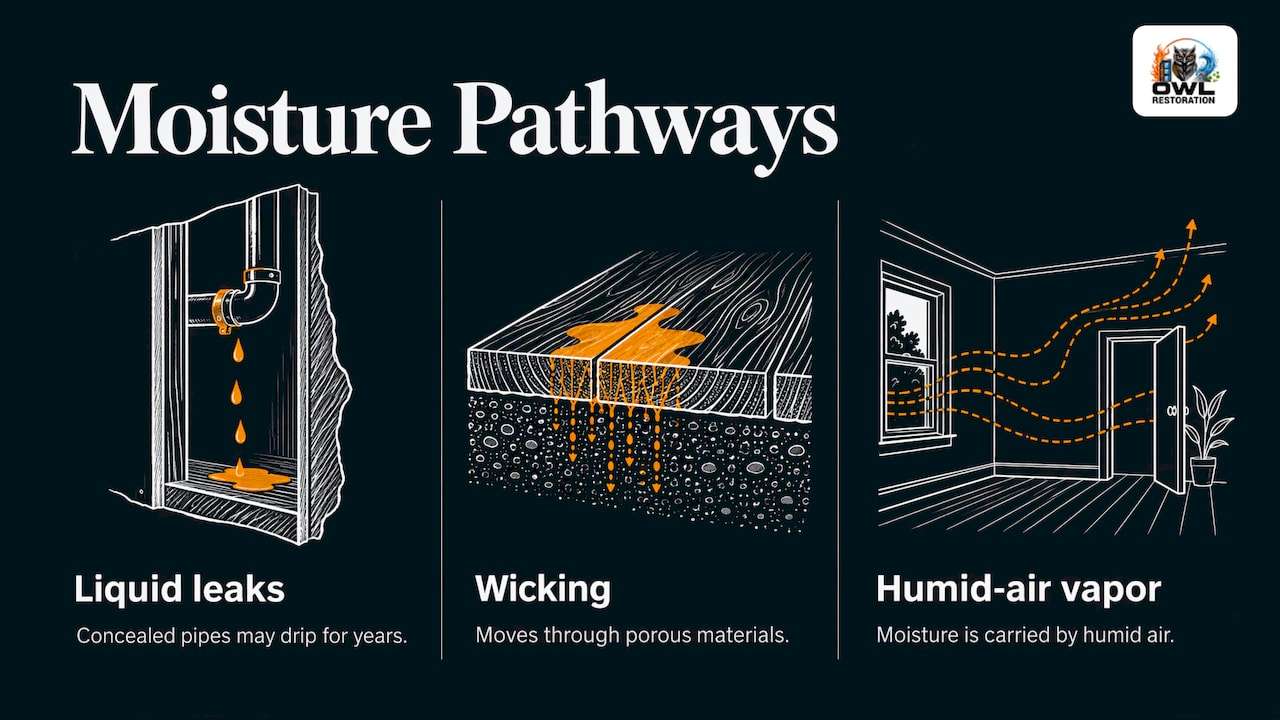
HUD’s research on building moisture notes that concealed pipes can drip for months or years before visible damage appears. By then, mold is established, wood is decaying, insulation is saturated and paint is peeling. The same research says early detection and repair is usually the most economical response. In other words, a small sign is the cheapest moment to act.
The visible signs, room by room
Stains, rings and discoloration
Brown or yellow patches on ceilings and walls are the classic sign. The ones to take seriously have a ring or an irregular border, because that pattern forms as a wet area dries and spreads again. A stain that looks darker and feels damp is usually recent. A lighter, dry stain with rings suggests water arrived at some point and may have returned more than once.
A dry stain is not proof the leak is over. If the ceiling stain grows after rain or after someone runs the shower upstairs, the source is still active. Our guide to ceiling water damage repair walks through what to do and when to call a pro.
Peeling, bubbling and cracking paint
The EPA lists peeling paint among the typical symptoms of moisture problems in buildings, alongside corrosion of metals, surface mold, stained finishes, and failing floor adhesives. State emergency agency guidance adds bubbling paint, warped floors and soft rotting wood to the list of water damage signs. Paint bubbles because water is trapped behind the film. Press a bubble gently: if it is soft or wet underneath, the wall behind it is holding moisture.
Warped, buckled or sloping floors
Flooring tells you a lot because each material fails differently:
- Hardwood cups (edges rise) or crowns (the center rises), and boards may separate at the seams.
- Laminate swells and buckles at the edges.
- Vinyl tile curls at the corners.
- Carpet ripples or feels spongy underfoot.
If you have vinyl plank or sheet flooring, this overview of what happens to vinyl floors in water damage shows how the material reacts to moisture underneath.
A floor that slopes is a bigger flag. Consumer Reports explains that water can activate mold spores that consume and rot wood, which can make part of a house settle. It advises contacting a home inspector or structural engineer in that case, and notes that wall cracks can point to water damage but can also come from ordinary settling or workmanship.
Soft drywall and texture changes
Drywall that feels soft or spongy has absorbed water into its core and will not dry back to strength. Walls that look slightly wavy, feel rough or show hairline cracks in a spiderweb pattern are also worth a closer look.
Kitchen and bathroom cabinets
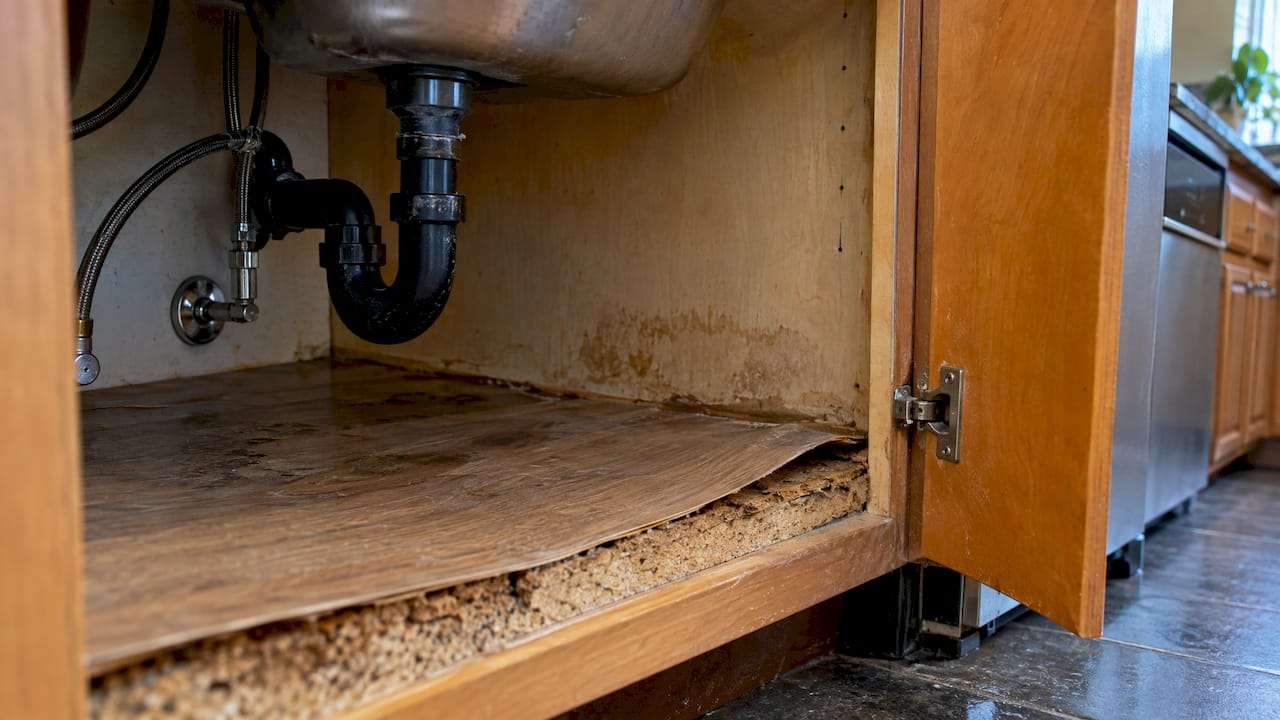
Under-sink cabinets are one of the first places a slow supply-line leak shows up: swollen particleboard, lifted laminate edges and a sour smell inside the door. How fast you dry them matters, and this breakdown of the 24 to 48 hour rule for kitchen cabinets by material shows how different cabinet materials respond.
Visible mold
Mold on a wall, in a corner where walls meet the ceiling, on baseboards or in a basement means moisture has been present for a while. Mass.gov, citing the EPA, says mold can grow when porous materials stay wet longer than 48 hours, and that relative humidity above 70% for an extended period can moisten materials enough to support it.
Early and hidden signs you can catch before the wall shows it
These are the signs that matter most to the reader who searches “how to tell if a house has water damage” and cannot see an obvious leak.
A musty smell
Consumer Reports says musty smells, often noticed in basements, are frequently the first sign of water damage. The odor can come from compounds released as mold grows. A smell that is stronger near an exterior-wall closet, a plumbing wall or the basement stairs is a good clue to where to look first. Do not just mask it. The smell means something is wet.
If the cause is general high humidity rather than a leak, Consumer Reports’ expert recommends a dehumidifier set to 45% relative humidity.
A water bill that rises with no change in habits
If your usage has not changed but the bill has, a hidden leak is a reasonable suspect. A simple check: turn off every fixture and appliance that uses water, then watch whether the meter still moves. If it does, water is going somewhere.
Sounds and drips
Dripping or hissing inside a wall, or a toilet that refills on its own, points to a leak in a supply line or fixture. Water heaters, washing machine hoses, dishwasher lines and ice maker connections are the usual suspects.
Floors and walls that feel different
Walls that feel cool and damp, baseboards that pull away, and flooring that smells or feels soft under a rug are all early signs. The EPA notes that damp concrete slabs can keep floor adhesive from curing, which loosens flooring, and that humid air can condense behind vinyl wallpaper on exterior walls and grow mold where you cannot see it.
Pests and corrosion
Insects drawn to damp wood, rusting metal fasteners and corroding fixtures are on the EPA’s list of moisture symptoms. They are easy to dismiss but they show moisture has been present a long time.
Rain-related clues
Mass.gov notes that when there is no plumbing failure or high humidity, weather events are the most common cause of moisture problems, and the date of the last significant rainfall can help estimate how long materials have been wet. A ceiling stain that appears after a storm often points to the roof. This guide on what to do about a roof leak during rain covers the first moves.
New damage or old damage?
It helps to know whether you are looking at a leak that just started or an old one.
| Sign | Likely recent | Likely older |
|---|---|---|
| Stain color | Darker, damp to the touch | Lighter, dry, often with rings |
| Paint | Fresh bubbles, soft when pressed | Flaking, peeling, cracked |
| Floor | Slight swelling, damp feel | Cupping, crowning, gaps, dark staining |
| Smell | Faint dampness | Persistent musty odor |
| Mold | Absent or spotty | Spreading, colored patches |
Old-looking damage can still be active. Treat any stain that changes size as a live problem.
How to check when nothing is obvious
Mass.gov points out that evaluating excess moisture is hard when there are no visible stains, mold or odors, and that moisture measuring devices help. The method it describes is to sample the suspect material and a control spot of the same material, record indoor and outdoor temperature and relative humidity, and, for drywall, take readings at three or more locations in an area. A pattern of high readings in one spot points to a leak. Uniformly elevated readings point to ambient humidity.
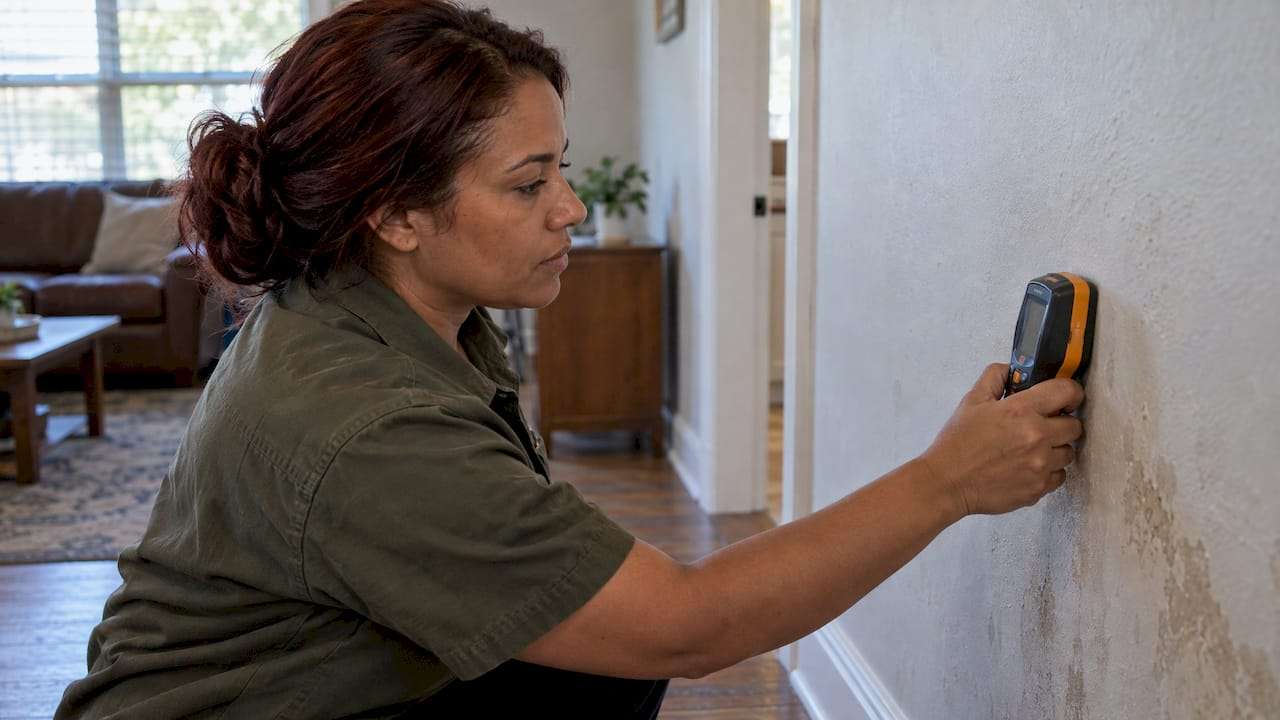
A visual inspection alone may not show the full extent of damage, because water moves into wall cavities, insulation and framing. Moisture meters, thermal imaging and selective openings are how a trained crew finds where the water went. This is the point where a restoration crew gives you more than a flashlight can. Our certified professionals use advanced techniques and equipment to restore properties, from initial mitigation through reconstruction, so you learn the real extent before anything is closed back up.
What the signs can and cannot tell you
A stain, a smell or a warped board tells you moisture is or was present. It does not tell you how far it spread, whether the framing is affected or whether the source is still running. That is why the next move is to find the source and dry the area, not to paint over it.
CalOES puts it plainly: mold problems will not go away unless moisture problems are fixed. Cleaning or painting without fixing the source means the damage returns.
What to do when you find signs
- Stop the source if you can. Shut off the water at the fixture or the main valve. If the water is coming from the roof, tarp or contain what you can safely reach.
- Stay safe. Keep away from standing water near outlets, appliances or a ceiling that is sagging. Sewage or floodwater needs professional handling.
- Start drying right away. Mass.gov’s mold guide says to identify and repair the moisture source and dry the area within 24 to 48 hours. Materials still wet after 48 hours should generally be removed and replaced.
- Photograph everything. Take dated photos and video of the damage, the source and affected belongings before anything is moved. That record supports an insurance claim.
- Call a professional for anything large. The same Mass.gov guide notes the EPA recommends professionals for mold-affected areas over 10 square feet, and CalOES advises hiring a licensed contractor with experience in mold remediation.
- Call your insurer early. Insurance policies differ on what is covered, so ask your carrier about your policy.
Our 48-hour action plan for water damage lays out these first two days in more detail, and emergency water restoration explains what a crew does on arrival.
Who this matters for
Homeowners usually find damage in the places they use daily: ceilings, under sinks, around tubs and in garages. Property managers and business owners face the same signs across more square footage, often in ceiling tiles, wall cavities, pipe chases and storage rooms, where a small leak can spread before anyone notices. For tenants, our article on water damage in an apartment explains what to do and who pays.
HUD’s research makes a point that applies to every owner: responsibility for preventing and correcting moisture problems ultimately falls on the owner or property manager. Regular walk-throughs of ceilings, mechanical rooms, crawl spaces, attics and basements catch problems when they are small.
When mold is part of the picture
A musty smell or visible growth after a leak is a reason to have the area assessed. Our mold testing and inspection is $575 for a residential property and $975 for a commercial property, with additional samples at $75 each for residential and $95 each for commercial. Our residential mold remediation protocol is $1,000. Details are on our mold testing page. Where growth has spread into crawl spaces, joists or attics, see our pages on crawl space mold removal, mold on floor joists and attic mold removal.
When to call us
If you see water damage signs in Dallas, Tarrant, Ellis or Johnson County, Owl Restoration offers 24/7 rapid response for water, fire and mold damage. We address leaks and moisture damage within 24 to 48 hours, and we coordinate directly with insurance companies so you are not carrying the claim paperwork on your own during an already stressful week. Our water damage restoration service covers the work from first mitigation to full reconstruction, and contents pack-out is available when belongings have to be moved out of the affected area.

If you are not sure whether what you found is serious, call us. Describe what you see, and we will tell you what it likely means and how quickly to move. You can start at Owl Restoration.
Our perspective
Most people call us after the stain has grown. The sign they noticed was real, but it was the last in a chain that started days or weeks earlier behind a wall.
Our view is simple: treat the first sign as an emergency, even when it looks small. Moisture does not wait for a convenient time, and the 24 to 48 hour window for drying is the one that decides whether you are drying a room or rebuilding it.
That is why we built our service around rapid response and a single team from mitigation to rebuild. When the same crew that finds the water also dries the structure, handles the insurance coordination and rebuilds what had to come out, nothing falls between steps. For homeowners, property managers and business owners across Dallas-Fort Worth, that means fewer surprises and less time living with damage.
Dustin
FAQ
What are the first signs of water damage?
The earliest signs are usually a musty smell, a faint stain with a ring-shaped edge, paint that bubbles, and a water bill that rises without explanation. Floors that feel slightly soft or edges that lift are also common. Treat any of these as a reason to find the source quickly.
How do I tell if my house has water damage when I can’t see a leak?
Start with smell, your water meter and the places leaks usually begin: under sinks, around the water heater, behind appliances, in basements and on ceilings below bathrooms. Moisture meters and thermal imaging can confirm what is behind a wall without cutting into it. If readings are high in one spot and normal elsewhere, a leak is the likely cause.
How long before water damage turns into mold?
Mold can start growing on damp materials within 24 to 48 hours. Mass.gov, following EPA guidance, says porous materials wet for more than 48 hours should be removed and replaced. If a flooded area could not be dried in that window, assume mold may be growing.
Is a brown ceiling stain always from a current leak?
No, but you cannot tell from the color alone. A darker, damp stain is likely recent, while a lighter dry one with rings may be older. If the stain grows or darkens after rain or after a fixture upstairs is used, the source is still active and needs repair and drying.
When should I call a professional instead of handling it myself?
Call a professional when the affected area is large, when mold covers more than about 10 square feet, when water is near electrical systems, when materials are sagging or soft, or when sewage or floodwater is involved. A restoration crew can also dry the structure properly and document the loss for your insurer.
Sources
- Moisture Control Guidance for Building Design, Construction and Maintenance (EPA)
- Building Moisture and Durability (HUD)
- Mold Remediation resource packet (CalOES)
- Use of moisture measuring devices for evaluating water damage in buildings (Mass.gov)
- Mold Cleanup, Repairs, and Excess Moisture Control (Mass.gov)
- 9 Sneaky Signs of Water Damage in Your Home (Consumer Reports)