
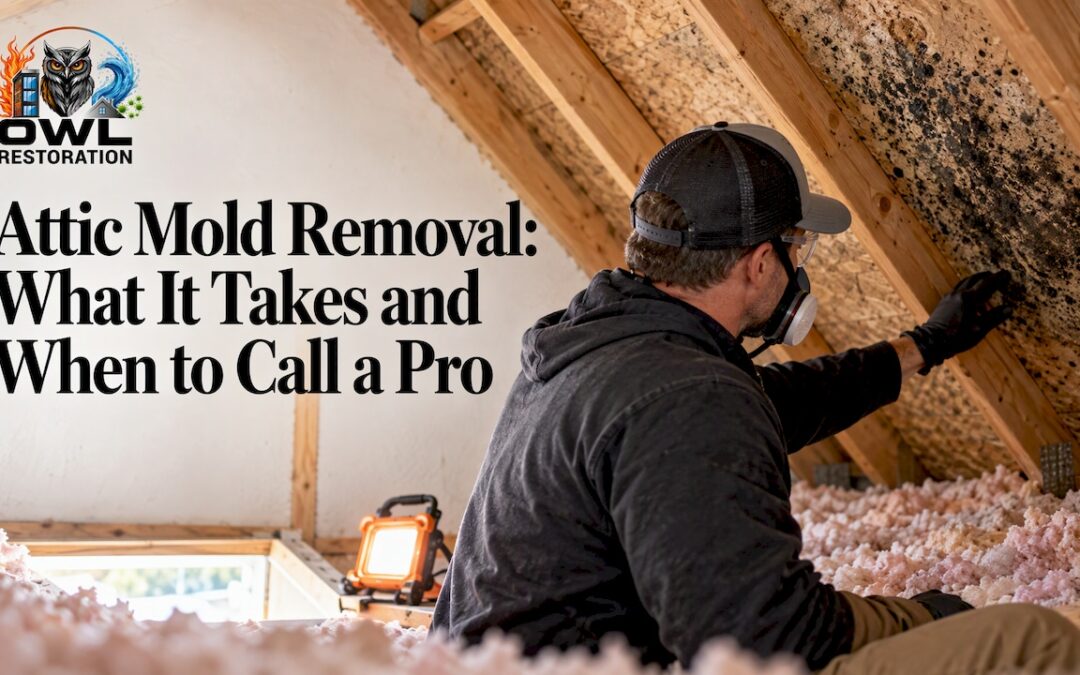
Mold in an attic is removed in two parts: the moisture feeding it is stopped, then the growth is contained and taken out of the framing, sheathing and insulation without spreading spores into the house. Anything beyond a small patch is a job for a remediation crew. In Dallas-Fort Worth, Owl Restoration handles attic mold from inspection through cleanup and, when materials have to be replaced, through rebuild.
This guide covers why attic mold appears, how serious it is, what proper removal involves step by step, and how to keep it from coming back. It is written for homeowners, business owners and property managers who have found stains, a musty smell or damp insulation overhead.
TL;DR
- Attic mold almost always traces back to moisture: a roof or flashing leak, poor ventilation, or humid air escaping from the living space.
- Federal guidance says areas larger than about 10 square feet call for a professional remediation contractor, and most attic infestations pass that mark quickly.
- Disturbing mold without containment and protective gear can spread contamination through the home.
- Removal that skips the water source fails: the mold returns.
- We respond around the clock across Dallas, Tarrant, Ellis and Johnson counties and coordinate directly with your insurance company.
Table of Contents
- Why mold grows in an attic
- Signs of mold in your attic
- Is attic mold serious?
- When attic mold needs a professional
- How attic mold removal works, step by step
- Fixing the moisture problem so the mold stays gone
- What attic mold removal costs
- Promo: attic mold in Dallas-Fort Worth
- Our perspective
- Preventing attic mold from returning
- FAQ
- Sources
Why mold grows in an attic
Mold is a fungus that thrives in wet places. The National Institute of Environmental Health Sciences lists flooding, leaky pipes, humid conditions and poor ventilation as the conditions that let it take hold in buildings, and says the best way to control it indoors is to control moisture.
In an attic, moisture usually arrives in one of three ways:
- Roof leaks. Failed flashing around a chimney or vent pipe, worn shingles or storm damage let water reach the decking and insulation. A slow leak can feed mold for months before a ceiling stain appears below.
- Poor ventilation. Blocked soffits, missing baffles or too few vents trap warm, humid air against cold roof sheathing, where it condenses. The NC State Extension mold and moisture checklist tells homeowners to check that soffits are not blocked and that exhaust ducts send air outdoors.
- Exhaust ducts that end in the attic. Bathroom fans and dryer vents that discharge into the attic space dump steam straight onto the framing.
The same extension checklist advises keeping indoor humidity below 60%, with 30 to 50% as the ideal range. North Texas summers push humidity high, so an attic with weak airflow has a hard time staying dry.
Signs of mold in your attic
Most people never go up there, so the first clue often shows up elsewhere. The U.S. Department of Energy’s Guide to Durable Attics lists these signs of water getting in:
- warped or rotted wood at the soffits,
- bubbled paint on fascia boards or soffits,
- worn or warped shingles at the roof edge,
- wet insulation, especially near the eaves,
- mold, mildew, or warped or rotting wood on attic surfaces.
Inside the house, watch for a musty smell, ceiling stains, or a damp odor when the attic hatch opens. If a ceiling is already stained, read our guide to ceiling water damage repair, because the leak and the mold are usually the same problem.
Black, green or white fuzzy or speckled growth on the underside of the roof deck is typical. The color does not tell you how risky it is. Treat any visible growth as a moisture problem that needs a proper fix.
Is attic mold serious?
Yes, and the way you handle it matters as much as the mold itself. The Washington State Department of Health points out that even dry, dead mold can cause health problems, so a patch that looks inactive is still worth removing correctly.
The larger risk is spreading it. The University of Georgia’s mold and moisture inspection checklist warns that investigating mold can disturb contaminated areas and spread contamination through the home. That poses a serious health risk to people with compromised immune systems, asthma or allergies, and it recommends consulting a doctor or hiring a professional before a thorough investigation.
If anyone in the household has asthma, allergies, a weakened immune system or a respiratory condition, talk to their doctor and keep them out of the house while the work is done. The NEHA guide to indoor mold concerns calls for extra precautions for children, older adults and people with respiratory conditions.
The EPA’s remediation guidance also lists what stirs mold up: breaking apart moldy porous materials, invasive work to examine mold in a cavity, and using fans to dry things. All three are common in an attic job, which is why containment matters.
When attic mold needs a professional
The EPA’s brief guide to mold draws the line at about 10 square feet. For extensive water damage or mold growth covering more than that, it points to its remediation guide for professionals. The NEHA guide says the same: consider a remediation contractor when the affected area is greater than 10 square feet.
Ten square feet is roughly a 3-by-3-foot patch. Attic mold rarely stays that small. Roof decking runs across the whole structure, insulation soaks up water and hides growth, and rafters and framing give mold plenty of surface. Once you can see growth on more than one rafter bay, you are almost certainly past the line.
Call a professional right away if:
- the growth covers more than about 10 square feet,
- the insulation is wet or matted,
- you see rotted or warped decking or framing,
- there is an active roof leak,
- someone in the home has asthma, allergies or a weakened immune system,
- the attic holds HVAC equipment or ductwork, which can carry spores through the house,
- the property is a commercial building or a rental, where tenants or employees are exposed.
The minimum protective gear for anyone disturbing mold, per the EPA, is an N-95 respirator, gloves and eye protection. NEHA adds long gloves reaching mid-forearm and goggles. In a hot, cramped attic, working in that gear is hard to sustain, and that is one more reason the job suits a trained crew.
How attic mold removal works, step by step
Here is the sequence a proper job follows, and where each step tends to go wrong.
1. Assess the extent and the cause
The crew inspects the whole attic: decking, rafters, insulation, vents, bath-fan ducts and the ceiling below. Mold often extends past what the hatch view shows. Where it goes wrong: treating only the visible patch and leaving hidden growth under insulation.
If you want documentation of what is in the attic, our mold testing and inspection is $600 for a residential property and $975 for a commercial one, with additional samples at $75 (residential) or $95 (commercial) each.
2. Stop the water source
The EPA is blunt: the source of the moisture must be addressed or the mold may simply reappear. A roof leak gets repaired, a blocked soffit gets cleared, a bath fan duct gets redirected outside. We cover this in the next section.
3. Contain the work area
The EPA states that the purpose of containment is to limit the release of mold into the air and surroundings, protecting both remediators and occupants. In practice, that means sealing off the attic from living space so spores released during cleanup do not drift down into bedrooms. Where it goes wrong: a hatch left open, or a fan pulling attic air through the house.
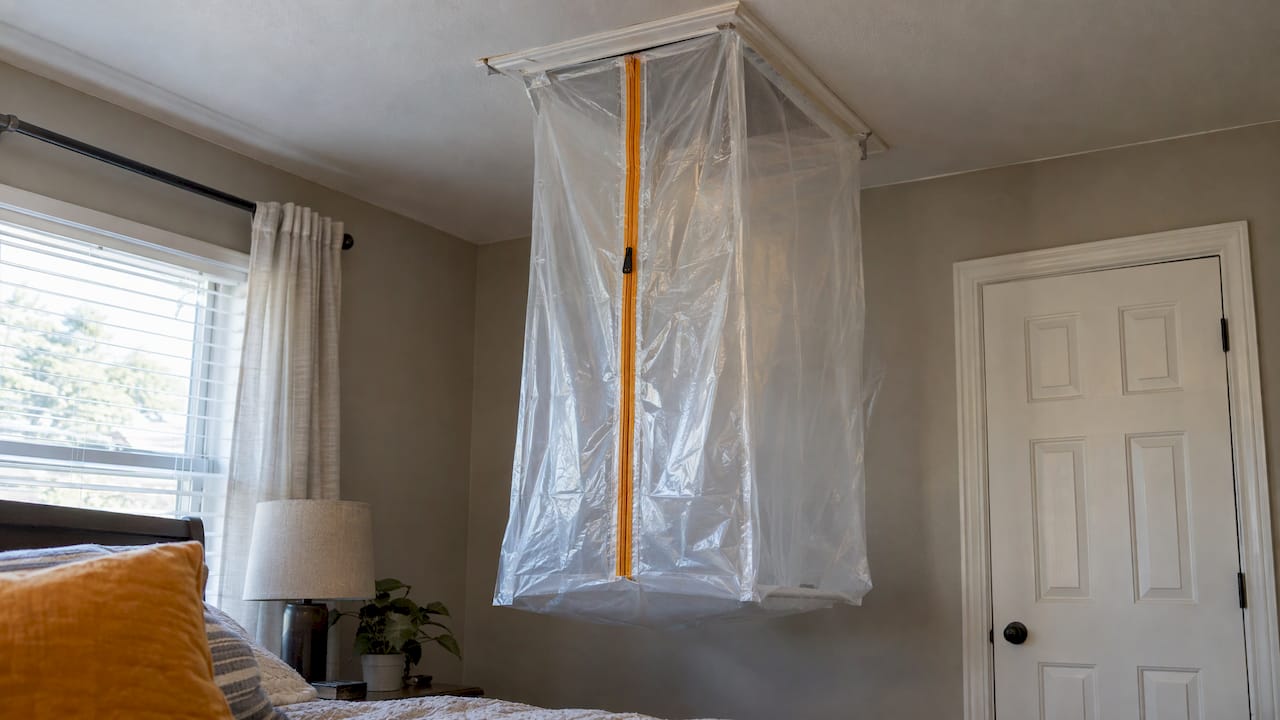
4. Remove what cannot be cleaned
Wet or moldy insulation is bagged and removed. Heavily affected porous materials come out too. NEHA notes that porous materials that stay wet for more than 24 to 48 hours might need to be discarded. Decking and framing that are structurally sound are cleaned instead of replaced.
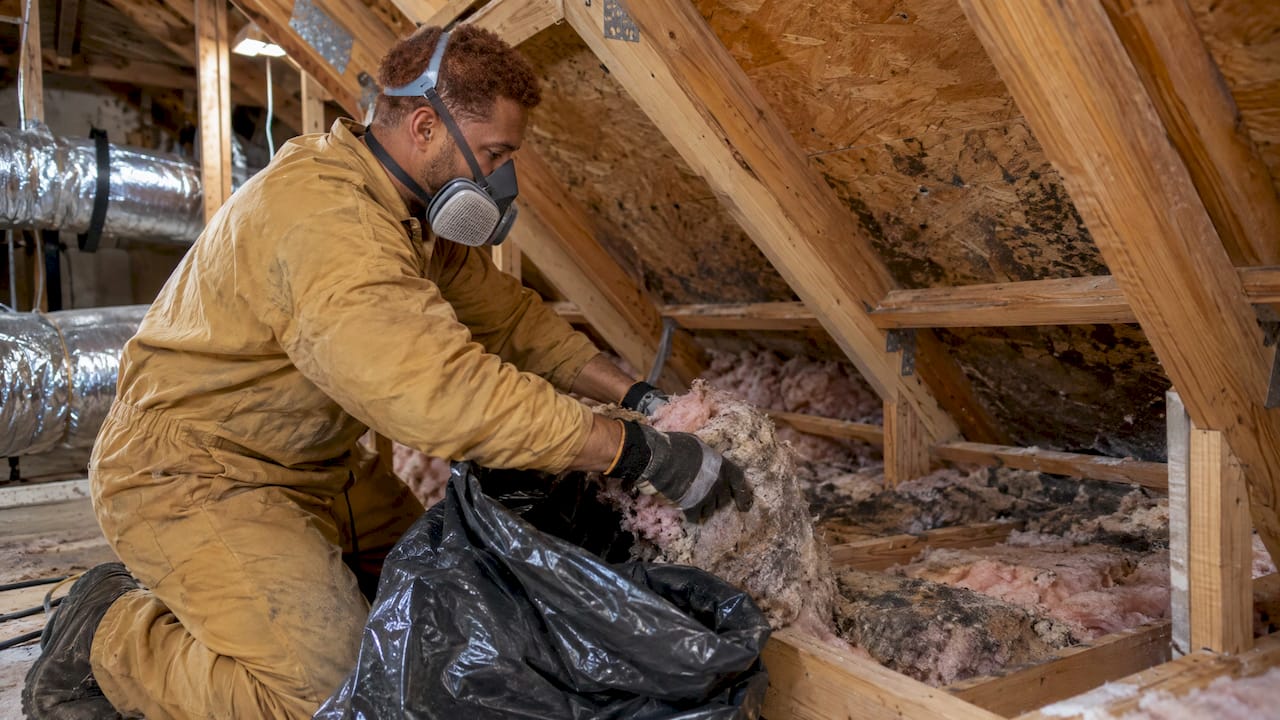
5. Clean the framing and decking
Surfaces are cleaned so that growth is removed, not just bleached to a lighter color. The Massachusetts Department of Public Health says mold can generally be cleaned with detergent and water, and that harsh chemicals like bleach are not recommended in most cases. A sprayed-on bleach solution can leave roots in the wood and fresh moisture in the attic, which is part of why do-it-yourself fixes so often fail.
6. Dry and correct ventilation
Once the surfaces are clean, the attic needs to stay dry. Intake and exhaust venting is balanced, baffles keep insulation from blocking airflow, and duct terminations are checked.
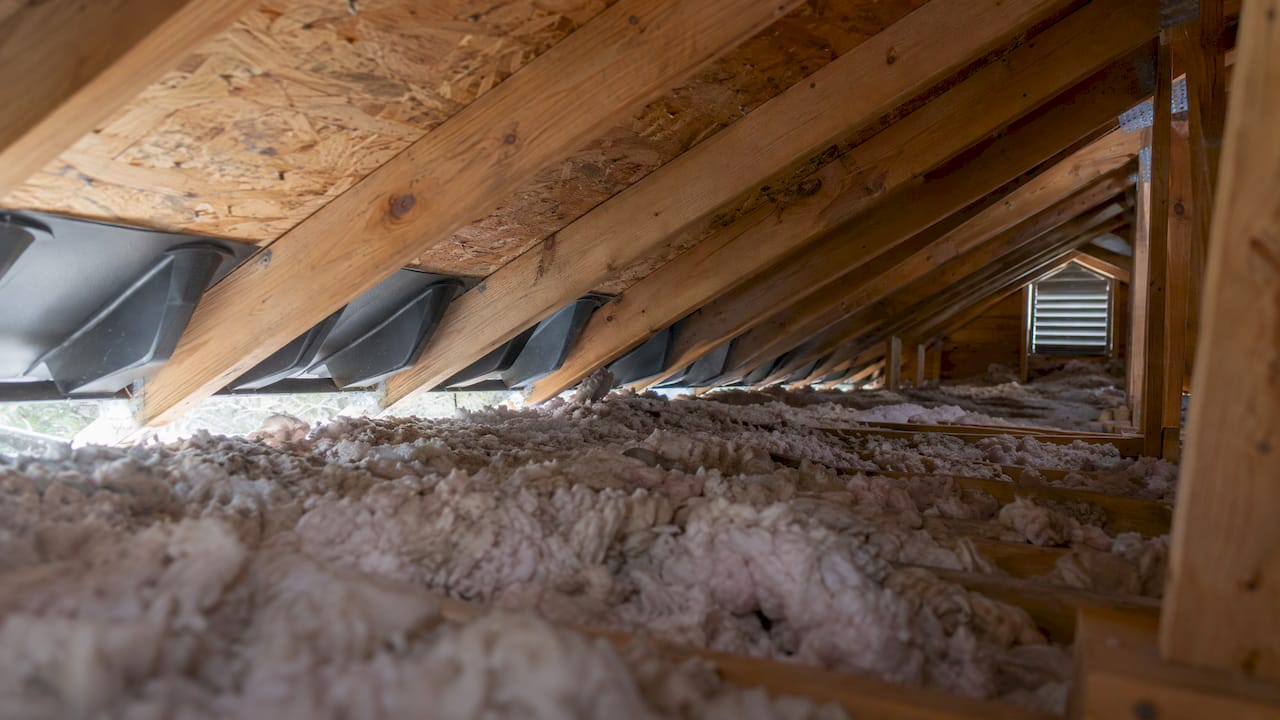
7. Verify the result
NEHA recommends reassessing and monitoring areas after remediation to confirm that moisture and mold do not reappear. If you see new staining after the next heavy rain, tell your contractor promptly.
8. Rebuild if needed
When decking, insulation or ceiling drywall had to come out, the area needs to be put back. We handle reconstruction and build-back so the same crew that opened the damage can close it, instead of leaving you to coordinate a second contractor.
Fixing the moisture problem so the mold stays gone
The EPA’s guidance on this is consistent: if you clean up mold but do not fix the water problem, it will most likely come back. Cleaning is only half the job.
Start by working out which of the three moisture sources applies:
- A roof leak shows up as staining concentrated under one area, often around penetrations and valleys, and gets worse after storms. A roofer should inspect and repair the roof. This explainer on when to get a roof inspection covers the signs that justify a visit.
- Condensation from poor ventilation shows up across a broad area of the north-facing or cold roof deck, with frost or dampness in winter. The fix is airflow: clear soffit vents, install baffles and add exhaust capacity.
- Indoor humidity leaking upward comes from bathroom fans, kitchen vents or a leaky ceiling plane. Ducts must terminate outdoors, and gaps around light fixtures and hatches should be sealed.
If a leak also wet the ceiling or walls below, the damage may extend beyond the attic. Our water damage restoration team dries those areas. The Washington State Department of Health advises cleaning and drying water-damaged carpets, clothing, bedding and upholstered furniture within 24 to 48 hours, and the EPA says that if damp materials are dried within that window, mold in most cases will not grow. That is why speed counts after a storm leak.
What attic mold removal costs
Attic jobs vary widely because the price depends on the square footage affected, how much insulation and decking must be replaced, access, and whether the roof or ventilation also needs work. National cost guides give wide ranges, so a figure from a website is less useful than a quote based on what is actually in your attic.
Here is what we publish for the starting steps:
| Service | Price |
|---|---|
| Mold testing and inspection, residential | $600 |
| Mold testing and inspection, commercial | $975 |
| Additional samples, residential | $75 each |
| Additional samples, commercial | $95 each |
| Mold remediation protocol, residential | $1,000 |
The remediation work itself and the commercial protocol do not have a published price. Insurance can matter here. Whether a policy covers mold depends on the policy and on what caused the water, which is why we coordinate directly with insurance companies on your behalf instead of leaving you to sort out paperwork while the attic sits open.
Promo: attic mold in Dallas-Fort Worth
If you have found growth in your attic, we can start with an inspection and tell you what is there and how far it goes. Owl Restoration serves Tarrant, Dallas, Ellis and Johnson counties with 24/7 emergency response, certified professionals, and one team from mitigation through rebuild. See our mold testing and inspection page, or call us to get an attic assessed.

Business owners and property managers get the same service for commercial buildings, with the commercial inspection priced at $975.
Our perspective
We get called about attic mold after someone has already tried to handle it: sprayed a patch, painted over a stain, or gone up with a dust mask and a shop vac. The patch comes back because the water never stopped, and sometimes the cleanup spread spores further than the mold ever traveled on its own.
Our view is simple. An attic is the worst place to improvise. It is hot, cramped, hard to seal off and directly above the rooms your family lives in. Doing it right means finding the moisture source, containing the space, removing what cannot be saved, and checking afterward that the problem is gone.
What we offer is the whole chain under one roof: testing and inspection, remediation, water damage restoration when a leak reached the ceiling below, and reconstruction when materials had to come out. We work directly with your insurance company, so you are not sorting out paperwork in the middle of an emergency.
If you see growth in your attic, do not wait for the next storm to make it worse. Call us, and we will tell you what we find.
Dustin
Preventing attic mold from returning
After remediation, a few habits keep the attic dry:
- Watch humidity. The EPA recommends keeping indoor humidity below 60%, ideally 30 to 50%, and the Oregon Health Authority recommends using exhaust fans to pull indoor moisture outside.
- Keep gutters clean and repaired. The EPA lists this among its prevention steps, since overflowing gutters push water back under roof edges.
- Check the attic after major storms. Look for damp insulation, new stains on the decking and daylight where there should be none.
- Keep vents clear. Do not let insulation block the soffits.
- Dry anything wet fast. The 24 to 48 hour window applies to any leak.
The Department of Energy guide recommends looking for the roof-edge and soffit signs described earlier. Do it twice a year and you catch problems while they are still small.
FAQ
Can I remove attic mold myself?
The EPA says homeowners can generally handle moldy areas smaller than about 10 square feet. Attic growth usually covers more than that, and disturbing it without containment and protective gear can spread it through the house. For anything larger, or if anyone at home has asthma or allergies, we recommend having a remediation crew do the work.
Can mold in an attic be fixed?
Yes. Once the moisture source is repaired, growth is removed and damaged materials are replaced, the attic can be returned to a dry, clean condition. The key is fixing the water problem, because the EPA says mold will most likely return otherwise. Monitoring the area afterward confirms the fix held.
How do I know if the mold in my attic is dangerous?
Color does not tell you. The Washington State Department of Health notes that even dry, dead mold can cause health problems, so the safe approach is to treat all visible growth the same. People with asthma, allergies or weakened immune systems should see their doctor and stay away from the work area.
Does insurance cover attic mold removal?
It depends on your policy and what caused the moisture, for example a sudden storm leak versus long-term seepage. We coordinate directly with insurance companies on your claim, and your adjuster makes the coverage decision. Photograph the damage and call us as soon as you find it.
Sources
- Guide to Durable Attics, U.S. Department of Energy
- Mold, National Institute of Environmental Health Sciences
- Mold and Moisture Checklist, NC State Extension
- Mold and Moisture Home Inspection Checklist, University of Georgia CAES
- Mold, Washington State Department of Health
- Responding to Indoor Mold Concerns Guide, NEHA
- Mold Remediation in Schools and Commercial Buildings, Chapter 3, U.S. EPA
- A Brief Guide to Mold, Moisture and Your Home, U.S. EPA
- Mold Cleanup, Repairs, and Excess Moisture Control, Massachusetts DPH