
A toilet overflow looks like a mop-and-bucket problem until the water reaches the subfloor, the baseboards or the unit below. The first hour decides how much you clean and how much you replace. Stop the water, keep people out of it, and get the structure drying inside 24 to 48 hours. If the water was contaminated or has soaked into flooring and walls, our crews at Owl Restoration handle the extraction, drying, disinfection and insurance paperwork across the Dallas-Fort Worth area.
TL;DR
- Stop flushing, close the toilet’s shutoff valve, and use the main shutoff if the water will not stop.
- Treat the water as contaminated: wear gloves, eye protection and boots, and keep children and pets out.
- Photograph everything and contact your insurer before you clean up or throw things away.
- Dry the area within 24 to 48 hours, because mold can start if materials stay wet.
- Water that has reached walls, subfloors, carpet padding or a second room usually needs professional drying equipment.
Table of Contents
- Step 1: Stop the water
- Step 2: Treat the water as contaminated
- Step 3: Document before you clean
- Step 4: Remove the water and wet materials
- Step 5: Clean and disinfect
- When the toilet overflow is more than a mop job
- Will a toilet overflow cause mold?
- Business owners and property managers
- Our perspective
- Need help now?
- FAQ
- Sources
Step 1: Stop the water
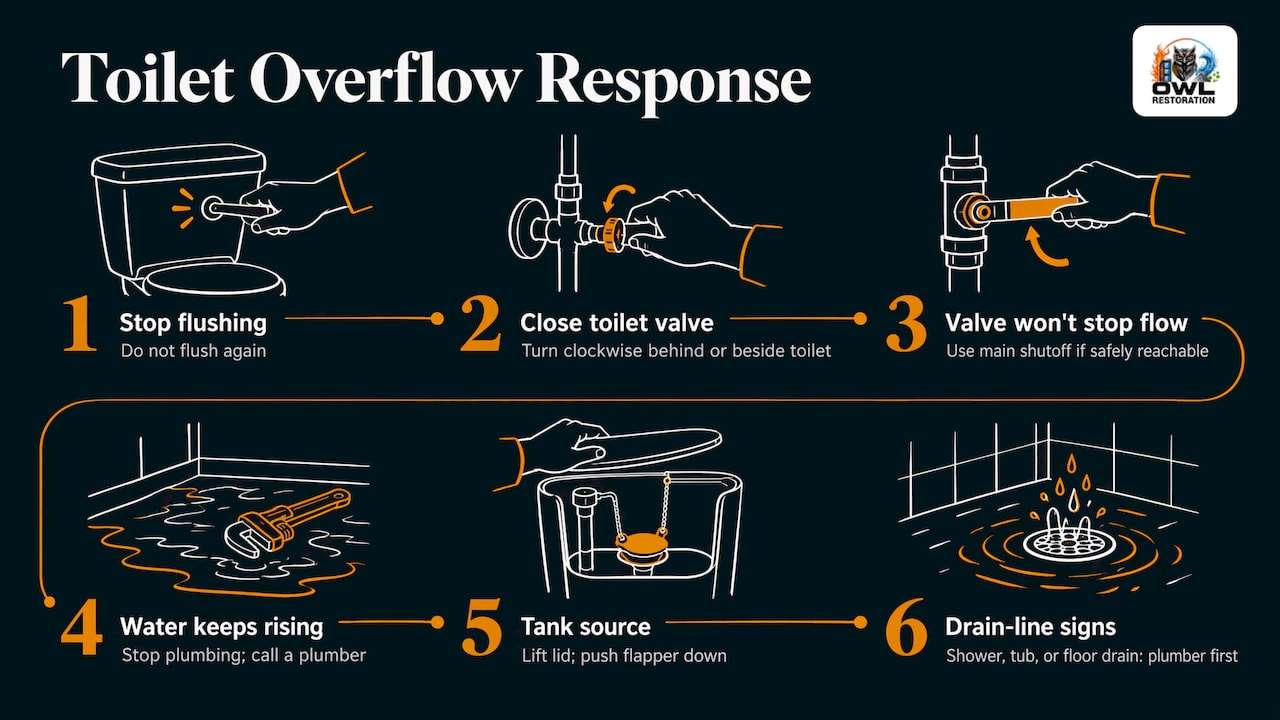
Stop flushing first. Then turn the shutoff valve behind or beside the toilet clockwise until it closes. Forbes Home’s guide to shutting off toilet water adds two fallbacks. If the valve will not stop the flow, use the home’s main shutoff if you can reach it safely. If water keeps rising after the supply is off, stop using plumbing throughout the house and call a plumber, since a drain or sewer blockage may be involved.
If the tank is the source, lift the lid and push the flapper valve down to stop water flowing into the bowl.
A quick rule of thumb: if the water came only from the toilet, you are dealing with a fixture overflow. If it is also coming up from a shower, tub or floor drain, the problem is in the drain line, and the plumber comes before anything else. That distinction also matters for insurance, as covered below.
Step 2: Treat the water as contaminated
Is an overflowing toilet a biohazard? Bowl water that has mixed with waste should be handled as contaminated. The CDC’s disaster cleanup guidance warns that floodwater can carry dangerous bacteria from overflowing sewage and other waste. It also notes that skin contact alone is not described as a serious risk, while swallowing contaminated food or water can cause disease. That is why the precautions focus on keeping the water off your hands, mouth and food.
Before you touch anything:
- Wear rubber gloves, eye protection and boots, as Massachusetts’ home-care guide for sewage backups recommends.
- Cover cuts and scrapes, and wash and disinfect any wound that touches sewage right away.
- Keep children and pets out of the area, and throw away any food or drink the water reached, per the Illinois Department of Public Health.
- Wash with soap and water when you finish.
Anyone with open wounds, a weakened immune system or a respiratory condition should stay out of the room and talk to their doctor if they were exposed.
Step 3: Document before you clean
The CDC’s guide to mold cleanup after disasters says to photograph the home and your belongings and to contact your insurance company before cleanup. The Boston Water and Sewer Commission adds useful detail: record the date, time and location of each photo, and keep receipts for any professional cleanup.
A workable routine:
- Take wide shots of each affected room, then close-ups of the floor, baseboards, walls and furniture.
- Photograph or list every item you plan to discard before it leaves the house.
- Note when the overflow happened and when you stopped it.
- Keep every receipt, from towels to equipment rental to a plumber’s invoice.
Property managers should add tenant names, unit numbers and any neighboring units the water reached.
What insurance usually looks at
Coverage turns on the cause. Kin’s March 2026 guidance says standard homeowners policies typically cover sudden, accidental overflows from toilets or tubs, while damage from a clogged sewer or drain system generally is not covered unless you added water-backup coverage. Dependable Claims Specialists draws the same line between fixture overflow and sewer or drain backup and says the outcome depends on your policy wording and limits. Read your own policy, and ask your adjuster which category your loss falls into.
We work directly with insurance companies on claims, so the documentation we produce while drying and cleaning goes to your adjuster as part of the job.
Step 4: Remove the water and wet materials
The CDC mold guide’s answer for soaked homes is to remove standing water and wet materials and dry everything as fast as possible, within 24 to 48 hours if you can. The Boston Water and Sewer Commission says delay increases property damage and the chance of health problems for occupants.
What that looks like in practice:
- Standing water: remove it with a mop and bucket for small spills, or a wet vacuum that is used only for this job and cleaned afterward.
- Rugs, bath mats, towels: launder hot if they can be washed thoroughly. Illinois’ guidance says to remove contaminated objects that cannot be thoroughly washed or laundered.
- Carpet and padding: padding holds water and contamination. If sewage-tainted water soaked it, it generally comes out.
- Drywall and insulation: the CDC says to remove drywall and insulation contaminated by sewage or floodwater.
- Air movement: open doors and windows, and run fans and dehumidifiers if the electricity is safe to use. Do not run electrical equipment in standing water.
The common failure here is drying only what you can see. Water wicks up drywall and travels under baseboards and vinyl planks, and a floor that feels dry on top can stay wet beneath. In Texas heat and humidity, a damp wall cavity is an easy place for mold to start.
Step 5: Clean and disinfect
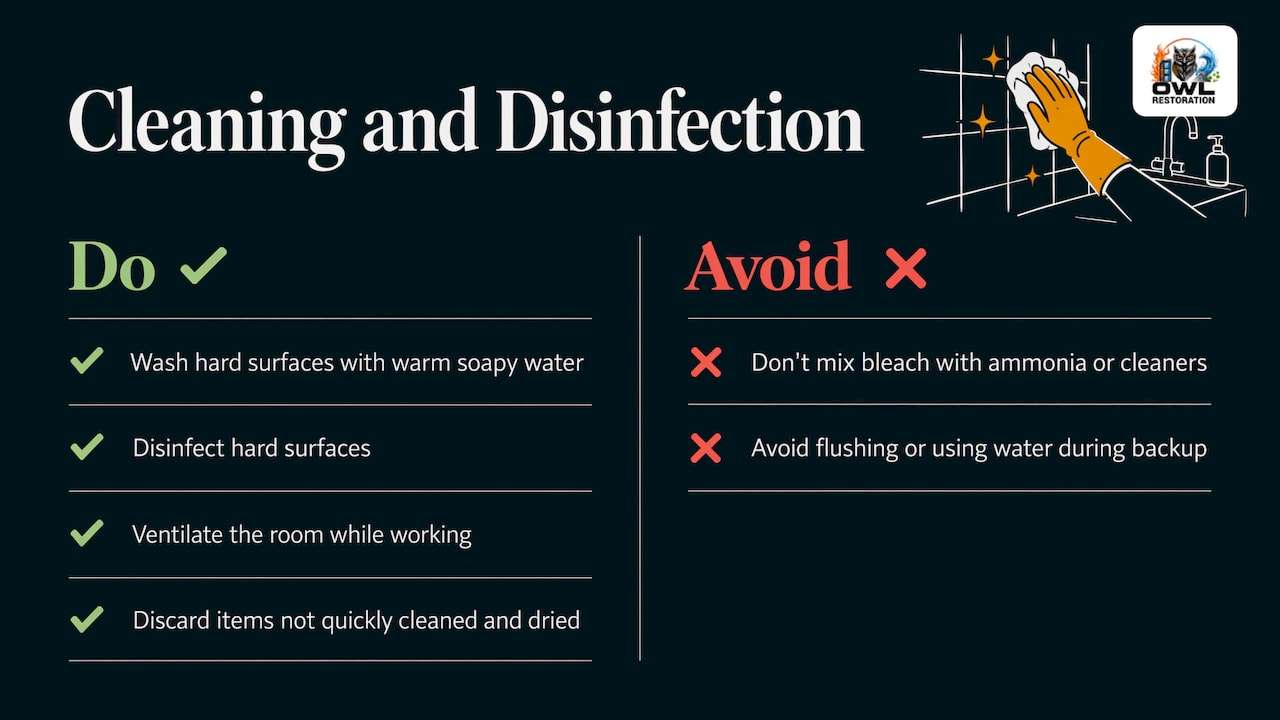
Once the water and ruined materials are gone, wash hard surfaces with warm soapy water, then disinfect. The Illinois guidance sets a ceiling of no more than 1 cup of household bleach per gallon of water. The Boston Water and Sewer Commission specifies one-quarter cup per gallon. Never mix bleach with ammonia or other cleaners, and ventilate the room while you work.
Seattle Public Utilities notes that sewage carries hazardous germs that can contaminate people and belongings, so clean and sanitize hard surfaces, and avoid flushing or other water use while a backup is active.
Porous materials such as grout, unsealed wood, upholstery and mattresses are harder to disinfect than tile or a sealed tub. Anything that cannot be cleaned and dried quickly should be discarded.
When the toilet overflow is more than a mop job
A bathroom overflow that you catch in minutes, on tile, with clean-looking water, is a manageable cleanup. These situations are different:
- The water reached carpet, hardwood, subfloor, drywall or another room.
- It leaked through the floor into a ceiling below. Our guide to ceiling water damage repair covers what happens next.
- The water came from a drain or sewer backup, not just the bowl.
- It happened in a rental, an apartment or a commercial space, where other occupants and liability are involved. See our page on water damage in an apartment for who pays.
- You cannot get everything dry within 48 hours.
Cleanup guidance for sewage-contaminated water in mold-remediation materials says to consult an experienced professional when you lack expertise in contaminated-water work, since it demands more precautions than routine clean-water drying. Water damage restoration is exactly that work, and our water damage restoration service covers extraction, drying and rebuild. For the wider timeline, see our 48-hour action plan.
Will a toilet overflow cause mold?
It can. The CDC’s mold guide says mold can develop when materials stay wet, recommends cleaning and drying within 24 to 48 hours, and says to assume mold growth if a flooded home could not be dried in that window. Watch for visible growth, a musty smell and moisture that keeps returning. Fix the water source, clean visible mold with detergent and dry the surface immediately. Once mold has started growing, the CDC advises against using fans, which can spread spores.
Timing matters across all water losses, not only roofs. A roof leak mold timeline shows the same pattern: the longer materials stay wet, the more likely growth becomes.
Mold testing after an overflow
If you suspect mold behind a wall or under flooring, testing tells you what is there and where. Our published prices are $600 for a residential mold test and inspection and $975 for a commercial one, with additional samples at $75 (residential) or $95 (commercial) each. Our residential mold remediation protocol is $1000. Details are on our mold testing page, and our mold remediation service covers the removal itself.
Business owners and property managers
A toilet overflow in an office, restaurant or multifamily building puts employees, customers and tenants in contact with contaminated water, and the clock on drying runs just the same. Close off the area, stop the water, photograph the scene, notify your carrier and keep tenants or staff out until the cleanup is finished. For shared plumbing, call your plumber to rule out a main-line blockage. We handle commercial properties as well as homes, from mitigation through reconstruction, and our emergency flood cleanup guide lays out the first 48 hours.
Our perspective
Most toilet overflows we hear about start small and become expensive for one reason: the water sits. People mop the visible puddle, shut the bathroom door and find a soft baseboard or a musty smell a week later.
That is why we pair fast response with the full job. We respond to water, fire and mold emergencies across Dallas-Fort Worth, work from mitigation to rebuild, and coordinate directly with your insurance company, so you are not carrying the claim, the drying and the repairs as three separate problems.
If it was a spill you caught in minutes, clean it safely and move on. If it reached anything porous, or you are not sure how far it went, call us early. The first 48 hours are the cheapest ones.
Dustin
Need help now?
If your toilet overflow has soaked floors or walls, or you are managing a property where it spread, our team is available around the clock across Dallas, Tarrant, Ellis and Johnson counties. We extract the water, dry the structure, clean and rebuild, and work with your insurer on the claim. Start with our water damage restoration page.

If contamination is a concern, we also provide biohazard cleanup and contents pack-out so your belongings are protected while the work is done.
FAQ
Can you put bleach in the toilet’s overflow tube?
The overflow tube is inside the tank, and it is not where cleaning is done after a spill. Disinfect the floors and hard surfaces the water touched with a diluted bleach solution, using the ratios from the Boston and Illinois guidance above. Never mix bleach with other cleaners.
Does a toilet overflow cause water damage to the floor below?
Yes, it can. Water travels through floor seams and around the toilet flange, and can reach the ceiling beneath. Stained or sagging drywall below a bathroom is a sign to get the area dried and checked promptly.
Is toilet overflow water damage covered by insurance?
Often a sudden, accidental fixture overflow is covered under a standard homeowners policy, while a sewer or drain backup typically needs a water-backup endorsement. Your policy wording and limits decide, so contact your insurer before cleanup and document everything.
How fast do I need to dry things out?
Aim for 24 to 48 hours. The CDC says to assume mold growth if a soaked home could not be dried within that period.
Sources
- How To Shut Off Toilet Water Supply, Forbes Home
- Guidelines for Cleaning Safely After a Disaster, CDC
- Massachusetts Flooding and Sewage Back-ups: Home Care Guide
- Cleaning Up After Flood and Sewer Overflows, Illinois Department of Public Health
- Homeowner’s and Renter’s Guide to Mold Cleanup After Disasters, CDC
- Cleanup Procedures After a Sewer Backup, Boston Water and Sewer Commission
- Side Sewer Backups, Seattle Public Utilities
- Does home insurance cover plumbing?, Kin
- Sewer Backup vs. Toilet Overflow Claims, DCS PIA
- Roof leak mold timeline