
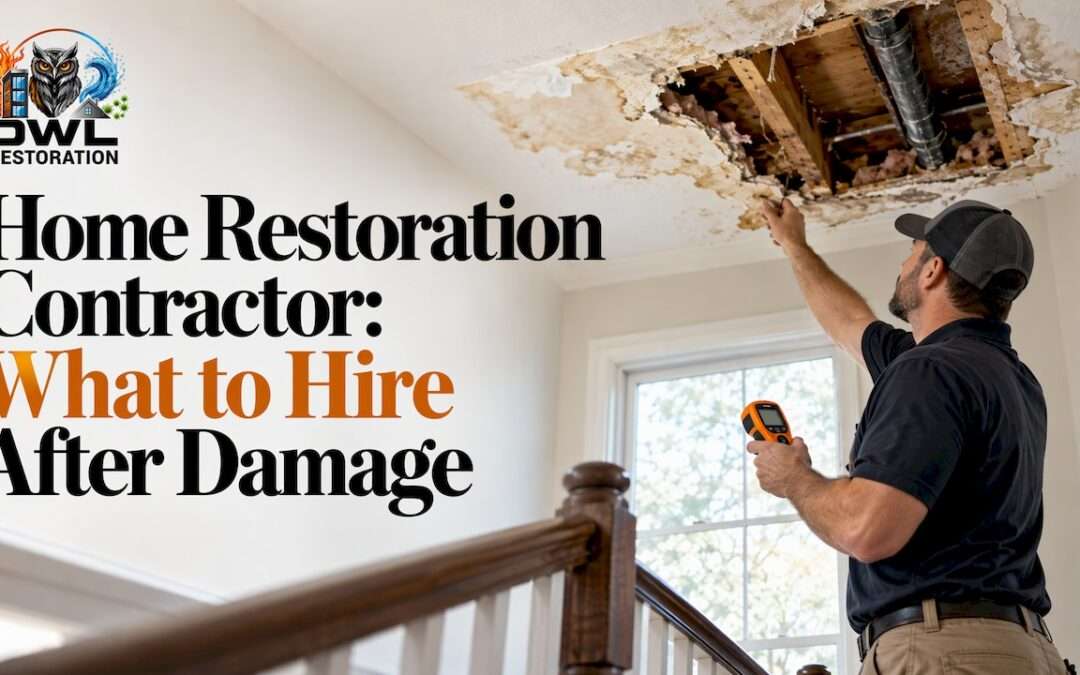
A home restoration contractor is the company you call when water, fire, smoke or mold has already hurt your property and every hour makes it worse. The right one stops the damage, dries and cleans the structure, documents everything for your insurer, and, if you choose, rebuilds. In Dallas-Fort Worth, that is the work Owl Restoration does: water, fire and mold remediation, biohazard cleanup, contents pack-out and reconstruction, with direct insurance coordination, for homes and commercial buildings in Tarrant, Dallas, Ellis and Johnson counties.
This guide is for homeowners, business owners and property managers who need to know what happens next, what to ask, and how to avoid signing something they will regret.
TL;DR
- A restoration contractor’s first job is mitigation: stopping further damage and protecting the home and its contents. Rebuilding is a separate scope of work, so ask for each in writing.
- Materials dried within 24 to 48 hours after a leak will in most cases not grow mold, so the speed of the first call matters more than almost any other choice.
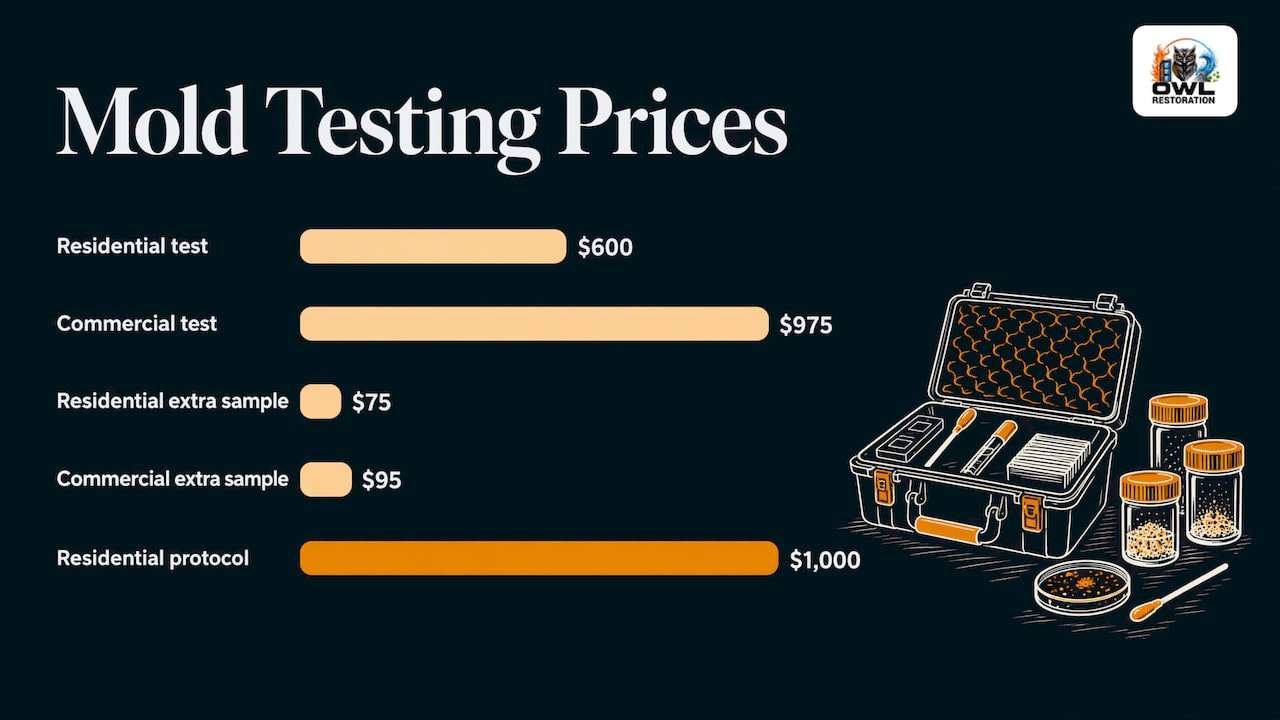
- Mold testing is useful for verifying cleanup or scoping a hidden problem, not for “proving” visible mold. Our published residential testing price is $600 and commercial is $975.
- You, not your insurer, pay the contractor you sign with. Read the scope and get more than one estimate before authorizing major work.
- A contractor who handles mitigation, claim paperwork and rebuild under one roof means fewer handoffs and fewer gaps.
Table of Contents
- What a home restoration contractor actually does
- The first 48 hours: why speed decides the outcome
- What fire and smoke restoration involves
- Mold: when testing helps and what it costs
- Working with your insurance claim
- How to choose a home restoration contractor
- What to avoid agreeing to
- Where Owl Restoration fits
- Our perspective
- FAQ
- Sources
What a home restoration contractor actually does
The name covers a lot of ground, so start with the distinction that trips most owners up. According to the Maryland Attorney General’s consumer guide on restoration companies, restoration companies are usually the first responders after floods, fires, water damage and sewage backups. Their job is to clean up, preserve and protect the home and its contents so no further damage occurs. Repairs are a different contract, and they require the right licensing for home improvement work.
In practice, a full-service project has three layers:
| Layer | What happens | Typical examples |
|---|---|---|
| Emergency mitigation | Stop the source, extract water, set drying equipment, board up, remove unsafe material | Burst supply line, kitchen fire, sewage backup |
| Cleaning and restoration | Remove contamination, clean surfaces and air systems, treat odor, pack out and clean belongings | Smoke residue, wet carpet and pad, mold remediation |
| Reconstruction | Rebuild what had to be removed: drywall, flooring, cabinets, paint | Build-back after a fire or major leak |
Owl Restoration covers all three, from initial mitigation to full reconstruction, so one team can hand its own work to the next phase. That matters because the notes, photos and moisture readings from the first day are exactly what the rebuild estimate and the insurance claim depend on.
The first 48 hours: why speed decides the outcome
The U.S. EPA’s Brief Guide to Mold, Moisture, and Your Home states that wet or damp materials dried within 24 to 48 hours after a leak or spill will in most cases not grow mold. That window is the reason emergency response exists. A ceiling leak that is dried on day one is a repair. The same leak left over a weekend can become wet insulation, swollen subfloor and a mold job.
What the first call should set in motion:
- Stop the source. Shut off the water at the main or the fixture, and turn off power to affected areas if water is near outlets or fixtures.
- Call a restoration contractor immediately. Do this before the claim is fully filed. Mitigation to prevent further damage is something you should not delay for paperwork.
- Photograph and video everything before anything is moved or removed.
- Let the crew measure. Moisture mapping and thermal readings show how far water traveled behind walls and under floors, which you cannot see.
- Keep a drying log. The Maryland guide advises asking for documentation of drying progress and completion, and re-inspecting affected areas in the weeks after water damage.
Our team responds around the clock, and we work to address water leaks, fire damage and mold growth within 24 to 48 hours. If water is already in your home, our 48-hour action plan for water damage walks through what to do while the crew is on the way, and our page on emergency water restoration explains what we do on arrival.
Specific situations get their own treatment: a ceiling water damage repair usually starts with finding what is still wet above the drywall, and renters and landlords can read about water damage in an apartment, including who pays.
What fire and smoke restoration involves
Fire work is more than cleaning. Smoke and soot travel through the whole structure, into HVAC ducts, insulation and fabrics. The California Department of Insurance’s Technical Guide for Wildfire Restoration, published December 9, 2025 and based on industry standards, lays out a useful four-phase framework that applies well beyond wildfires:
- Pre-restoration evaluation by the restorer to define the damage and scope.
- Formal assessment by an industrial hygienist when conditions call for a third-party opinion.
- The restoration phase, removing combustion byproducts.
- Project completion, with a completion evaluation by the restorer or an independent verification.
The same guide describes general surfaces being cleaned in two steps, HEPA vacuuming and then damp wiping with mild detergent and water, and says HVAC systems must be professionally cleaned by a qualified contractor following National Air Duct Cleaners Association (NADCA) standards. In other words, a quick wipe-down or a fogger is not a restoration.
When the home is not livable or the contents need to be cleaned off-site, contents pack-out moves your belongings out, inventories them and keeps them safe while the structure is repaired. We handle this through our contents pack-out service. For the full process, see our guides to fire and smoke restoration and smoke odor removal, or go straight to fire damage restoration in DFW.
Outdoor damage is usually a separate trade. Fences, for example, tend to be handled apart from interior mitigation, and a storm-damaged fence guide shows how the question of who pays and who fixes it gets sorted out after a storm.
Mold: when testing helps and what it costs
Mold is where owners most often pay for the wrong thing. The EPA’s guide says sampling is unnecessary in most cases when visible mold is present, and because no federal limits exist for mold or mold spores, sampling cannot show compliance with a federal standard. Where sampling does earn its cost is in verifying that an area has been adequately cleaned or remediated, and the EPA says professionals should conduct that sampling using AIHA or ACGIH analytical methods.
So test when:
- You smell mustiness or had a leak but see nothing, and need to know whether hidden growth exists.
- You need a written scope before remediation, so every bidder prices the same work.
- You need clearance after remediation, to confirm the job was done.
- A tenant, buyer, lender or insurer wants documentation.
Our published mold testing and inspection prices:
| Service | Residential | Commercial |
|---|---|---|
| Mold testing and inspection | $600 | $975 |
| Each additional sample | $75 | $95 |
| Mold remediation protocol | $1,000 | No published price |
The remediation protocol is the written plan that defines what gets removed, contained and cleaned. Details are on our mold testing and inspection page. For remediation itself, see mold remediation in Dallas-Fort Worth. Hidden problems often sit in specific places, and we have written up crawl space mold removal, mold on floor joists and attic mold removal.
How big is too big?
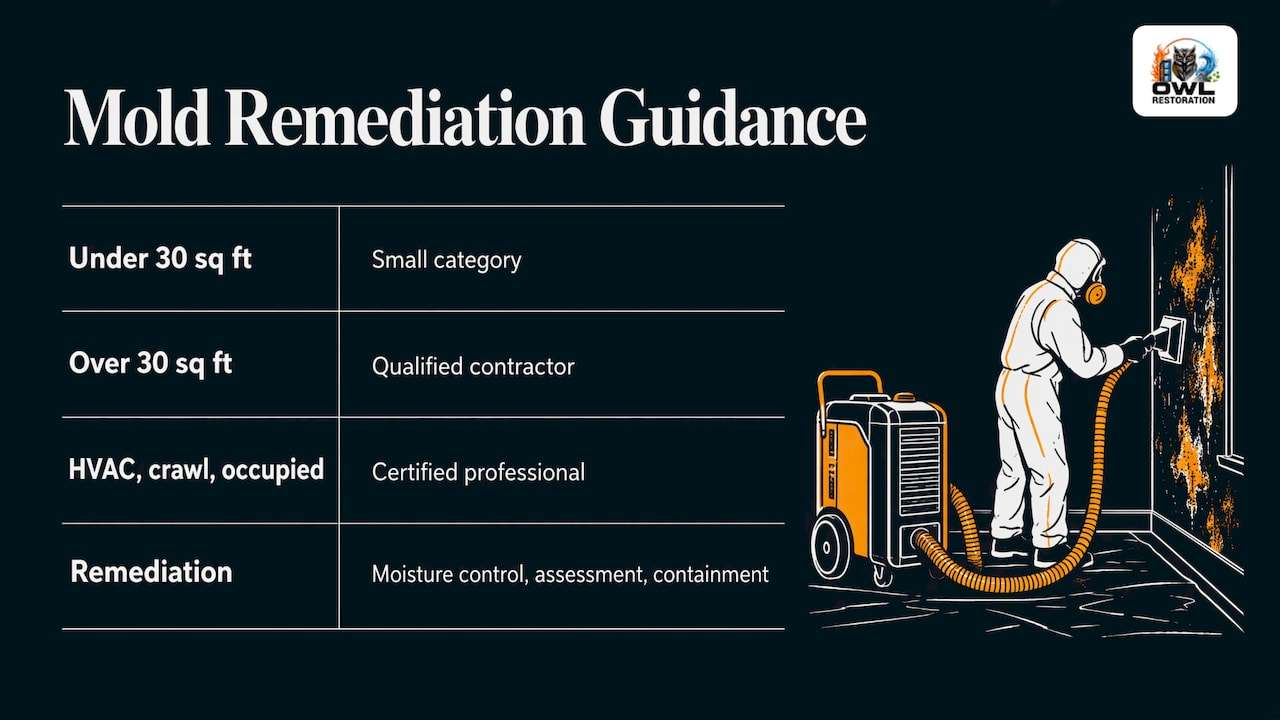
A U.S. government consumer guide, Consumer Tips for Post-Disaster Home Restoration, explains that mold remediation involves moisture control, assessment of impacted materials and containment. It also relays OSHA guidance: jobs under 30 square feet are the small category, while jobs over 30 square feet should be performed by a qualified contractor. Anything larger than that, or anything in an HVAC system, a crawl space or an occupied commercial building, belongs with a certified professional who can contain the area so spores do not spread to clean rooms.
The reason a property survey matters here is that moisture has a source, and removing mold without fixing that source only resets the clock. A guide to damp in a property survey shows how moisture problems are identified before anyone prices a cleanup, which is the same logic behind our inspection-first approach.
Working with your insurance claim
Most owners calling a restoration contractor are also filing a claim, often for the first time. A few rules keep it clean:
- Report the loss promptly and keep reporting. The NAIC’s Post-Disaster Claims Guide tells policyholders to contact their insurer and adjuster any time they find damage that was not already reported or inspected, or learn something new about the damage.
- Document before and during. Photos, video, moisture readings, equipment logs and an inventory of affected contents are what an adjuster works from.
- Understand who owes whom. The Maryland guide warns that once you sign a restoration contract, you, not the insurance company, are responsible for paying the restoration company for the described work, even if the claim is later denied. Read the contract and the scope before you sign, and ask how the work is described and priced.
We coordinate directly with insurance companies, which takes the back-and-forth of estimates, scope questions and supporting documentation off your plate. That is a real advantage when you are also dealing with a damaged home or a closed business.
For property managers and business owners, the same discipline applies at a larger scale: log the date of discovery, notify your carrier and tenants as your lease and policy require, and keep a single point of contact for the contractor. Commercial losses add downtime, and a team that can mitigate, clean and rebuild lowers the number of vendors you manage.
How to choose a home restoration contractor
The top search results for this keyword are mostly directories listing remodelers and roofers in cities across the country. That is a different search from yours. When your floor is wet or your kitchen has burned, you need an emergency restoration specialist who is near you and can be on site fast. Use these criteria:
- Response and availability. Is someone reachable 24/7, and what is the stated time to arrival and to starting work?
- Certified staff and proper equipment. Ask which certifications the technicians hold and what drying, air filtration and cleaning equipment they use.
- Scope in writing. What is being removed, dried, cleaned and rebuilt, and what is not included? The Maryland guide is a good reminder that mitigation and repair can be separate contracts.
- More than one estimate for large work. The NAIC guide advises getting estimates from more than one contractor and notes that an estimate much lower than the others does not mean it is the best deal. It also advises checking with local officials about permit requirements and using reputable contractors.
- Insurance experience. Will the contractor talk to your adjuster directly and provide documentation?
- Completion evidence. Drying logs, clearance results or a completion evaluation, as the California framework describes.
- Local knowledge. Permit rules and building practices differ by city. A DFW crew that works in Tarrant, Dallas, Ellis and Johnson counties knows the local conditions.
This is also where a single full-service contractor pays off. When mitigation, pack-out, mold work and reconstruction come from one company, the person who saw the original damage is the same person scoping the rebuild, and nothing gets lost between crews.
What to avoid agreeing to
People often ask what not to tell a contractor. A better question is what not to sign. Hold off on authorizing anything you cannot describe in your own words. Do not sign a blank or open-ended work authorization. Do not let anyone discard damaged materials before they are photographed and, if your adjuster asks, inspected. And do not assume the claim will be paid in full, because as noted above the contract you sign is yours. Ask the contractor to explain each line of the scope, and ask who handles what if the insurer’s estimate differs from the contractor’s.
Where Owl Restoration fits
If you are standing in a wet, smoky or musty property right now, start with the service that matches the problem: water damage restoration, fire damage restoration, mold remediation, biohazard cleanup or reconstruction and build-back. Our certified professionals serve homes and commercial properties across the DFW area, respond 24/7 and coordinate with your insurance company directly.
For a mold concern, our mold testing and inspection is $600 for a home and $975 for a commercial property. For emergencies, call through our main site and tell us what happened. We will tell you what to do while the crew is on the way.
Our perspective
Most of the damage we see getting worse is damage that sat for a day or two while the owner waited for the claim, a bid or a callback. Mitigation first, paperwork in parallel, is the order that protects both the property and the claim.
We built Owl Restoration around handling the whole job: emergency response, drying and cleaning, mold testing and remediation, pack-out, and the rebuild. When one certified team carries a property from the first emergency visit through reconstruction and works directly with your insurance company, you get one set of records, one point of contact and fewer chances for something to slip.
If you are in Dallas, Tarrant, Ellis or Johnson County and something has gone wrong, call us early. The first 24 to 48 hours are the ones that count.
Dustin
FAQ
What do home restoration companies do?
They respond to damage from water, fire, smoke, mold and similar events, stop it from spreading, and clean and dry the structure and contents. Many, including us, also rebuild the affected areas. Mitigation and rebuilding are best described separately in writing.
How quickly should restoration work begin?
As soon as the source is stopped. The EPA says materials dried within 24 to 48 hours after a leak will in most cases not grow mold, so that is the target. Call a 24/7 restoration contractor right away, and report the loss to your insurer in parallel.
Do I need mold testing if I can see mold?
Usually not to confirm it, since the EPA says sampling is unnecessary in most cases when mold is visible. Testing helps to find hidden growth, define a remediation scope and verify cleanup afterward. Our residential testing is $600, with additional samples at $75 each.
Will my insurance pay the restoration contractor directly?
That depends on your policy and your insurer. The contract you sign makes you responsible for payment, even if the claim is later denied, so read it carefully. We coordinate directly with insurance companies to move the claim along.
How many estimates should I get?
For large repairs, more than one, as the NAIC advises. Compare the scope line by line rather than only the total, since a much lower number may leave out work. For emergency mitigation, do not delay the first call while you collect bids.
Sources
- Attorney General of Maryland: Consumer Guide on Restoration Companies
- California Department of Insurance: Technical Guide for Wildfire Restoration (2025)
- U.S. EPA: A Brief Guide to Mold, Moisture, and Your Home
- Consumer Tips for Post-Disaster Home Restoration (govinfo.gov)
- NAIC Post-Disaster Claims Guide