
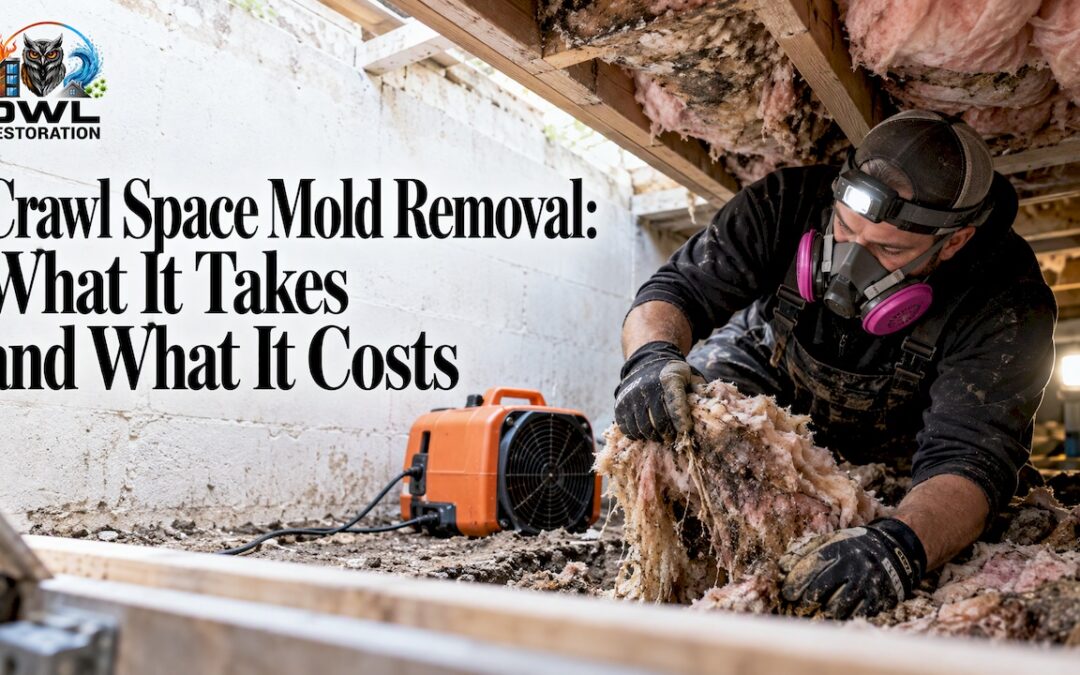
Crawl space mold removal is a two-part job: confirm how much mold there is and where it started, then remove it and fix the moisture that fed it. Skip either part and the mold returns. In the Dallas-Fort Worth area, we start with licensed mold testing, then follow with remediation and the repairs that keep the space dry. Our team responds to water and mold emergencies within 24 to 48 hours.
This guide explains why crawl spaces grow mold, how to tell how serious it is, what professional removal involves, what it typically costs and how insurance treats it.
TL;DR
- Mold in a crawl space is a moisture problem first. The EPA says that if the water problem isn’t fixed, the mold will most likely come back.
- Bleach and other biocides are not the answer. The EPA does not recommend routine biocide use, because dead mold can still cause allergic reactions.
- Anything beyond a small patch (about 10 square feet) is a job for a professional, and a tight, dark crawl space makes even small jobs harder.
- Typical professional costs for crawl space jobs run from the hundreds to several thousand dollars, depending on area, access and the moisture repair.
- Our residential mold testing and inspection is $600, and our residential Mold Remediation Protocol is $1,000.
Table of Contents
- Why mold grows in crawl spaces
- Signs of mold and moisture under your home
- How serious is crawl space mold?
- What professional crawl space mold removal involves
- Why a hose-and-bleach approach falls short
- What crawl space mold removal costs
- Crawl space flooding and water damage
- Does insurance cover crawl space mold?
- Who this matters for
- How to choose a crawl space mold contractor
- Perspective
- Get the crawl space tested and cleared
- FAQ
- Sources
Why mold grows in crawl spaces
Mold needs moisture, organic material to feed on and time. A crawl space supplies all three. Wood joists, subfloor and cardboard-like paper facing on insulation are food. The air is still, dark and often humid.
The EPA notes that crawl spaces with high relative humidity are common places for hidden mold, especially over bare earth, because soil moisture evaporates into the air under your house. Groundwater can also enter where the water table is high.
The moisture usually comes from one or more of these sources, which a state health guide on crawl spaces lists:
- Plumbing leaks from supply or drain lines
- Groundwater and high water tables
- Porous soil
- Condensation on cool surfaces
- Poor ventilation
- Missing gutters
- Poor drainage or grading around the foundation
North Texas adds its own pressure. Heavy spring storms, clay soil that holds water against foundations and humid summers all push moisture toward the space under the floor. A single leaking pipe can wet insulation for weeks before anyone looks.
Signs of mold and moisture under your home
Most homeowners never go into the crawl space, so the first sign is often indoors: a musty smell in the house, floors that feel soft or cold, or a rise in allergy symptoms at home. If you do look, the Department of Energy’s Building America program lists the signs of crawl space moisture problems:
- Standing water or puddles
- Water stains
- Efflorescence (white, chalky mineral deposits)
- Damp or sagging insulation
- Visible mold or mildew
- Rusty pipes and nails
Mold on the wood framing is a particular concern, because it sits right under your living space. We cover what that looks like in our page on mold on floor joists.
Safety if you look yourself
If you need to peek into the space, protect yourself. The California Department of Public Health recommends goggles, gloves and an N-95 respirator when handling moldy material. People with asthma, allergies, a weakened immune system or a lung condition should not go in at all. Stirring up mold in a confined space spreads spores into the air you then breathe and can carry them into the house above.
How serious is crawl space mold?
It depends on three things: how much there is, what it is growing on and how much moisture is still present.
Size. The EPA says a homeowner can generally handle an affected area smaller than about 10 square feet, and that larger or more complicated jobs may call for professional help. A crawl space is the kind of complicated job: low clearance, limited airflow, wiring and plumbing in the way, and surfaces overhead.
Material. Mold on hard surfaces can often be cleaned. Mold in porous materials is different. The EPA says moldy porous materials may need to be discarded because mold can penetrate them. Wet fiberglass insulation and similar materials usually fall in this category.
Moisture. Active water makes mold a recurring problem. Mold that sits on a dry beam after one leak is a smaller problem than mold above a space that floods every spring.
Because you can’t judge any of this from the hatch, the right first step is an inspection. Our mold testing and inspection tells you how much mold is present and where, so the removal plan is built on facts instead of guesses.
What professional crawl space mold removal involves
A proper job runs in a set order. Here is each stage, and where jobs go wrong.
1. Inspect and test
The job starts with finding every area of growth and the moisture source behind it. Where it goes wrong: treating only the visible patch and missing mold on the opposite side of the joists, behind insulation or near a vent. Our residential testing and inspection is $600, with additional samples at $75 each. Commercial testing and inspection is $975, with additional samples at $95 each.
Texas also licenses people and companies that assess and remediate mold through the Texas Department of Licensing and Regulation, so it is worth confirming that whoever you hire holds the right license.
2. Stop the water
The EPA is direct: mold won’t grow without moisture, so the water problem has to be fixed along with the cleanup. A cleaned crawl space with a leaking drain line above it will grow mold again. If the source is a burst or leaking pipe or standing water after a storm, our water damage restoration work covers that side of the job.
3. Remove and clean affected materials
Hard surfaces are scrubbed and dried. Materials that can’t be cleaned, such as soaked insulation, are removed. The EPA says that killing mold alone does not remove it, and dead mold can remain allergenic. That is why a spray-and-walk-away fix, or a bleach fogging, doesn’t finish the job.
4. Contain the work
In a crawl space, the risk is that spores travel up through floor gaps, ducts and plumbing penetrations. The California guidance advises venting to the outdoors and preventing spread to other parts of the home. This is a large part of why crawl space work is better left to certified crews with the right equipment.
5. Dry completely
Massachusetts’ homeowner guide recommends drying cleaned areas completely with fans or dehumidifiers, aiming for 24 to 48 hours, then confirming that visible mold and odor are gone before any repairs begin. Closing up damp wood is how a second round of mold starts.
6. Correct the conditions
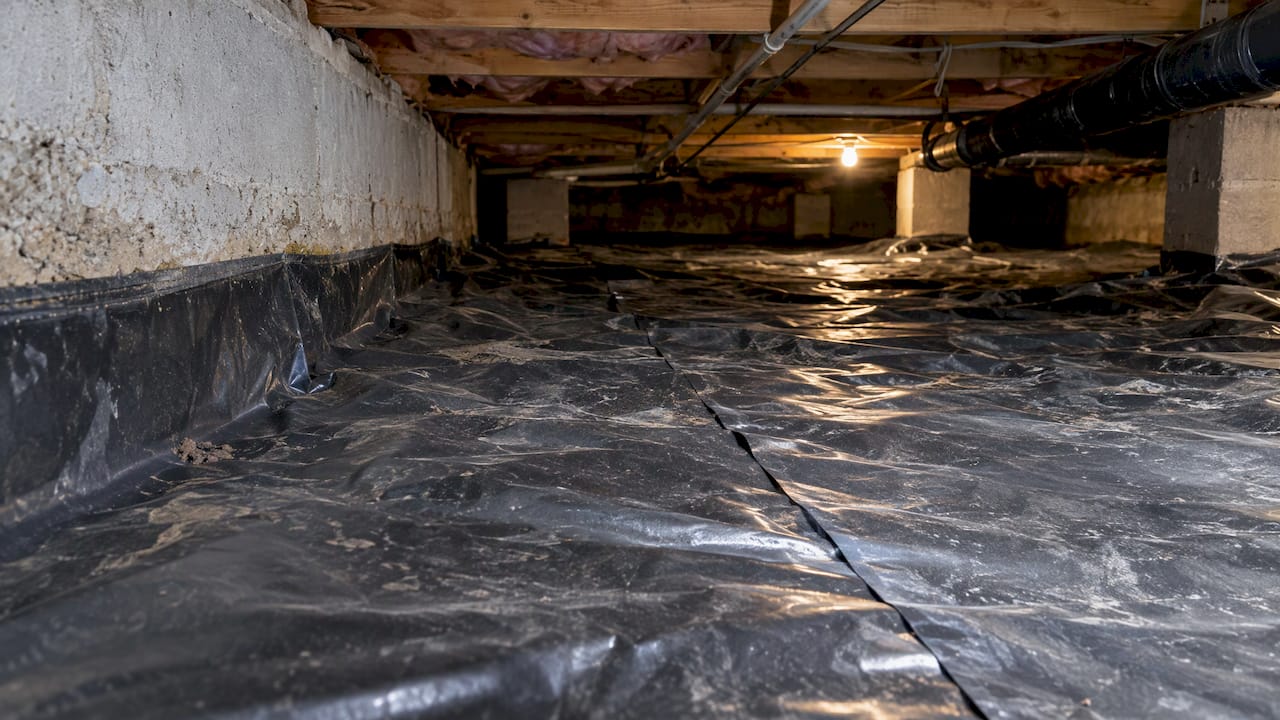
Depending on the source, state guidance suggests plastic sheeting over the crawl space floor, surface drainage directed away from the house and, where groundwater is the source, a drain and sump pump. The right fix depends on where the water is coming from, which is why the inspection comes first.
7. Repair and rebuild
If wood, subfloor or insulation had to come out, the space needs to be put back. We handle the work from mitigation through reconstruction, so the repair doesn’t have to be handed to a different company.
Why a hose-and-bleach approach falls short
The search results for this topic are full of do-it-yourself plans: peroxide on the joists, a spray bottle of soapy water, retail mold cleaners. These treat what you can see from the hatch. The problems in a crawl space are usually what you can’t see: moisture in the soil, a slow leak, damp insulation, growth on the underside of the subfloor. The EPA’s guidance about moisture and porous materials is the reason surface treatments so often fail. If the water source remains, the mold returns.
A professional job also protects the rest of your home. Disturbing mold without containment sends spores upward, and in a home with children, older adults or anyone with respiratory issues, that is a risk worth avoiding.
What crawl space mold removal costs
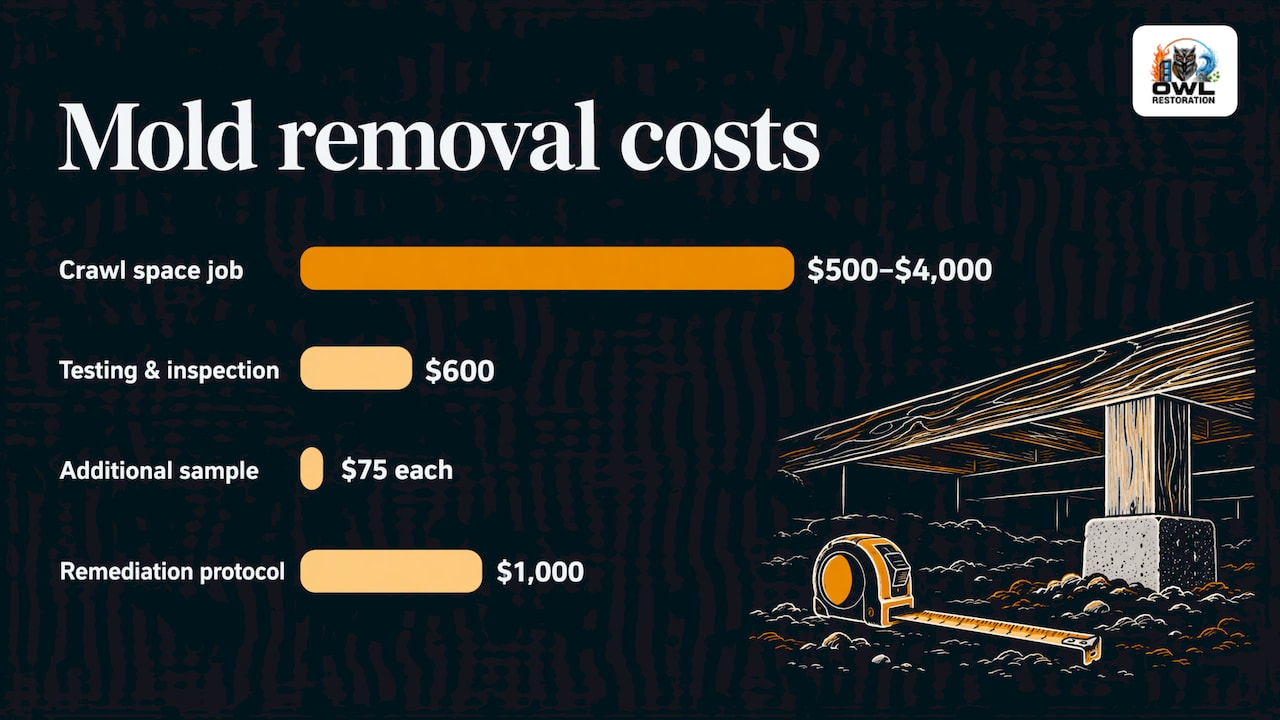
Prices vary by size, access, the amount of material that has to come out and what caused the moisture. One 2026 cost guide puts crawl space jobs at roughly $500 to $4,000, with a vapor barrier adding more if one is needed. Treat that as a general national range, not a quote for your home.
The factors that move the estimate most:
| Factor | Why it changes the price |
|---|---|
| Area affected | More square footage means more labor, materials and drying time |
| Access | Tight clearance slows every task |
| Materials removed | Insulation, vapor barriers and damaged wood add removal and replacement cost |
| Moisture source | A plumbing repair, drainage correction or sump pump is a separate scope |
| Testing | Samples before and after confirm what is there and that the work succeeded |
| Rebuild | Replacing subfloor or framing is reconstruction, not just remediation |
Our published pricing is for the front end of the job: residential testing and inspection at $600, additional samples at $75 each, and a residential Mold Remediation Protocol at $1,000. Commercial remediation, water damage restoration and reconstruction are quoted after we see the property.
Crawl space flooding and water damage
If the crawl space has taken on water from a burst pipe, a storm or a failed drain, speed matters more than anything else. The EPA says that wet or damp materials dried within 24 to 48 hours after a leak or spill will, in most cases, avoid mold growth. FEMA gives the same window for flood-damaged homes and advises that items that can’t be cleaned and dried in that time should be removed, bagged and sealed.
In the first hours:
- Stay out of standing water until the power to that area is confirmed off. FEMA advises protective equipment and checking for structural hazards before going into flooded areas.
- Photograph everything for your claim. FEMA recommends photographing flood damage for insurance.
- Call a restoration crew. A wet vacuum alone is not enough: the EPA notes that wet vacuums handle materials that are still wet and don’t by themselves dry them.
We respond to water emergencies within 24 to 48 hours. For the full first-day sequence, see our guide to emergency flood cleanup. Flood-soaked drywall and fiberglass or cellulose insulation generally need to be removed and discarded, which is why a flooded crawl space often turns into a repair job as well as a cleanup.
Does insurance cover crawl space mold?
The answer turns on what caused the moisture, and your policy language decides. Read your own policy, and talk with your insurer, before assuming anything.
For flood coverage, the rules are strict. The National Flood Insurance Program says moisture, mildew or mold damage that the owner could have avoided is not covered. FEMA’s published appeal example from a 2017 flood shows that the program requires evidence of direct physical flood loss and excludes some mold and moisture losses tied to conditions within the owner’s control. That decision depended on that claim’s facts.
The practical lesson: document the damage early, dry it quickly and keep records. Delay can turn a sudden event into what an insurer calls a long-term moisture problem. We coordinate directly with insurance companies on claims, which takes paperwork and phone calls off your plate while the drying work goes on.
Who this matters for
Homeowners usually discover the problem from a smell or a plumber’s visit. Start with testing so you know the extent.
Business owners and property managers have added considerations: tenants, occupancy, and records for insurers. Our commercial testing and inspection is $975, and commercial remediation is scoped to the building.
Insurance claimants should photograph damage, keep receipts and bring the restoration company in early, so the cause and timeline are documented.
How to choose a crawl space mold contractor
The EPA recommends choosing a mold cleanup contractor with relevant experience and checking references, and it points to guidance from EPA, ACGIH and IICRC. Look for:
- A Texas license for mold assessment or remediation, which you can check on the TDLR site
- A written scope that covers both removal and the moisture source
- A plan for containment and drying
- Testing that confirms the result
- Experience with insurance claims
We meet that list in one team: testing, remediation, water mitigation and reconstruction, with certified professionals and local Dallas-Fort Worth experience.
Perspective
Most crawl space mold calls we hear about start the same way: someone cleaned what they could see, and the smell came back a few months later. The mold was never the whole problem. The water was.
That is why we begin with testing. Knowing how much mold there is and where it sits lets us build one plan that covers removal, drying and whatever repair the structure needs, instead of three contractors working from three different guesses.
We also think speed matters more than most homeowners expect. Damp materials left past the first couple of days are where small problems become large ones, and our crews respond to water and mold calls within 24 to 48 hours across the DFW area. When insurance is involved, we work with the carrier directly so you can focus on your home.
If you have mold in a crawl space, don’t crawl in and improvise. Have it tested, fix the source and have it removed properly.
Dustin
Get the crawl space tested and cleared
If you suspect mold under your home, start with our mold testing and inspection. Residential testing is $600, and if the results call for it, our residential Mold Remediation Protocol is $1,000. For the removal itself, see our mold remediation service, available across Tarrant, Ellis, Johnson and Dallas counties.

If the cause is an active leak or flooding, we handle the water damage and the rebuild as well.
FAQ
What kills mold in a crawl space?
Removing the moisture is what stops it. The EPA does not recommend routine biocide use, including bleach, because killing mold alone does not remove it and dead mold can still be allergenic. Professional remediation removes the mold and materials it has penetrated, then dries the space.
How much does it cost to remove mold from a crawl space?
National cost guides put crawl space jobs at roughly $500 to $4,000, depending on size, access and repairs. Our residential testing and inspection is $600 and our residential Mold Remediation Protocol is $1,000. Water repairs and reconstruction are quoted separately.
Will homeowners insurance cover mold in a crawl space?
It depends on your policy and what caused the moisture. Flood policies are strict: the NFIP says avoidable mold and moisture damage is not covered. Document damage right away and review your policy with your insurer. We work with insurance companies directly on claims.
How serious is mold in a crawl space?
It can be serious, because the space sits under your living area and air can move up into the home. The EPA suggests professional help for areas larger than about 10 square feet or more complicated jobs. Testing shows how far the mold has spread.
How fast does mold grow after a leak?
Quickly. The EPA says materials dried within 24 to 48 hours after a leak or spill will in most cases avoid mold growth. That is why a fast call matters.
Sources
- EPA: A Brief Guide to Mold, Moisture and Your Home
- EPA: Mold Course Chapter 2
- EPA: Mold Course Chapter 4
- EPA: Mold Remediation in Schools and Commercial Buildings, Chapter 3
- EPA: Mold Cleanup in Your Home
- Idaho: Mold and Moisture Problems in Crawlspaces
- California Department of Public Health: Frequently Asked Questions about Mold
- Building America: Look at Crawlspace for Moisture Issues
- Massachusetts: Mold Cleanup, Repairs, and Excess Moisture Control
- FEMA: The ABC’s of Returning to Flooded Buildings
- FEMA: Prevent Mold from Becoming a Secondary Disaster
- U.S. Department of Energy: Repairing Walls & Floors
- FloodSmart: Mold, Mildew and Moisture Appeal Decision
- FloodSmart: What Is Covered by a Flood Insurance Policy
- Texas Department of Licensing and Regulation: Mold Assessors and Remediators FAQs
- Mold Remediation Cost Guide 2026