
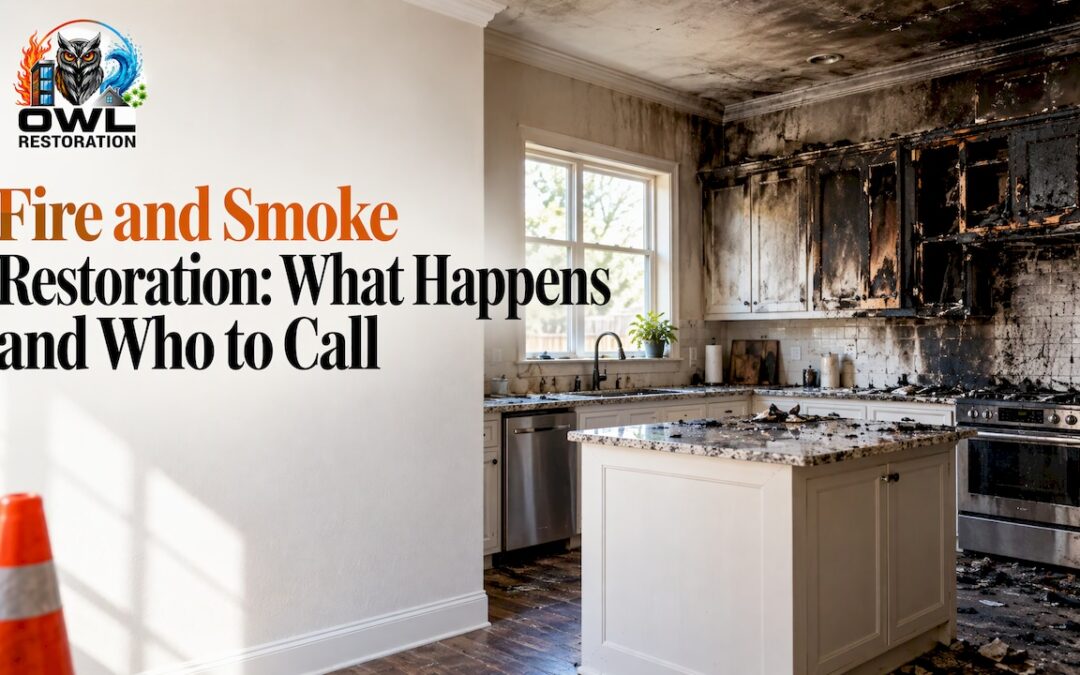
Fire and smoke restoration is a sequence, not a single cleanup: secure the property, document the loss, remove soot and water, clean or replace every affected surface, deodorize, then rebuild. Smoke keeps damaging a building after the flames are out, so the sooner a trained crew starts, the more of your structure and belongings can be saved. In Dallas-Fort Worth, we handle that whole sequence, from mitigation to rebuild, and we coordinate directly with your insurance company.
TL;DR
- Stay out until the fire department says the building is safe, then call your insurer and secure the property.
- Photograph everything and keep damaged items until the adjuster has seen them.
- Do not run the HVAC system or wipe soot with a wet cloth. Both can spread the damage.
- A national standard, ANSI/IICRC S700, now defines how fire and smoke restoration is assessed, cleaned and checked.
- One contractor for mitigation, pack-out and reconstruction means fewer handoffs and one point of contact for your claim.
Table of Contents
- What to do in the first hours after a fire
- What fire and smoke damage actually does to a building
- How restoration is done, step by step
- Light, moderate or heavy: what changes
- Documenting the loss for your insurance claim
- What to look for in a fire and smoke restoration company
- Fire, water and mold often arrive together
- Our perspective
- Start your restoration
- FAQ
- Sources
What to do in the first hours after a fire
The first rule comes from the fire service, not from a contractor: do not enter until the fire department says it is safe. The same federal guide tells you to contact your insurance company right away, ask what to do first, and secure the property, boarding up windows and doors if needed.
Once you are cleared to go in, work in this order:
- Call your insurer. Report the loss and ask what they need from you. Ask whether they want you to use a particular process for emergency services.
- Prevent further damage. The Texas Department of Insurance advises you to make only the repairs needed to protect the property, such as covering broken windows and holes, and to keep receipts. Permanent repairs wait until your insurer says go.
- Photograph and list. Video each room before anything is moved. Write down damaged belongings as you go.
- Keep damaged items. The same Texas guidance says not to throw away damaged property until an adjuster has had a chance to see it.
- Call a restoration company. Open walls, soaked insulation and soot on porous materials get worse by the day.
If windows, doors or the roof were opened by the fire or by firefighters, a proper board-up after a fire protects the building from weather and theft, and it is the kind of emergency expense insurers expect you to take care of.
What fire and smoke damage actually does to a building
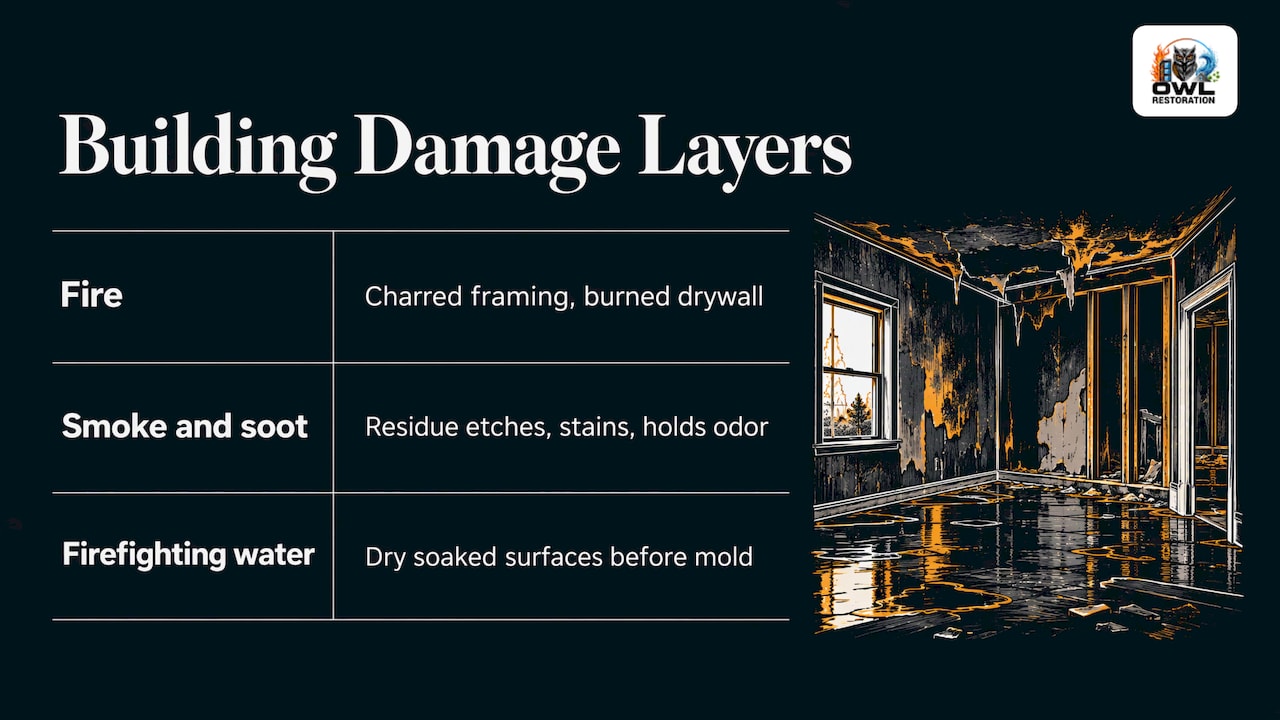
Fire damage is the visible part: charred framing, burned drywall, melted fixtures. Smoke and soot damage is wider and quieter. Smoke travels through the whole structure, into closets, attics, wall cavities and ductwork, and leaves residue on surfaces far from the fire. That residue is acidic and sticky enough to etch, stain and hold odor.
A third layer is water. Firefighting leaves walls, ceilings and floors soaked, and that moisture needs to be dried before it becomes a mold problem. Water that has picked up contamination, such as a sewage backup, is a different category of cleanup; sewage backup cleanup explains why. For fire-related water, our water damage restoration team dries the structure as part of the same job.
How restoration is done, step by step
Since January 2, 2025, the work has had a formal benchmark. The ANSI/IICRC S700 Standard for Fire and Smoke Damage Restoration was published as a new American National Standard. It covers assessment, restoration cleaning, odor management, HVAC systems, contractor qualifications and post-restoration evaluation. The IICRC is the certification body for the cleaning and restoration trades. Here is what that looks like on a real job.
1. Assessment and scoping
A technician maps where smoke and soot went, not only where the fire burned. The S700 notes that without a pre-loss baseline, you cannot know exactly which contaminants the fire created, so restorers use targeted sampling together with an odor inspection to set the boundaries of fire-related damage. This scope becomes the backbone of your insurance estimate.
Where it goes wrong: a quick walk-through that only counts burned rooms. Missed smoke migration into the attic or an unaffected bedroom shows up later as odor that will not leave.
2. Stabilizing the property
Board-up, tarping, removal of standing water and removal of material that cannot be saved. Our emergency response runs 24/7, and we address water, fire and mold issues within 24 to 48 hours.
3. Contents pack-out
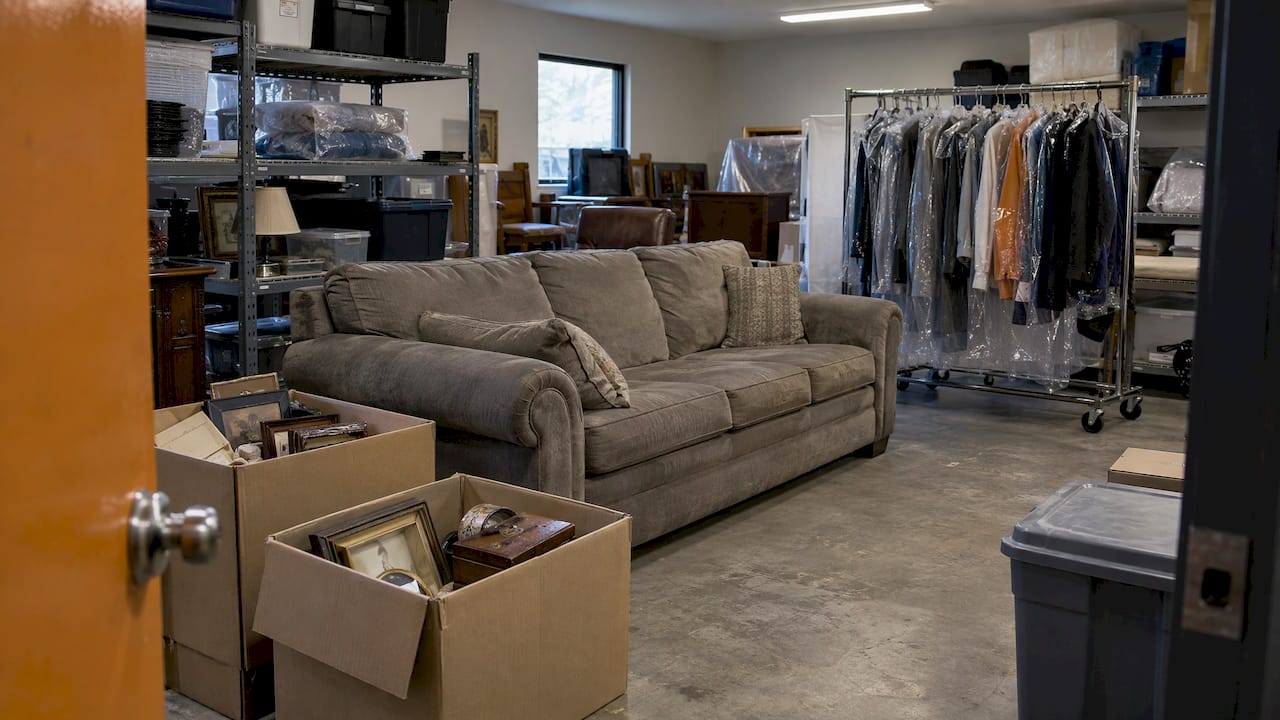
Furniture, clothing, electronics and keepsakes are cleaned more safely away from the work zone. Our contents pack-out service moves items out so crews can clean and rebuild without working around them.
4. Soot removal, top to bottom
Professional guidance is to start with dry removal using HEPA vacuums, then wipe with a mild detergent, working from the top down: attic, ceiling, then floor, per the Smoke Restoration Guide from United Policyholders. Two mistakes cause most of the lasting damage:
- Wet-wiping soot. Water on dry soot smears it into the surface. The right method depends on the residue: dry, oily and protein residues each respond differently, which is why cleaning starts with testing a small area.
- Running the HVAC early. FEMA is explicit that the air handler should stay off until the bulk of soot and ash has been removed, because running it spreads particulate and re-contaminates cleaned surfaces. The same guide recommends professional cleaning of all ducts and the furnace.
5. Odor removal
Odor leaves when its source leaves. That means removing char and residue first, and only then using air treatments. For light smoke, FEMA’s four basic steps are to ventilate, filter the air with a MERV 11 or higher filter, absorb odors with activated charcoal and clean absorbent materials. For moderate damage, the guide adds initial and detailed cleaning, discarding what cannot be saved and cleaning the HVAC system. When smell persists in drywall, insulation or subfloor, replacement is usually the answer. Our guide to smoke odor removal covers what works and when to bring in a pro.
6. Post-restoration check
The S700 sets the test for a finished job: surfaces and materials free of visible fire residue and no detectable fire-related odor, verified through visual and odor inspection with your participation. Walk the home with the project lead and point out anything that still smells or looks wrong before the rebuild closes up walls.
7. Reconstruction
Drywall, paint, flooring, cabinetry and framing. Because our reconstruction and build-back is part of the same company, the crew that scoped the smoke damage is the one rebuilding, so nothing gets lost between the cleanup contractor and the builder.
Light, moderate or heavy: what changes
| Loss level | What it looks like | Typical approach |
|---|---|---|
| Light smoke | Faint odor, thin residue, no structural burning | Ventilate, filter air, absorb odor, clean absorbent materials |
| Moderate | Visible soot on many surfaces, odor throughout | Detailed cleaning, discard unsalvageable items, clean HVAC |
| Heavy / structural | Charred materials, soaked structure, odor in walls | Pack-out, demolition of affected materials, drying, deep cleaning, rebuild |
The first two rows follow FEMA’s tiers for residential smoke damage. The heavy row is where a full-service crew matters most, because mitigation, cleaning and rebuilding all happen on one schedule.
Documenting the loss for your insurance claim
The claim and the restoration run in parallel, and good paperwork speeds both.
- Before cleanup: video every room, then photograph close-ups of damaged items, appliances and serial numbers.
- Inventory: list each item, its age and what you paid if you remember. Texas guidance is to make a list of damaged property and photograph or video it.
- At the adjuster visit: walk around with the adjuster so nothing is missed. The same guide suggests you may want your contractor present.
- Receipts: keep every receipt for emergency repairs, board-up and temporary housing.
We work directly with insurance companies on the claim, which takes the back-and-forth of estimates and scope questions off your plate. For business owners and property managers, our commercial restoration team does the same for commercial properties, where downtime is the real cost.
Smoke-testing rules are changing in some states. California bills awaiting the governor’s decision in 2026, reported by Insurance Business, would require insurers to inspect smoke-damage claims within 30 days of notice. That is a California proposal for wildfire smoke, not a Texas rule. Your policy and your insurer’s instructions are what govern a Texas claim.
What to look for in a fire and smoke restoration company
A good contractor does these things, and you can hold anyone to them:
- Responds around the clock and starts mitigation fast.
- Uses certified technicians who follow the S700 for assessment, cleaning and final evaluation.
- Handles water, smoke, contents and reconstruction under one roof.
- Works directly with your insurer on scope and estimates.
- Knows your area, its building stock and its local officials.
Those are the points we built our company around: 24/7 rapid response, certified professionals, direct insurance coordination and local DFW expertise, across Tarrant, Ellis, Johnson and Dallas counties. We also serve nearby communities such as Mansfield and Midlothian.
Fire, water and mold often arrive together
Water used to put out a fire can leave wall cavities and subfloors damp for days. If drying is not thorough, mold follows. After fire damage, we offer residential mold testing and inspection at $600 and commercial testing at $975, with additional samples at $75 (residential) and $95 (commercial) each. A residential mold remediation protocol is $1,000. Mold remediation work itself has no published price, so it is quoted per job. Details are on our mold testing page.
Our perspective
Most people think a fire job is about the burned room. In our experience the burned room is the easy part. The hard part is everything the smoke touched, and the schedule that ties cleanup, your insurer and the rebuild together.
That is why we do not split the job up. Mitigation, pack-out, cleaning, mold testing when moisture is a concern, and reconstruction sit with one team. You deal with one company, and we deal with your insurance company directly.
If you take one thing from this page: do not wait. Smoke residue keeps working on surfaces and the sooner trained technicians scope the loss, the more your home or building keeps its original materials.
Dustin
Start your restoration
If you have had a fire in a home, rental property or business in the Dallas-Fort Worth area, our fire damage restoration team can start with mitigation and carry the job through to reconstruction, working with your insurer along the way.
For immediate help, start at Owl Restoration. We respond 24/7.
FAQ
How long does fire and smoke restoration take?
It depends on the size of the loss, how much water was used and how much needs rebuilding. A light smoke cleanup can be quick, while a structural fire involves mitigation, drying, cleaning and reconstruction in stages. Your project lead can give a schedule once the scope is set.
Can I clean smoke damage myself?
Surface dusting with a HEPA vacuum is where professional cleaning starts, but soot type, porous materials and ductwork decide the rest. Wet-wiping or running the HVAC early can spread the damage. Having a restoration team scope the loss first protects your claim and your finishes.
Will the smoke smell go away on its own?
Odor stays as long as residue stays in surfaces, insulation and ducts. It leaves when the source is cleaned or removed, and air treatments come after that. The S700 final check includes confirming that no fire-related odor is detectable.
Does my insurance cover fire and smoke restoration?
Most homeowners and commercial property policies cover fire loss, but terms vary by policy. Call your insurer right away and ask what they need. We work directly with insurance companies to move the claim along.
Sources
- After the Fire, U.S. Fire Administration
- FEMA Homeowner’s Guide to Risk Reduction and Remediation of Residential Smoke Damage
- IICRC S700 press release, January 2025
- ANSI/IICRC S700 Standard presentation, IAQ Radio
- Smoke Restoration Guide, United Policyholders
- How do I file a homeowners insurance claim? Texas Department of Insurance
- California sets first wildfire smoke testing rules for insurers, Insurance Business
- Sewage Backup Cleanup