

Most professional crime scene cleanups cost between about $1,000 and $5,000, according to HowStuffWorks. Large or long-neglected scenes can run into the tens of thousands. The final number depends on how much material was contaminated, how long the scene sat, and how much of the structure has to come out. In Texas, insurance and the state’s victim compensation program may cover part of it, and we deal with the insurer directly so you do not carry that paperwork while you are grieving or in shock.
This guide is for homeowners, business owners, property managers and insurance claimants in the Dallas-Fort Worth area who need a realistic number and a clear path. It explains what the price is made of, how to read a quote, and where the money can come from.
TL;DR
- Typical crime scene cleanup runs about $1,000 to $5,000, a single-room scene with heavy blood can reach about $3,000, and mass-trauma or structural cases can reach the tens of thousands (HowStuffWorks).
- The price is driven by contaminated area, time since the event, materials that must be removed and regulated waste disposal, not by hours on site alone.
- Homeowners policies often cover cleanup after a covered crime, but pollution exclusions, deductibles and caps can reduce the payout.
- Texas can reimburse a licensed provider up to $2,250 for crime-caused biohazard removal, if insurance does not apply or is exhausted.
- Call early: a faster response limits how far contamination spreads. Our team responds 24/7 across Dallas-Fort Worth.
Table of Contents
- What crime scene cleanup actually costs
- What drives the price up or down
- How to read a quote
- Does insurance pay for crime scene cleanup?
- Help paying in Texas: Crime Victims’ Compensation
- Worked example: how the pieces add up
- What to do in the first hours
- Our perspective
- Get help from one team
- FAQ
- Sources
What crime scene cleanup actually costs
No national price list exists, because no two scenes are alike. What published figures agree on is the shape of the range:
| Scene type | Typical cost range | Source |
|---|---|---|
| Most crime scenes, cleaned and decontaminated | $1,000 to $5,000 | HowStuffWorks |
| Single-room homicide with heavy blood | Up to about $3,000 | HowStuffWorks |
| Mass-trauma or structural-damage scenes | Tens of thousands | HowStuffWorks |
Treat these as orientation, not as a quote. Published guides rarely say how many jobs sit behind their averages, and a scene that is cleaned the same day can cost a fraction of one found weeks later. If you see a single flat number promised over the phone for a scene nobody has seen, be careful with it.
Biohazard cleanup versus crime scene cleanup
The two terms overlap heavily. Biohazard cleanup is the broader category: anything contaminated with blood, bodily fluids or other potentially infectious material. That includes trauma and injury scenes, unattended deaths and sewage-contaminated spaces. Crime scene cleanup is biohazard cleanup performed after a violent crime or a death investigation. The work is the same: remove contaminated material, disinfect, dispose of waste legally and deodorize. So the biohazard cleanup cost you see online and the crime scene figure above describe largely the same kind of job. Our biohazard cleanup service covers this work for homes and commercial properties in Dallas-Fort Worth.
What drives the price up or down
A quote is built from a handful of factors. Knowing them lets you compare quotes sensibly.
Size of the contaminated area. A small stain on a hard floor is a surface job. Blood or fluid that has soaked through carpet, padding and subfloor means cutting out and replacing materials, which takes more labor and creates more waste.
Time since the event. This is the factor families expect least. The longer a scene sits, the more material it affects and the longer odor treatment takes. Unattended deaths found days later cost more than scenes addressed quickly. Early action is the cheapest thing you control.
Porous versus non-porous surfaces. Tile and sealed concrete can be disinfected. Mattresses, upholstery, carpet and drywall absorb fluids and usually have to be removed and discarded.
Protective equipment and crew size. Technicians work in full protective gear that is discarded after the job, and larger scenes need more than one person.
Regulated waste disposal. Contaminated material cannot go in a household dumpster. It has to be packaged and disposed of through licensed channels, and that cost is part of every job.
Odor and air treatment. Decomposition odor can soak into building materials. Air scrubbing and deodorizing take equipment and time.
Rebuild work. Cleanup removes the hazard. If flooring, drywall or cabinetry had to come out, someone must put the property back together. When the same company handles both, you avoid coordinating two contractors. We carry a job from mitigation through reconstruction and build-back.
How to read a quote
Hourly numbers on a quote can mislead. A crew rate usually covers several technicians, disposable protective gear, disinfectants, waste handling and insurance, not one person’s wages. So a high hourly figure does not necessarily mean a high-profit company, and a low one can exclude things you will pay for later.
When you compare estimates, check these points:
- Is the price per scene, per hour or per square foot? If it is hourly, ask whether the rate is per person or per crew.
- Does it include waste disposal and deodorizing? These should be listed, not added at the end.
- What is removed and what is replaced? Cleanup of contaminated material is different from rebuilding.
- Who will talk to your insurer? Adjusters need documentation of the scope of work, and a company that prepares it saves you days.
- Does the company hold the credentials your situation requires? For a crime scene reimbursement in Texas, the work must be done by a licensed provider (see below).
We do not publish a price for biohazard cleanup, because the scope has to be seen before it can be priced honestly. Call us and describe the situation, and we will tell you what the next step is.
Does insurance pay for crime scene cleanup?
Often, yes, at least in part. Standard homeowners policies generally cover biohazard cleanup when it results from a covered event, and crimes committed by outsiders, such as break-ins, vandalism or violent crime, are among the clearest examples, according to LegalClarity’s guide to biohazard coverage. The same source lists the common limits:
- Intentional acts by the policyholder or household members are excluded.
- Suicide is a gray area that depends on the policy and the insurer.
- Hoarding-related cleanup is typically excluded as neglect.
- Deductibles commonly run $500 to $2,500, and caps on biohazard payouts can be a share of dwelling coverage.
Another obstacle is the pollution exclusion in standard homeowners forms. LegalClarity explains that some insurers argue blood and bodily fluids count as contaminants under that clause, which is a common reason valid claims are denied or reduced. Reading your policy’s exclusions, deductible and claim limits before you call the adjuster helps you ask the right questions. A guide to insurance coverage, exclusions and claim limits shows how those policy terms typically fit together.
For business owners and property managers, a commercial property policy may respond differently. Ask your agent which policy applies, and ask whether the loss falls under a business interruption clause if you have to close while the work is done.
We coordinate directly with insurance companies, which means we handle the back-and-forth over documentation while you focus on everything else. Tell the adjuster early, photograph nothing that is not necessary, and keep copies of every invoice.
Help paying in Texas: Crime Victims’ Compensation
If the scene resulted from a crime and you cannot cover the cost, Texas has a program for it. The Texas Attorney General’s Crime Victims’ Compensation Program reimburses licensed providers up to $2,250 for crime-caused biohazard removal and hazardous waste disposal, for crimes that occurred after July 14, 2016. Things to know:
- It covers biohazard removal and waste disposal. It does not cover structural repairs or replacing damaged property.
- You must show that homeowners or renters insurance does not apply or has been exhausted.
- The reimbursement goes to a licensed provider, so confirm the company is eligible before work starts.
Because the program picks up where insurance stops, the order matters: report the claim to your insurer first, then ask about compensation. Check the Attorney General’s page for the current application steps, since forms and rules can change.
Worked example: how the pieces add up
The numbers here are illustrative, not a quote, and they use the ranges above.
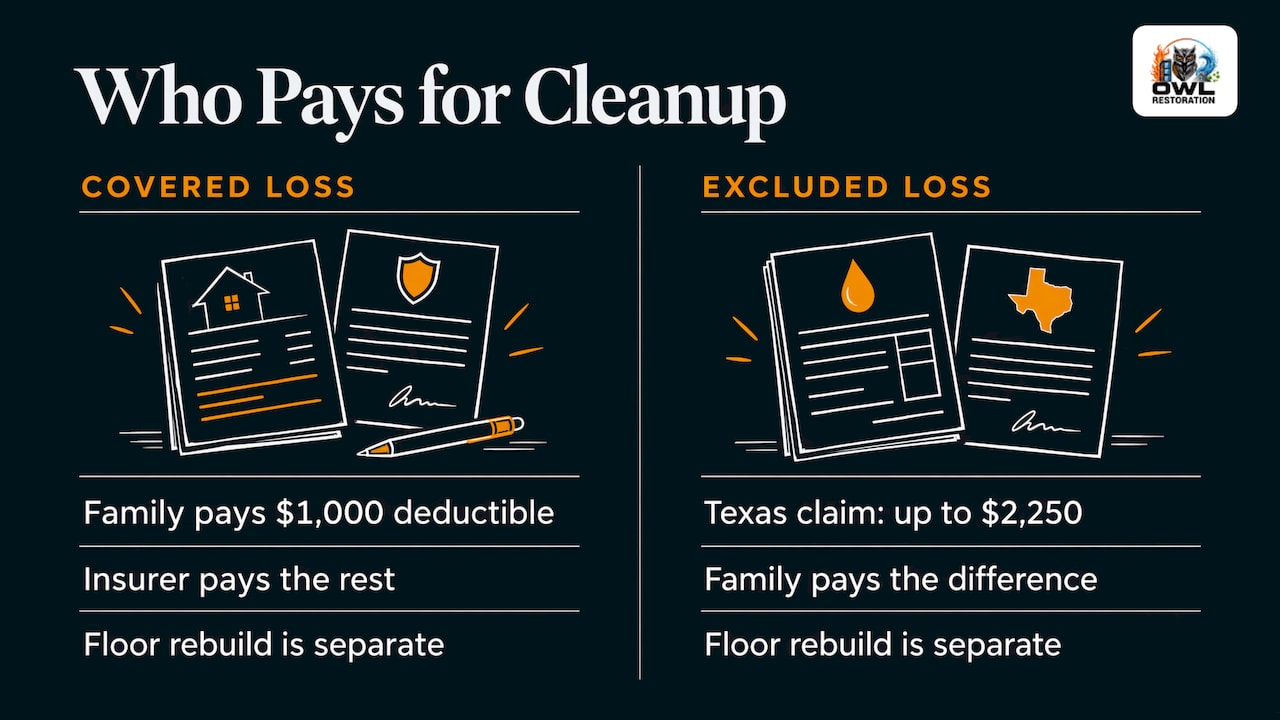
A family finds that an injury in a bedroom soaked the carpet and padding. The scene is dealt with within a day. The job is a single-room scene: contaminated carpet and padding come out, the subfloor is disinfected, waste is disposed of, and the room is deodorized. That sits in the lower part of the published ranges. If the homeowners policy has a $1,000 deductible and covers the loss, the family pays the deductible, and the insurer pays the rest. If the policy excludes the loss, a Texas compensation claim may reimburse the provider up to $2,250 of eligible cleanup, and the family pays the difference. Rebuilding the floor is a separate line either way.
Now take a scene discovered after several days. More material is affected, air treatment takes longer, and flooring and drywall may have to be replaced. The same room can land in a much higher bracket. Time is the biggest swing factor.
What to do in the first hours
- Call emergency services first if anyone is hurt or the scene is part of an active investigation. Do not enter until police release the scene.
- Do not clean it yourself. Blood and body fluids can carry pathogens, and household cleaners do not remove what soaked into porous materials.
- Keep children, pets and others out of the affected rooms.
- Call your insurer to open a claim, and ask what documentation they need.
- Call a professional biohazard team. The faster the response, the less the contamination spreads. We respond 24/7 across Dallas-Fort Worth, and if blood is the main issue, our page on blood cleanup services explains what to expect.
Our perspective
The question we hear first is “how much?” The question behind it is usually “how do I get through this?” Both deserve a straight answer.
Cost in this work comes from what has to be removed and how long it has been there, which is why we ask for the details of the scene before we talk numbers. We would rather tell you a range we can stand behind than give you a low figure that grows.
Most people we speak with have never dealt with an insurance claim of this kind. Our team coordinates directly with insurance companies, so the documentation an adjuster needs is handled as part of the job. When a scene also involves fire, smoke, water or mold, we handle those as well, from mitigation through full reconstruction, so you have one team instead of several.
Call early. Time is the one cost factor you can still change.
Dustin
Get help from one team
If you are dealing with a scene in Tarrant, Dallas, Ellis or Johnson County, our team handles biohazard cleanup for homes and commercial properties, with 24/7 rapid response, certified professionals and direct coordination with your insurer. If the damage extends to walls, floors or contents, we can also handle contents pack-out and the rebuild.

Call us or request help through our main site, and tell us what happened. We will explain the next steps and what your insurer will likely need.
FAQ
How much does crime scene cleanup cost?
Most scenes cost about $1,000 to $5,000 to clean and decontaminate, with a single-room scene involving heavy blood reaching up to about $3,000 (HowStuffWorks). Mass-trauma or structural-damage scenes can cost tens of thousands. The scope of contamination and the time since the event decide where a job lands.
Is biohazard cleanup the same as crime scene cleanup?
The work is largely the same: removing contaminated material, disinfecting, disposing of regulated waste and deodorizing. Biohazard cleanup is the wider term and includes unattended deaths, injuries and sewage-contaminated spaces as well as crime scenes. The pricing factors are the same for both.
Who pays for crime scene cleanup?
Often your homeowners or commercial property insurer, if the event is a covered loss, subject to your deductible and policy limits (LegalClarity). If insurance does not apply, the Texas Crime Victims’ Compensation Program may reimburse a licensed provider up to $2,250 for biohazard removal and waste disposal after a crime.
Can I clean up a crime scene myself?
We do not recommend it. Blood and body fluids can carry pathogens, and contaminated materials need legal disposal. A professional team has the protective equipment and process for it, and handing the job over also gives your insurer the documentation it asks for.
How quickly should I call?
As soon as police have released the scene. Contamination spreads into porous materials and odor deepens over time, which raises cost. We offer 24/7 rapid response across Dallas-Fort Worth.
Sources
- HowStuffWorks: How Crime-scene Clean-up Works
- LegalClarity: Does Homeowners Insurance Cover Biohazard Cleanup?
- LegalClarity: Does Homeowners Insurance Cover Crime Scene Cleanup?
- Texas Attorney General: Crime Scene Clean-Up Reimbursement