

If water is coming through your apartment ceiling, walls or floor, stop the source if you can, get everyone and everything valuable out of the wet area, photograph it, and report it to management in writing the same day. Then get the structure dried fast, because mold can start on wet drywall, carpet and wood within about a day. In Dallas-Fort Worth, Owl Restoration responds around the clock to water losses, handles mitigation through rebuild, and works directly with insurance companies, so a burst pipe at 2 a.m. does not turn into a week of phone tag.
TL;DR
- Shut off the water at the unit’s valve if it is safe, cut power to wet areas, and photograph everything before you move or clean anything.
- Report the leak to your landlord or property manager in writing. In Texas, a seven-day repair window is presumed reasonable once proper notice is given.
- Landlord insurance usually covers the building. Your renter’s policy usually covers your belongings and living costs, depending on the cause, policy and deductible.
- Wet materials left for more than 24 hours can grow mold, so drying speed decides how big the repair gets.
- Our team handles emergency drying, contents pack-out, mold testing and rebuild, and coordinates with your insurer directly.
Table of Contents
- The first hour: stop the water, protect yourself, document
- Why the first 24 to 48 hours decide everything
- Who is responsible for water damage in a rental?
- Your rights as a Texas tenant
- Do you hire the restoration company or does the landlord?
- Water damage to mold: what happens if drying is late
- A practical timeline for a water loss in an apartment
- Mistakes that make apartment water damage worse
- What we offer for water damage in Dallas-Fort Worth
- Our perspective
- FAQ
- Sources
The first hour: stop the water, protect yourself, document
Water damage in an apartment is different from a house in one way that matters: you share walls, ceilings and pipes with neighbors, and you do not control the building’s systems. Your first hour is about limiting harm and building a record.
- Stop the source if it is yours. Close the shutoff valve under the sink or toilet, or the main valve for your unit. If water is falling from above, you cannot fix that, but you can stop it spreading across your floor.
- Think about electricity. Water and power do not mix. If water is near outlets, light fixtures or a ceiling that is sagging, stay out and turn off power to that area at the breaker if you can reach it safely. FEMA’s flood program says to make sure electricity and gas are off and to have an electrician check the system before turning power back on.
- Photograph and video everything before cleanup. The National Flood Insurance Program advises documenting damage before you clean, photographing appliance serial numbers and keeping carpet samples. Do this room by room, wide shots first, then close-ups of stains, wet walls and damaged belongings.
- Lift what you can. Move electronics, papers, shoes and small furniture onto dry surfaces. Pull rugs and cushions out of standing water.
- Call management. Use the emergency maintenance line first, then follow up in writing (more on that below).
- Call a restoration company. Do this the same day. The sooner extraction and drying begin, the less of your unit has to be torn out.
If the water might be sewage, from a backed-up toilet or drain, or contaminated by chemicals, do not wade in and do not run fans. The EPA says contaminated water calls for protective equipment and containment, and fans should not be used until the water is confirmed clean. That is a job for trained crews, and it is where our biohazard cleanup service applies.
Why the first 24 to 48 hours decide everything
The EPA says mold can grow on wood, drywall, carpet and furniture when they stay wet for more than 24 hours. Its commercial-building guidance recommends responding to water damage within 24 to 48 hours to help avoid a mold problem, and notes that carpet and backing should be dried in that window using water extraction, lower humidity and fans.
In an apartment, that clock is harder to beat than in a house. Water from a unit above often runs inside the ceiling cavity and down wall interiors, so the surface may look only slightly stained while insulation and drywall behind it stay soaked. The EPA is clear that flooded wall cavities should not be sealed up, and wet materials should not be painted or sealed until they are completely dry inside. A fresh coat of paint over a damp wall hides the problem and holds the moisture in.
Drying itself can take days, and the EPA says full drying after a flood can run from several days to weeks. That is why professional equipment matters: extraction pumps, air movers and dehumidifiers running on a plan, not a box fan and a hope. Our water damage restoration team starts with extraction and structural drying, which is how we keep a problem in the “dry and done” category and out of the “tear out the drywall” category. You can see how that works on our water damage restoration page.
What is usually salvageable, and what is not
The EPA’s guidance draws a practical line. Carpet and backing can often be saved if they are extracted and dried inside that 24 to 48 hour window. Swollen or separated wallboard should be removed and replaced. Porous items that cannot be cleaned and fully dried may have to be thrown out, while hard surfaces can be scrubbed with detergent and water and dried completely, per the EPA’s mold guide for homes.
Before you throw anything away, photograph it. The FEMA flood checklist says to document first, then dispose of perishables and items that could grow mold when they cannot be salvaged safely. Your insurer will want the record.
Who is responsible for water damage in a rental?
The short answer: responsibility follows the cause. A burst supply line in the wall, a failed building water heater, a roof leak or a leak from the unit above is typically a building problem. A overflowing tub, a dishwasher you installed or a washing machine hose you left running is more likely to land on the tenant.
Insurance generally tracks that split. A landlord’s or condo association’s policy typically handles building repairs, while a renter’s policy may cover your belongings and loss of use. How much is paid depends on the water source, the policy, the deductible and whether anyone was negligent, according to an AAA explainer on upstairs flooding. If a neighbor caused the leak, their liability coverage may come into play, but that is usually sorted out between insurers.
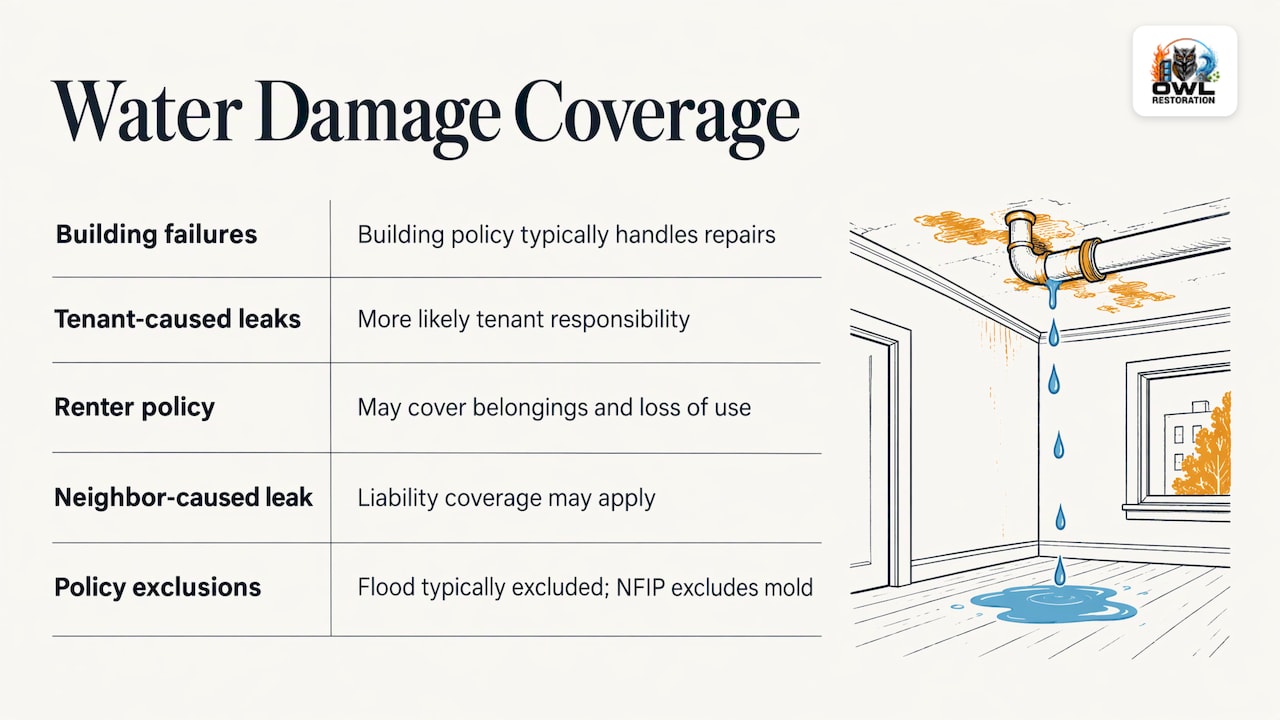
Two cautions on insurance wording. First, standard renters, homeowners and commercial policies typically exclude flood, as the California Department of Insurance notes, while sudden pipe or appliance discharge is a different category in most policies. Second, NFIP policies do not cover mold damage, which is one more reason to dry fast. Read your own policy and deductible, and if a claim is denied, ask the adjuster which policy provision applies. The California regulator recommends that, and also advises keeping a claim diary. Those are California sources, but the habits translate to any state.
Your rights as a Texas tenant
If you rent in the Dallas-Fort Worth area, Texas Property Code Chapter 92 governs repairs. The key points for a water problem:
- A landlord must make a diligent effort to repair a condition when you give notice, you are current on rent, and the condition materially affects the physical health or safety of an ordinary tenant, under Section 92.052.
- The law presumes that seven days is a reasonable time to repair, though a landlord can rebut that depending on the severity of the problem and how available materials and labor are.
- If the landlord does not act after proper notice, Section 92.056 lists remedies that can include terminating the lease or having the repair done and deducting the cost, subject to strict notice requirements. Those procedures are technical, so before you deduct anything from rent, talk to a Texas tenant attorney or a legal aid office.
Put every report in writing and keep a copy. Text and email help, but your lease may specify how formal notice must be delivered. HUD’s rules for assisted multifamily housing follow the same logic: residents should report apparent hazards and defects in building systems, fixtures or appliances to management, and are entitled to timely repairs on request. Local or state law may add more rights.
What to put in your written notice
- Your name, unit number and the date and time you found the damage.
- Where the water came from, if known, and where it traveled.
- A list of affected rooms and belongings, with your photos attached.
- A request for a repair date and a request that management notify its insurer.
- A statement that a restoration company has been called, if it has.
Do you hire the restoration company or does the landlord?
Often the property manager brings in a contractor for the structure, and the tenant is left with wet belongings and a damp unit. If management is slow, you are still allowed to protect your own property: move belongings out, document, and have your own contents handled.
That is where contents pack-out helps. Our crews can pack, move and store belongings from affected rooms so the drying team can work and your things are not sitting in a damp apartment. See our contents pack-out service for how that fits with a water loss. For property managers, we also handle larger multi-unit losses through our commercial restoration services, so one call can cover mitigation across affected units.
Whoever pays, the insurance paperwork is where renters and managers lose the most time. We coordinate directly with insurance companies, so the moisture readings, photos and scope of work go to the adjuster in the form they expect, rather than you relaying them secondhand.
Water damage to mold: what happens if drying is late
Mold control is moisture control. The EPA’s advice is to fix the water source, remove bulk water and dry the area quickly with fans, dehumidifiers or open windows, and to keep indoor humidity below 60 percent, ideally between 30 and 50 percent. The EPA also says to gently clean visible mold before running fans or dehumidifiers, so spores are not blown around.
In apartments, mold often shows up where you cannot see it: behind baseboards, inside a closet wall shared with the leaking unit, under vinyl flooring. A musty smell after a leak, or a stain that returns after painting, are signals. For a closer look at how fast mold appears after a leak and what a proper evaluation looks like, read this guide on mold after a roof leak, which covers the same moisture timeline.
The EPA notes that visible mold usually does not need sampling, and that because no federal mold-spore limits exist, sampling cannot show compliance with a federal standard. Where sampling is appropriate, qualified professionals should do it. In practice, testing is useful when you suspect hidden growth, when a lease or insurance dispute needs documentation, or when you want a written baseline after drying. Our mold testing and inspection is $600 for a residential property, with additional samples at $75 each, and our residential mold remediation protocol is $1,000. If growth is confirmed, our mold remediation service handles containment and removal.
A practical timeline for a water loss in an apartment
| When | What to do | Why it matters |
|---|---|---|
| First hour | Stop the source if safe, shut off power to wet areas, photograph and video damage, call management | Limits spread and starts your paper trail |
| Same day | Written notice to management, call your insurer, call a restoration company | Notice triggers repair duties; early drying prevents mold |
| Day 1 to 2 | Water extraction, structural drying, pack-out of belongings if needed | The EPA’s 24 to 48 hour window for carpet and wall materials |
| Day 2 to 7 | Moisture monitoring, removal of materials that cannot dry, insurer inspection | Wet wallboard and insulation are what turn into mold |
| Week 1 onward | Follow up on repairs, mold testing if needed, rebuild | Do not paint or seal until the cavity is completely dry |
Mistakes that make apartment water damage worse
- Waiting for the landlord before drying anything. Written notice does not dry carpet. Start protecting your belongings and documenting right away.
- Cleaning before photographing. Insurers want to see the original condition.
- Painting over stains. It traps moisture. The EPA says wet materials should not be painted or sealed until fully dry.
- Running fans on contaminated water. If the source could be sewage, leave it to trained crews.
- Throwing out everything unseen. Photograph and list items first, then dispose of what is unsafe to keep.
- Assuming the surface tells the story. A ceiling stain the size of a dinner plate can sit on a soaked cavity.
What we offer for water damage in Dallas-Fort Worth
Owl Restoration provides emergency water, fire and mold restoration across the Dallas-Fort Worth area, including Tarrant, Ellis, Johnson and Dallas counties. We respond 24/7, address water leaks and damage within 24 to 48 hours, and carry the job from initial mitigation through full reconstruction, with direct coordination with insurance companies along the way.

If you are standing in a wet apartment now, start with our water damage restoration page or read our guide to the first 48 hours after a flood. Property managers with multiple affected units can reach us through our main site.
Our perspective
Most people who call us about an apartment leak are not asking how to pull up carpet. They want to know who is going to deal with everyone else: the landlord, the insurer, the neighbor upstairs. That is the real cost of water damage in a rental, and it is why we built our service around the whole path, not one step.
Our view is simple. Water damage is a race against moisture. Drying work that starts within a day is a different job from drying work that starts after a week of emails. Mitigation, contents pack-out, mold testing and rebuild should come from one team, so nothing is dropped between the stages and the insurance record stays consistent from the first photo to the final invoice.
Our certified professionals use advanced equipment to dry structures, and we coordinate directly with insurance companies so the people living through the loss are not left translating between adjusters and contractors. If you are in Dallas-Fort Worth and the water is still moving, call us first and sort out the rest from a dry floor.
Dustin
FAQ
Who pays for a leak from the apartment above?
It depends on the cause and the policies involved. A landlord’s or association’s insurance typically handles building repairs, and your renter’s policy may cover your belongings and temporary living costs. If a neighbor’s negligence caused the leak, their liability coverage may be involved, so report it to management and your insurer promptly and keep your documentation.
How long does a landlord have to fix water damage in Texas?
After you give proper notice and are current on rent, Texas law presumes that seven days is a reasonable time to repair a condition affecting health or safety, though a landlord can argue a different period given the circumstances. Check Chapter 92 of the Property Code and your lease for notice requirements, and consult a Texas tenant attorney before using remedies such as repair-and-deduct.
How fast can mold grow after an apartment leak?
The EPA says mold can grow on wet drywall, carpet, wood and furniture when they stay wet for more than 24 hours. Fast extraction and drying are the best protection. If you see or smell mold after a leak, our mold testing and remediation services can assess and treat it.
Should I call a restoration company or wait for my landlord?
Call the same day. You can report to management and call a restoration company at the same time, since drying delays are what turn a leak into a larger repair. Our team is available 24/7 in the Dallas-Fort Worth area and coordinates with insurance companies.
Sources
- Flood Recovery Checklist, National Flood Insurance Program
- Flood Cleanup to Protect Indoor Air and Your Health, US EPA
- Mold Remediation in Schools and Commercial Buildings, Chapter 4, US EPA
- Mold and Moisture, US EPA Indoor Air Quality
- A Brief Guide to Mold, Moisture, and Your Home, US EPA
- Resident Rights, HUD
- Texas Property Code Section 92.052
- Texas Property Code Section 92.056
- What If My Upstairs Neighbor Floods My Apartment?, AAA
- Insurance Commissioner alerts consumers, California Department of Insurance, 2025
- California Department of Insurance press release, 2024