
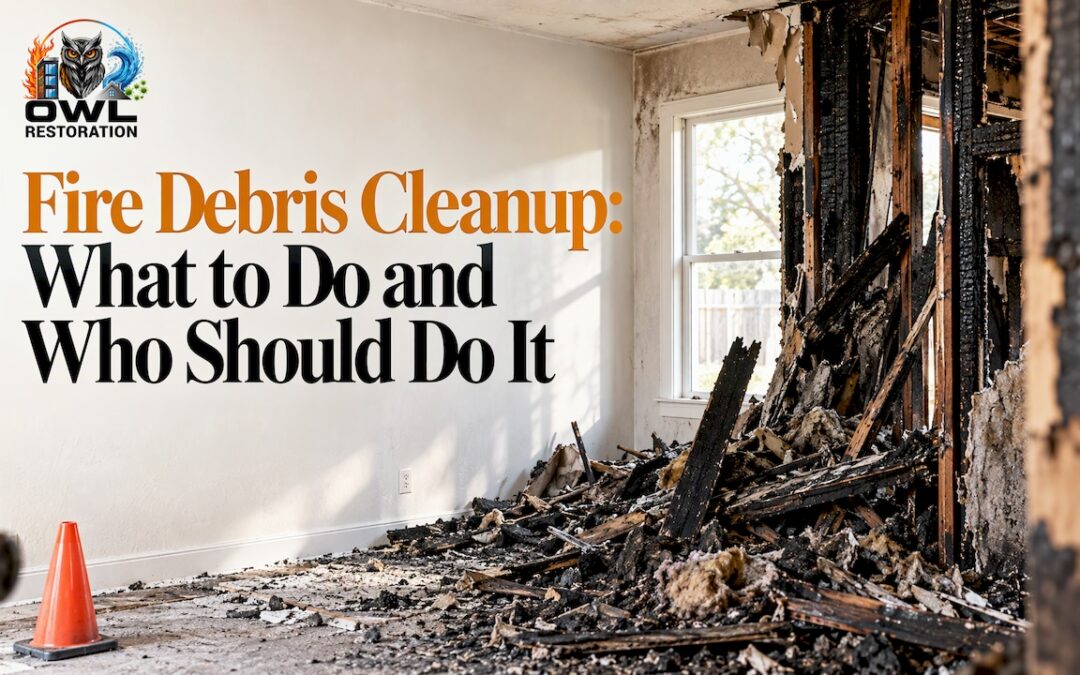
Fire debris cleanup is not ordinary cleanup. Ash, char and soot from a burned building can carry heavy metals, asbestos and other toxic residue, and it often looks no different from harmless dust. The safest order is to call your insurer, document everything, have the site assessed, and let a trained crew remove and dispose of the debris. In Dallas-Fort Worth, Owl Restoration handles fire damage restoration from mitigation to rebuild and works directly with insurance companies.
TL;DR
- Burned-building ash can contain lead, arsenic, asbestos and other toxins, and contaminated debris may look identical to clean material.
- Call your insurance company before you start any cleanup, and photograph everything before you move it.
- Never burn debris, dump chemicals down drains, or haul loose ash in a truck bed.
- Wear a fitted respirator, gloves, long sleeves and goggles for any limited work you do yourself.
- Larger jobs, asbestos concerns and anything structural belong with a certified restoration crew.
Table of Contents
- What is actually in fire debris
- Before you touch anything
- Protecting yourself if you must enter
- The debris removal process, step by step
- What to throw out and what to save
- When the job needs professionals
- What a large-scale fire cleanup looks like
- Perspective
- Getting help in Dallas-Fort Worth
- FAQ
- Sources
What is actually in fire debris
After a structure fire, the material left behind is a mix of everything the building and its contents were made of. Plastics, synthetic fabrics, asphalt shingles, treated wood, adhesives, electronics, batteries, paints and household chemicals all break down into hazardous substances when burned.
The Washington State Department of Health notes that structural-fire ash often contains or emits heavy metals such as arsenic and lead, asbestos, dioxins, benzene, formaldehyde and PAHs. PAHs are polycyclic aromatic hydrocarbons, a group of chemicals formed when material burns incompletely. California’s workplace safety agency adds that PAHs, PCBs, dioxins and furans can remain at structure fire sites several days after the fire is out.
California’s OEHHA points out that fire ash is not classified as hazardous waste, yet it may contain traces of lead, cadmium, nickel and arsenic, plus asbestos from older buildings. Asbestos, nickel, arsenic and cadmium are the particular cancer concerns. Many Texas homes built before the 1980s may have asbestos in materials like flooring, insulation or texture coatings, which is why assessment comes before removal.
Before you touch anything
The first hour decides how smoothly the claim and the cleanup go.
- Make sure the structure is safe. Confirm gas and electricity are off, and rope off or mark visibly dangerous areas such as partial collapses before anyone works there.
- Call your insurance company. The Washington State Department of Health advises contacting your insurer before beginning any cleanup, because the insurer may need to inspect the damage first and will set reimbursement requirements.
- Photograph and video the scene first. Take photos or videos before disturbing any debris.
- List and keep. List and photograph each damaged item, keep items until you reach an agreement with the insurer, and keep every receipt.
- Get a professional assessment. Have a qualified crew inspect the property before you enter heavily damaged areas.
Documentation matters more than most owners expect. An insurance attorney quoted in the Milwaukee Journal Sentinel warned that items thrown out before assessment can be denied as unverifiable. The U.S. Fire Administration also suggests confirming who pays for cleaning and getting a cost estimate in writing.
Owl Restoration works directly with insurance companies, so the documentation, scope and billing questions do not fall on you alone while you are dealing with the loss.
Protecting yourself if you must enter
If you need to enter the property briefly, for example to retrieve documents once it has been cleared, protect your body and your home from tracked-in residue.
- Wear gloves, long sleeves, long pants and goggles. OEHHA warns that wet ash may cause chemical burns or irritation.
- Wash ash off skin, eyes or mouth as soon as possible, and change shoes and clothing before leaving so you do not carry ash offsite.
- Limit your time in the area and wear a well-fitting P100, N100 or N95 respirator. These protect against particles, not gases or vapors, and an N95 does not give adequate protection from asbestos.
- Watch for leaking containers. The EPA says never to combine chemicals from leaking containers, and never to pour cleaners or paint down drains, storm sewers or toilets. Mark unbroken containers and set them aside for proper disposal.
Children, pets, pregnant people and anyone with lung or heart conditions should stay out of the area. If anyone has been exposed and feels unwell, see a doctor.
The debris removal process, step by step
Here is the sequence professionals and health agencies follow, with the places it commonly goes wrong.
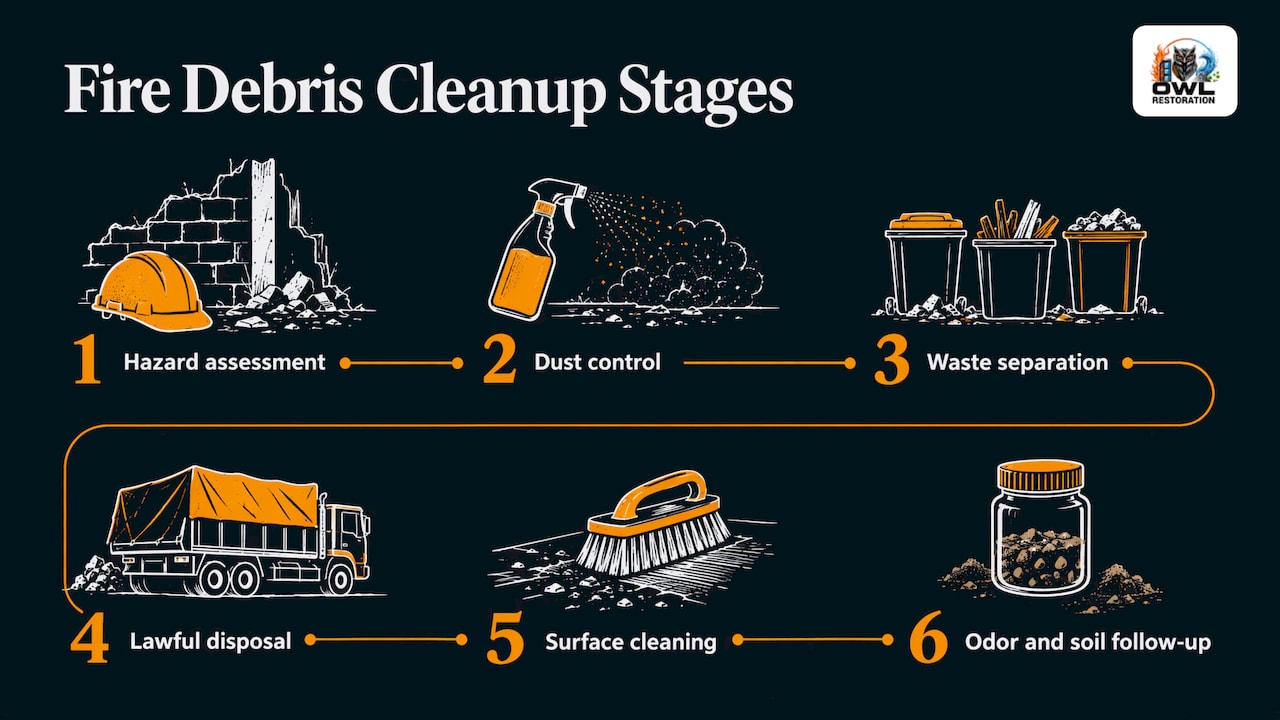
1. Assess for asbestos and other hazards
The Washington Department of Health says to assess the area for asbestos and other hazards first. One health district in Washington goes further: do not remove ash or debris until a certified inspector has completed an asbestos survey. Rules differ by state and city, so ask your local building or environmental office what applies to your address. Skipping this step is the costliest mistake: disturbing asbestos spreads it through the rest of the structure.
2. Control the dust
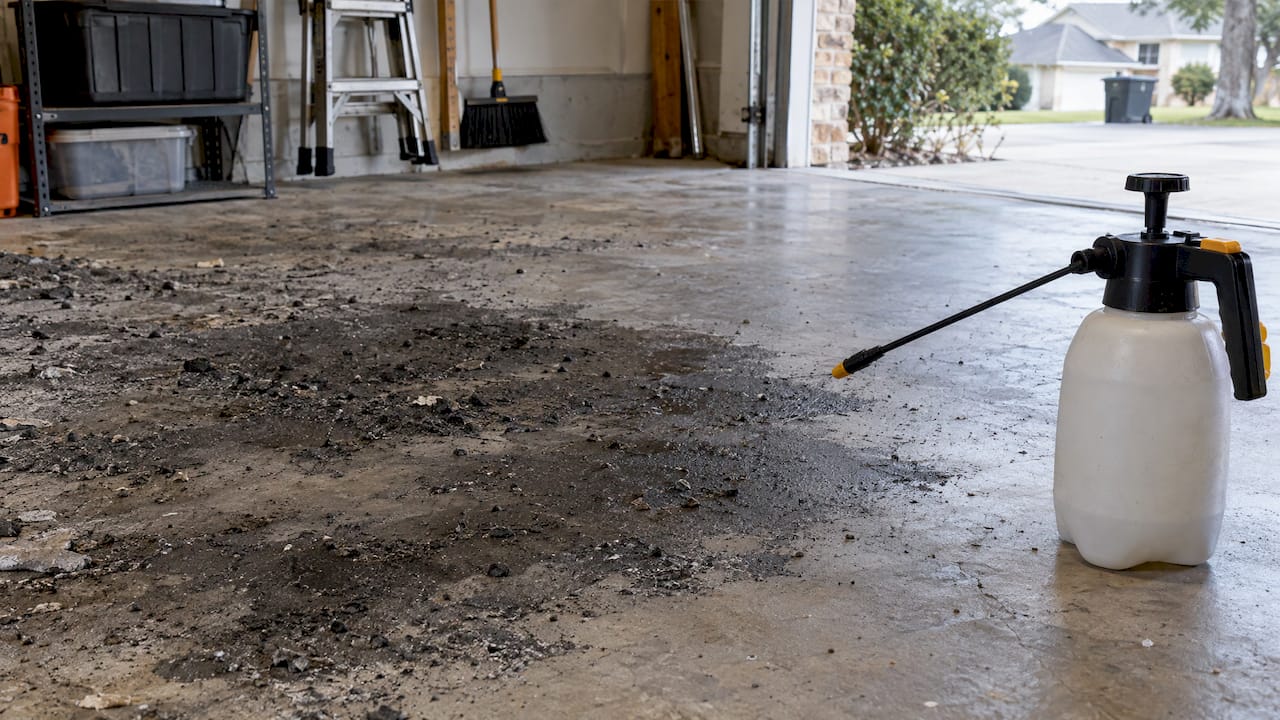
Misting ash lightly with water and scooping it into tightly closed plastic bags keeps it from becoming airborne. Do not sweep dry, and do not use a leaf blower. Wet-mop hard surfaces with mild detergent and keep runoff out of storm drains.
3. Separate the waste
Double-bag ash and debris, including used protective gear. Household chemicals, batteries, propane tanks and electronics need separate handling. In the 2025 Los Angeles fires, government crews removed household hazardous waste first, before ash and structural debris could be cleared.
4. Remove and dispose lawfully
Fire debris is not household trash. Health officials say do not transport loose, unpackaged ash or debris, and do not burn it on your property, since burning building materials releases more toxic smoke and may break local fire restrictions. Landfills and haulers set their own packaging rules, so confirm them before loading anything.
5. Clean what remains
The industry standard of care for restoration focuses on source removal: HEPA-vacuum and damp-wipe walls and ceilings, HEPA-vacuum and damp-clean hard floors, hot-water-extract restorable carpet, and have the HVAC system professionally cleaned. HEPA stands for high-efficiency particulate air, a filter grade that traps very fine particles. Ductwork is where smoke residue hides and recirculates, so air-system cleaning is part of finishing the job. Indoor air quality and ductwork services address that stage in the home’s air system.
6. Deal with odor and soil
Smoke odor lingers in porous materials after the visible debris is gone. Our guide to smoke odor removal explains what works. Outdoors, soil near a burned structure may hold heavy metals, so the Washington Department of Health advises not to mow, use a leaf blower or disturb soil, including garden soil, until it is tested by a qualified professional.
What to throw out and what to save
Food from a refrigerator or freezer that smells smoky or has soot should go, and thawed food should never be refrozen. Smoke-damaged pillows should be replaced, and water-soaked items that cannot be fully cleaned or disinfected should be discarded.
For items you want to save, go gently. A university extension guide explains that water and cleaning solutions can drive soot deeper into surfaces, so vacuum with a HEPA filter on the lowest suction first and do not force photo albums open. FEMA’s guidance says to salvage cherished items only when they can be removed safely without sifting through ash.
This is where contents pack-out helps: a crew removes belongings, inventories them and cleans them offsite while the structure is being worked on. See our contents pack-out services.
When the job needs professionals
Hire a restoration company when any of these apply:
- The building is older and could contain asbestos.
- Structural damage, partial collapse or a total loss requiring demolition. For demolition, the industry guide says OSHA’s HAZWOPER standard (29 CFR 1910.120) should be consulted for health and safety plans.
- The loss is a commercial property, where downtime and liability raise the stakes. See our commercial restoration services.
- Firefighting water has soaked materials. Wet drywall and insulation can grow mold within days, and we offer mold testing at $600 for a residential inspection and $975 for a commercial one, with additional samples at $75 residential and $95 commercial.
- The scene involved a death or injury. Our biohazard cleanup team handles that work.
The Washington Department of Health also recommends considering a professional remediation company to evaluate hazards before you enter the property, and points to certification checks for the firm you hire. Certified restoration staff are part of how we work.
What a large-scale fire cleanup looks like
The 2025 Los Angeles wildfires show how formal the process becomes at scale. Under the state’s program, EPA hazardous-waste cleanup was automatic and free for residential properties, followed by a second phase of ash and structural debris removal. Owners who opted out had to hire a licensed specialized contractor and a certified asbestos consultant. The Los Angeles Times reported that the debris phase can take 3 to 12 months, with a final clearance required before building permits.
A single-structure fire in North Texas is far smaller, but the logic carries over: hazards first, documentation before disposal, licensed handling, and clearance before rebuilding.
Perspective
Most people think of debris cleanup as hauling. It is really a sequence: secure the structure, document, test, contain, remove, clean, and only then rebuild. Break the sequence and you risk contaminating rooms that were salvageable or weakening your insurance claim.
We built our work around that sequence for North Texas properties. Our team responds within 24 to 48 hours, handles mitigation through reconstruction, and coordinates directly with your insurance company, so the same crew that documents the loss is the one that cleans it and rebuilds it. That continuity is what removes stress for owners who are already dealing with the worst week of their year.
Dustin
Getting help in Dallas-Fort Worth
If you are dealing with a fire in Tarrant, Dallas, Ellis or Johnson County, we can start with the assessment and the insurance coordination. Our fire damage restoration service covers emergency response, cleanup, contents and rebuilding, with 24/7 rapid response.
If you want the whole picture of what happens after the fire trucks leave, read fire and smoke restoration: what happens and who to call, or contact us through Owl Restoration.
FAQ
Can I clean up fire debris myself?
Light cleaning of small areas is possible with protective gear, but only after you have talked to your insurer, documented the damage and ruled out asbestos. Heavily burned structures, older buildings and large amounts of ash call for a certified crew.
What should I throw out after a house fire?
Discard smoky or sooty refrigerated and frozen food, smoke-damaged pillows, and water-soaked items that cannot be fully cleaned. Keep items and photos until your insurer has had a chance to assess them.
Can I burn or dump fire debris?
No. Burning releases additional toxic smoke and may violate local fire restrictions, and ash should never be transported loose. Chemicals must not go down drains or toilets. Ask local authorities about approved disposal sites.
Does insurance cover fire debris removal?
Many policies include debris removal as part of a fire claim, but coverage varies by policy. Call your insurer before cleanup so they can tell you what they require, and keep receipts and photos.
Sources
- Post-Fire Cleanup Guidance, Washington State Department of Health
- Workplace hazards from the Southern California fires, Cal/OSHA
- Fact sheet: Protecting Public Health from Home and Building Fire Ash, OEHHA
- Worker Health and Safety during Fire Cleanup, Cal/OSHA
- After a Fire: Cleaning Your Property, City of San José
- After the Fire: Advice for Salvaging Damaged Family Treasures, FEMA
- Technical Guide for Wildfire Restoration, IICRC/RIA/CIRI
- How do I clean items that have been in a fire?
- Dealing with Debris and Damaged Buildings, US EPA
- Health Guidance for Residents Returning to Fire-Damaged Homes, Spokane Regional Health District
- Cleanup and debris removal, CA.gov
- Timeline: Rebuilding After a Wildfire in Los Angeles, Los Angeles Times
- After the Fire, U.S. Fire Administration