
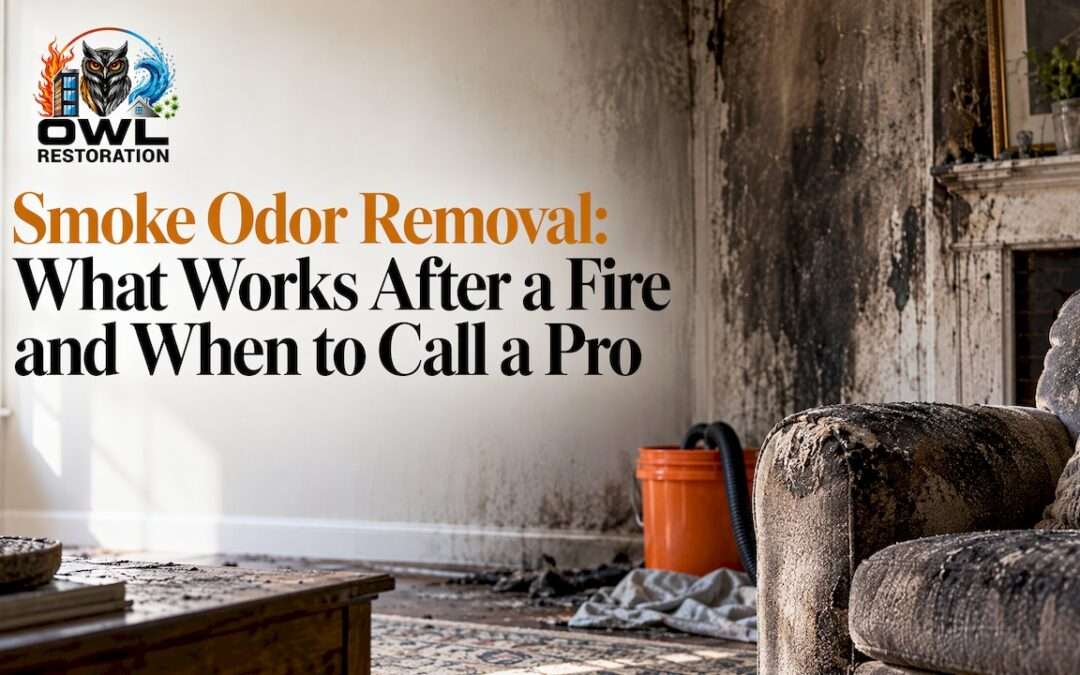
Smoke odor leaves a house only when the soot and residue causing it are removed. For light smoke, that means ventilating, cleaning surfaces and absorbent items, and filtering the air. For moderate to heavy smoke, it usually means professional cleaning of walls, contents and the HVAC system. Sprays and air fresheners cover the smell for a day, but they do not take it away.
This guide explains what works at each level of smoke damage, what to avoid, what professionals do differently, and how to decide when it is time to call one. It is written for homeowners, business owners and property managers dealing with a fire, whether it was big or small.
TL;DR
- Smoke smell comes from particles and residue left on surfaces, so cleaning is the real fix. Fragrance sprays and masking products are not.
- Light smoke: ventilate, upgrade to a MERV 11 or higher filter, set the HVAC fan to constant, place activated charcoal, and wash fabrics.
- Moderate smoke: HEPA-vacuum, damp-wipe every hard surface top to bottom, and have ducts and the furnace professionally cleaned.
- Heavy smoke, or any visible structural fire damage: do not re-enter until the fire department clears the home, then bring in a restoration contractor.
- Be careful with ozone machines. Staying out of the house while one runs is not optional.
Table of Contents
- Why smoke smell lingers in a house
- First, make sure the house is safe to enter
- How to remove smoke smell by damage level
- What absorbs smoke smell
- Clothes, linens and soft goods
- Smoke in the HVAC system, ducts and chimney
- Ozone, hydroxyl and fogging: what to know
- What professionals do differently
- What smoke odor removal costs
- When to hire a smoke odor removal service
- Smoke damage help across Dallas-Fort Worth
- FAQ
- Sources
Why smoke smell lingers in a house
Smoke is not just a gas. It is a mix of fine particles, tar-like residue and volatile compounds that settle on walls, ceilings, carpet, upholstery and the insides of ductwork. Those particles keep releasing odor for weeks or months.
A 2026 Lawrence Berkeley National Laboratory report on restoring homes after wildfires interviewed 10 remediation companies. All of them agreed that thorough cleaning is the most important first step, and that the odor is a byproduct of the particulate and residue in the house. That is the most useful idea in this whole topic: remove the source and the smell goes with it.
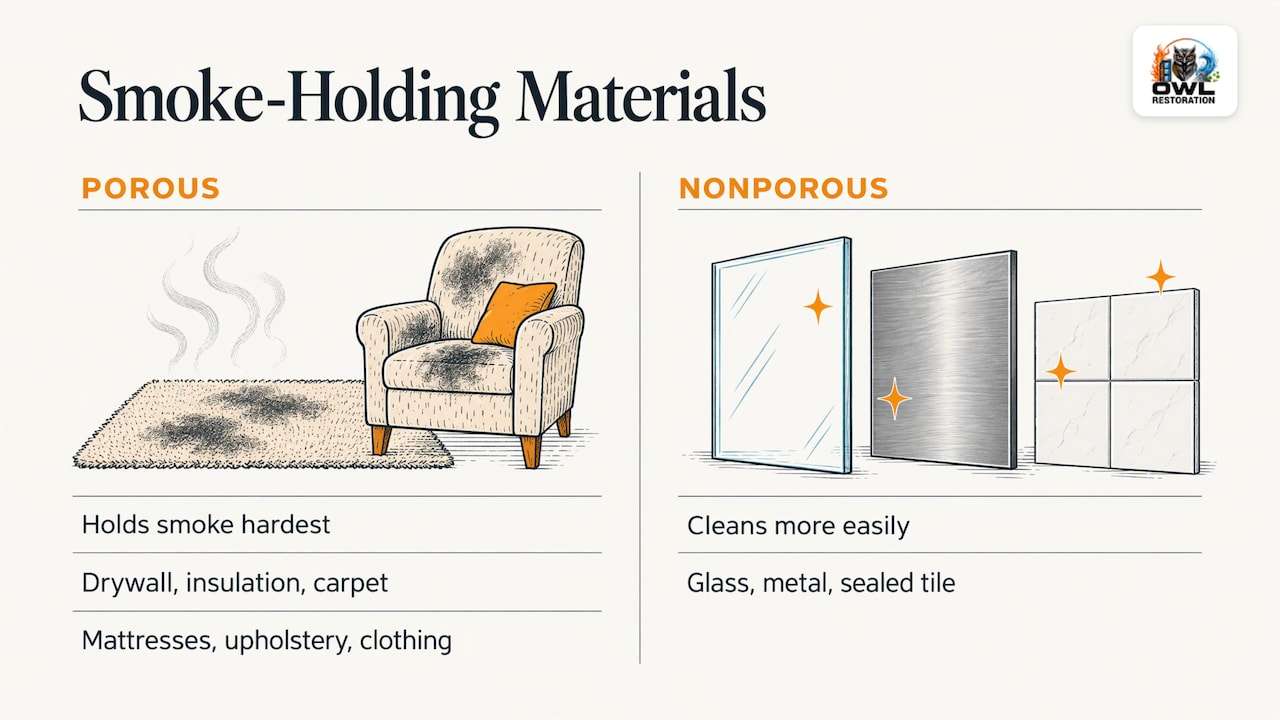
Porous materials hold smoke the hardest. Drywall, insulation, carpet and pad, mattresses, upholstered furniture and clothing all absorb it. Hard, non-porous surfaces such as glass, metal and sealed tile clean up much more easily.
First, make sure the house is safe to enter
Before any odor work, safety comes first. FEMA’s guidance says that if there is visible fire damage to structural elements, you should not enter until the fire department clears the home, and then you should use professionals to address the structural and smoke damage (FEMA homeowner’s guide, April 2025).
Once you are cleared to go in and start cleaning, FEMA’s guide recommends protective gear: goggles, an N95 or P100 respirator, gloves, long pants, a long-sleeved shirt and closed-toe shoes (FEMA homeowner’s guide, 2023). Soot is an irritant, and dry-sweeping it just puts it back in the air. If anyone in the household has asthma, a heart condition or another respiratory problem, ask their doctor before they spend time in a smoke-affected home.
How to remove smoke smell by damage level
The right approach depends on how much smoke reached the house. Match your response to the level, and move up a level if the smell is still there after you finish.
Light smoke damage
Light damage means a faint odor and little or no visible soot, such as a small kitchen fire or smoke drifting in from a neighboring unit. FEMA recommends these steps (FEMA, April 2025):
- Open windows and doors to ventilate.
- Install a new MERV 11 or higher filter and run the HVAC system in constant fan mode.
- Place activated charcoal bags or containers throughout the home.
- Clean absorbent materials such as linens and fabrics where the odor is strongest.
For strong or concentrated odors, a portable air cleaner with both a HEPA filter and an activated carbon filter helps. According to CIRES at the University of Colorado, the carbon filter captures the volatile compounds that cause the smell, while the HEPA filter removes 99.97% of particles, including compounds bound to them.
Moderate smoke damage
Moderate damage means visible soot film on surfaces and an odor that does not fade with airing out. FEMA’s 2023 guide recommends HEPA-vacuuming carpets, damp-wiping surfaces with water and a mild detergent, keeping the HVAC air handler off until most of the soot is removed, and having the ducts and furnace professionally cleaned (FEMA, 2023).
In practice, the order matters:
- Ventilate and keep the air handler off.
- HEPA-vacuum ceilings, walls, carpets and upholstery before any wet cleaning.
- Damp-wipe ceilings, walls, hard contents and furniture with water and a mild detergent or all-purpose cleaner. Clean high surfaces first, then work downward, so you do not re-soil what you have already cleaned.
- Wash or professionally clean soft goods.
- Have the ducts and furnace cleaned before you turn the system back on.
Work in small sections and change your cleaning cloths often. A cloth loaded with soot will smear it rather than lift it.
Heavy smoke damage
Heavy damage means thick soot, charred materials, odor in every room, or smoke that has gotten into walls and attic spaces. FEMA says to retain a professional cleaning and restoration contractor for heavy smoke damage if detailed cleaning steps are unsuccessful (FEMA, April 2025). Realistically, with heavy damage most owners go straight to a contractor. Cleaning that much surface area with household supplies is slow, and mistakes can set the odor in.
What absorbs smoke smell
Absorbers help with the air and with small spaces. They do not clean surfaces, so treat them as support, not the solution.
- Activated charcoal. Place it in bowls or bags around the home. FEMA lists it for light smoke damage, and Oklahoma State University Extension also recommends it (OSU Extension, March 2024).
- Baking soda. OSU Extension suggests leaving bowls of it around the house for several days.
- Carbon-and-HEPA air cleaners. Best for continuous air treatment while you clean.
- Fresh air. Cheap, and the first step in every guide. Open windows when outdoor air is clean and dry.
One warning from FEMA applies to nearly every product on a store shelf. Its guide advises against odor-masking products and perfume-based counteractants, because they are not effective at eliminating smoke odors and may create new odors that are hard to identify (FEMA, April 2025). That is why the smell often comes back, now mixed with a floral one.
Clothes, linens and soft goods
Fabrics are where most people start, and where a common mistake happens. OSU Extension recommends adding 1 cup of vinegar to the detergent in the wash cycle for clothing with smoke odor. It also warns against drying clothes that still smell like smoke, because heat sets the odor into the material (OSU Extension). Wash again, or air-dry and re-check, before the dryer.
For items that cannot go in the washer, such as upholstered furniture, mattresses, drapes, books, electronics and keepsakes, professional cleaning is usually the better path. Many restoration companies pack out contents, clean them off-site and store them while the structure is being repaired. Our contents pack-out service works this way for DFW homes and businesses.
Smoke in the HVAC system, ducts and chimney
If the HVAC system ran during or after the fire, it spread smoke through every room. American Family Insurance notes that smoke will usually enter your heating and cooling ducts, so an HVAC evaluation is worth considering (American Family). That is why FEMA says to keep the air handler off until most soot is cleaned up, and to have ducts and the furnace professionally cleaned.
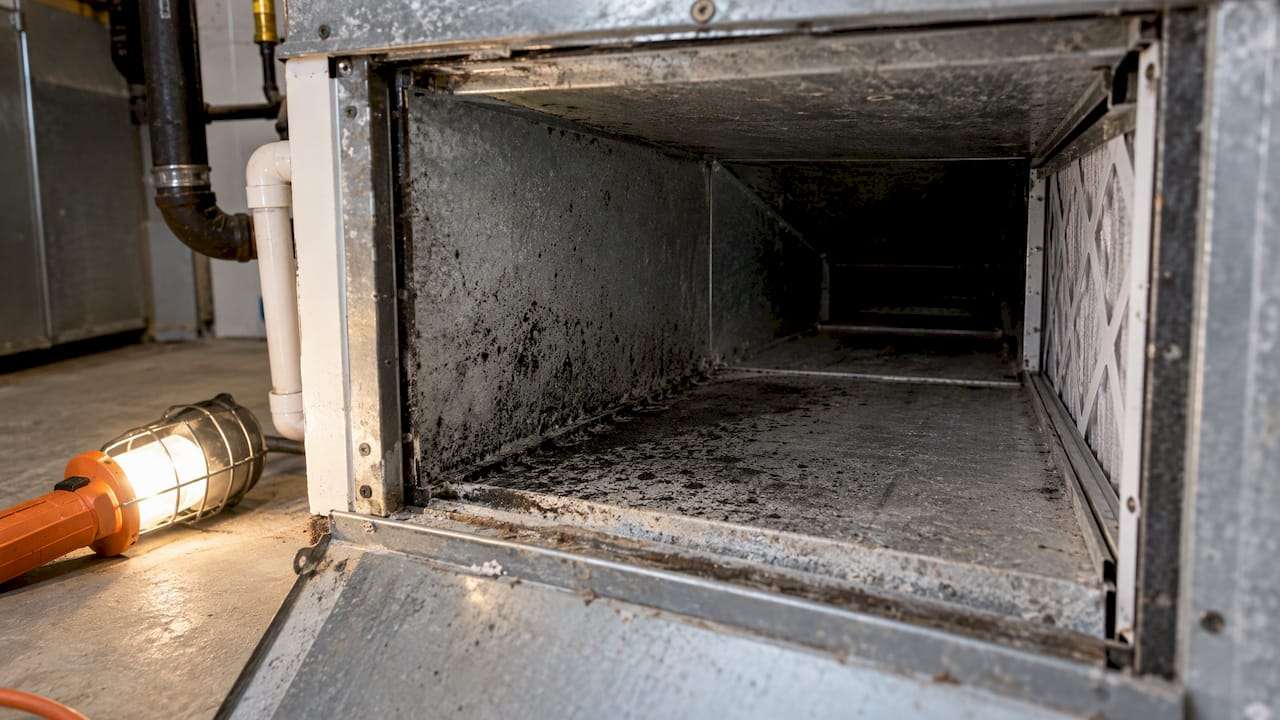
If the fire started at or near a fireplace, the chimney is part of the picture too. Problems in the flue and smoke chamber can send smoke back into living space, and a specialist chimney inspection is the right professional for that part. This overview of smoke chamber repair signs explains what damage looks like.
A filter swap is the cheapest part of the job and one people forget. Put in a fresh MERV 11 or higher filter after cleaning, and again a few weeks later, since the first one will load up with fine soot.
Ozone, hydroxyl and fogging: what to know
Restoration companies use several secondary odor treatments after cleaning: ozone, hydroxyl generators, thermal fogging and sealants. The Berkeley Lab report found that companies differ on these, with little consensus on how well they work, how safe they are or how to apply them.
Ozone deserves particular care. CIRES notes that ozone generators are commonly used by professionals for odor remediation, but there are no studies of their effectiveness in fire smoke-damaged homes, and they can produce byproducts such as formaldehyde, other carbonyls, acetone and ultrafine particles. Its advice is to stay out of the home during ozonation and air it out for three hours before going back in (CIRES). The EPA also has a page on ozone generators sold as air cleaners that lists the health effects of ozone, including lung function decreases and asthma aggravation.
The practical rule: never run an ozone machine in a home where people, pets or plants are present, and do not treat it as a substitute for cleaning. If a contractor proposes it, ask how they will keep everyone out and how long they will ventilate afterward.
What professionals do differently
The IICRC, RIA and CIRI Technical Guide for Wildfire Restoration (December 2025) describes professional source-removal cleaning: HEPA vacuuming, damp cleaning and professional HVAC cleaning. That is the same sequence a careful homeowner follows, done with commercial equipment, trained judgment about each material, and a documented process.
A professional smoke odor job typically looks like this:
- Assessment. The crew identifies what burned, how far smoke traveled and which materials are porous.
- Source removal. Soot and residue are removed from surfaces, contents and ductwork. Materials that cannot be cleaned are removed.
- Deodorization. Once the source is gone, odor-control methods deal with what remains.
- Verification and rebuild. The home is checked, and any repairs or reconstruction follow.
Credentials matter here. The IICRC offers an Odor Control Technician certification covering how odor is detected, the theory of odor control, equipment and chemical options, including odors from fire and smoke damage.
Perspective: why we clean first and deodorize second
Most calls we get about smoke smell start the same way: the owner has already tried sprays, candles or a machine from the hardware store, and the smell is back in a week. In our experience the cause is nearly always that residue is still in the house, in the walls, the ductwork or the contents.
That is why our approach follows the damage from start to finish. We start with mitigation, clean the structure and contents, deal with the HVAC, and only then address what odor remains. If walls or flooring cannot be cleaned, our reconstruction team can rebuild, so you have one team instead of three.
Fire often brings water too. Hoses and sprinklers soak drywall and insulation, and that moisture can turn into mold if it sits. We handle water, fire and mold under one roof, and we work directly with your insurance company, so you are not coordinating trades while your home smells like smoke.
Our advice: do not wait for the odor to fade on its own. Smoke residue is easier to remove the sooner it is dealt with.
Dustin
What smoke odor removal costs
There is no single honest number, because the price follows the damage. The size of the property and the extent of the fire drive the cost (American Family). A single smoky kitchen is a very different job from a whole-house fire with duct contamination and contents to clean.
Things that move the price most:
- Square footage affected, and whether smoke reached every room
- Whether the HVAC system and ducts need cleaning
- How many contents need cleaning or pack-out
- Whether porous materials such as drywall, insulation or carpet must be replaced
- Whether water damage or mold came with the fire
We do not publish a price for fire damage restoration, because every loss is different. We assess the damage and give you a scope of work. If the fire was covered by a homeowner’s or commercial property policy, we coordinate directly with the insurer, so ask your carrier what it covers before you pay out of pocket.
When to hire a smoke odor removal service
Call a professional when any of these is true:
- Fire damaged structural elements such as framing, roofing or load-bearing walls
- You can see soot on walls or ceilings, or the smell is in every room
- Smoke ran through the HVAC system
- Airing out, washing and damp-wiping have not worked
- Water from firefighting soaked drywall, insulation or flooring
- It is a business or a rental, and downtime or tenants are a concern
- You are filing an insurance claim and want the work documented
If the fire also left moisture behind, ask about mold. Our residential mold testing and inspection is $600 one-off, with additional samples at $75 each. The commercial version is $975, with additional samples at $95 each.
Smoke damage help across Dallas-Fort Worth
If you are dealing with smoke damage in Tarrant, Dallas, Ellis or Johnson County, our certified team handles the whole job, from emergency mitigation and smoke odor removal to contents pack-out and rebuild. We respond around the clock and address urgent damage within 24 to 48 hours.
See our fire damage restoration page for how we work, or call us through our 24/7 emergency restoration page.
We also serve nearby cities, including Arlington, Mansfield and Midlothian.
FAQ
What gets rid of the smell of smoke fast?
Fresh air, a MERV 11 or higher HVAC filter in constant fan mode, activated charcoal and a carbon-and-HEPA air cleaner reduce light odors quickly. For anything stronger, the fast fix is cleaning the soot off surfaces, since that is where the smell comes from. Masking sprays are not recommended by FEMA.
How do professional cleaners get rid of smoke smell?
They remove the residue first, using HEPA vacuuming, damp cleaning and HVAC cleaning, and then use odor-control methods on what is left. Contents are cleaned or packed out, and materials that cannot be cleaned are replaced. The cleaning step matters most.
Does vinegar remove smoke smell from clothes?
Oklahoma State University Extension recommends adding 1 cup of vinegar to detergent in the wash. Do not machine-dry clothes that still smell like smoke, because drying sets the odor. Wash them again or air-dry and check first.
Is an ozone generator safe for smoke odor?
Not while anyone is in the house. CIRES says ozone can create harmful byproducts, and advises staying out during treatment and airing the home out for three hours before re-entering. Ozone is not a replacement for cleaning, so ask a professional how they use it.
How long does smoke smell last if I do nothing?
It can persist for weeks or months, because the residue keeps releasing odor. Cleaning soon after the fire gives the best chance of fully removing it, and heavy smoke is best left to a restoration contractor.
Sources
- FEMA Homeowner’s Guide to Risk Reduction and Remediation of Residential Smoke Damage (April 2025)
- FEMA Homeowner’s Guide to Risk Reduction and Remediation of Residential Smoke Damage (2023)
- CIRES: After the fire, frequently asked questions
- Oklahoma State University Extension: How to remove fire odor from belongings and homes
- Lawrence Berkeley National Laboratory: Restoring Homes After Wildfires
- IICRC, RIA and CIRI Technical Guide for Wildfire Restoration
- IICRC Odor Control Technician certification
- American Family Insurance: Smoke damage clean-up and restoration costs
- EPA: Ozone generators sold as air cleaners
- Smoke chamber repair: signs, parging methods and costs