
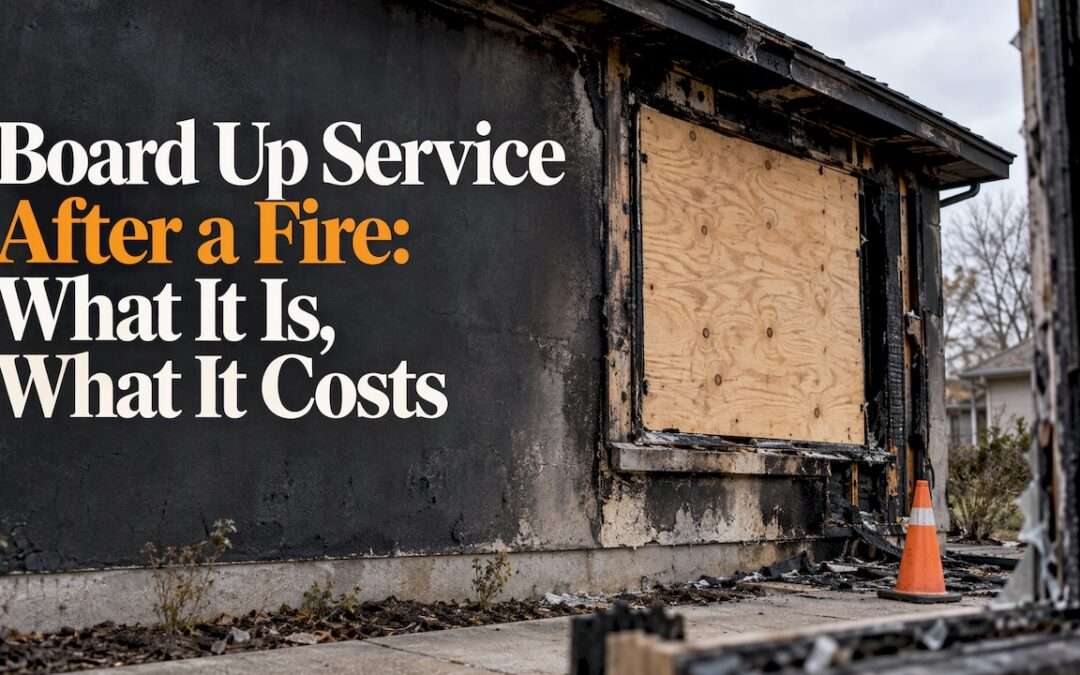
A board up service temporarily seals the openings of a damaged building (broken windows, burned doors, holes in walls or roofs) so weather, thieves and trespassers cannot get in while you plan repairs. After a fire, it is usually the first protective step once the fire department says the structure is safe to approach. Call right away, because most insurance policies expect you to protect the property from further harm.
TL;DR
- Board-up is temporary protection, not repair. It stops further damage and unauthorized entry until restoration begins.
- Do not enter a fire-damaged building until the fire department says it is safe.
- Typical cost runs from about $237 to $286 per window opening for basic work, and rises with the number of openings, roof tarping and access difficulty.
- Standard homeowners policies require you to take reasonable steps to prevent more damage, so photograph everything and keep every receipt.
- In Dallas-Fort Worth, we handle board-up, fire restoration and insurance coordination under one roof, 24/7.
Table of Contents
- What a board up service actually does
- When you need one
- How response time works
- How openings are boarded safely after a fire
- What board-up costs
- Board-up and your insurance claim
- What to do after the boards go up
- Residential versus commercial board-up
- How to choose a board up provider
- Our perspective
- Get your property secured in DFW
- FAQ
- Sources
What a board up service actually does
Boarding up means covering openings with solid panels, usually plywood, fastened so they cannot be pushed in or pried off. Fire breaks windows, burns through doors and exposes the interior to rain, wind and animals. Firefighters also often break windows and doors to ventilate and put out the fire, so the building can be left wide open even where the fire itself was small.
A crew typically does four things:
- Assesses which openings are exposed, including doors, windows, garage entries and holes in the roof or walls.
- Cuts and fits panels to each opening and fastens them to sound framing.
- Tarps roof openings to keep rain out of the structure.
- Posts the property and records the work with photos so it can be documented for the claim.
The fire department’s own guidance points the same direction. The Lakewood Fire Department says fires can start again even when they appear out, that roofs and floors may be damaged and could fall, and that in some cases you may need to board up openings so no one can get in. It also advises telling the police department the home will be unoccupied.
When you need one
You need a board up service whenever a building cannot be locked or kept weathertight. The common triggers are:
- Fire damage that has burned or broken doors, windows or roof sections
- Storm damage, such as hail or wind breaking glass
- A break-in or vandalism that damaged an entry point
- A vehicle striking the building
- A vacant commercial space after an incident
In Texas, hail and wind season makes storm board-ups common, but fire is where the work is most urgent because a burned structure is both unsafe and attractive to scavengers. The Cottage Grove, Minnesota After the Fire guide notes that vacant fire-damaged homes are often targeted by burglars or curious minors, which is why sealing the building quickly matters.
How response time works
Emergency providers run around the clock. One industry guide reports that most local providers arrive within 60 minutes and that severe damage, such as missing walls, large roof openings or several shattered windows, goes to the front of the line. Actual arrival depends on your location and the night’s call volume, so ask the dispatcher for an honest window when you call.
Our teams respond across Tarrant, Dallas, Ellis and Johnson counties and address damage within 24 to 48 hours of the call, with emergency response available around the clock. See our 24/7 emergency restoration page for how dispatch works.
How openings are boarded safely after a fire
There is a recognized standard for this. The U.S. Fire Administration’s Board Up Procedures say basement openings, first-floor doors and windows, and any entry reachable from a porch, fire escape or other climbing point must be barricaded. The materials it calls for:
- 1/2-inch (4-ply) exterior-grade CDX plywood
- 2-by-4 construction-grade lumber braces, 8 feet long
- 3/8-inch by 12-inch carriage bolts with 3/8-inch nuts and 1/2-inch flat washers
- 1 5/8-inch (6D) galvanized or stainless steel ring-shank nails
The same document says particle board, waferboard, Masonite and similar materials should not be used. Openings at least 10 feet above the ground that cannot be reached may be secured with nails in each brace and every 12 inches around the perimeter. When the work is done, the structure should carry a “No Trespassing” sign.
Local codes can be stricter. Phoenix, for example, requires at least 3/4-inch exterior-glue plywood with no OSB, painted to match the exterior, for unoccupied structures. Check with your city’s code office if the building will stay vacant for a while.
Fire-specific complications
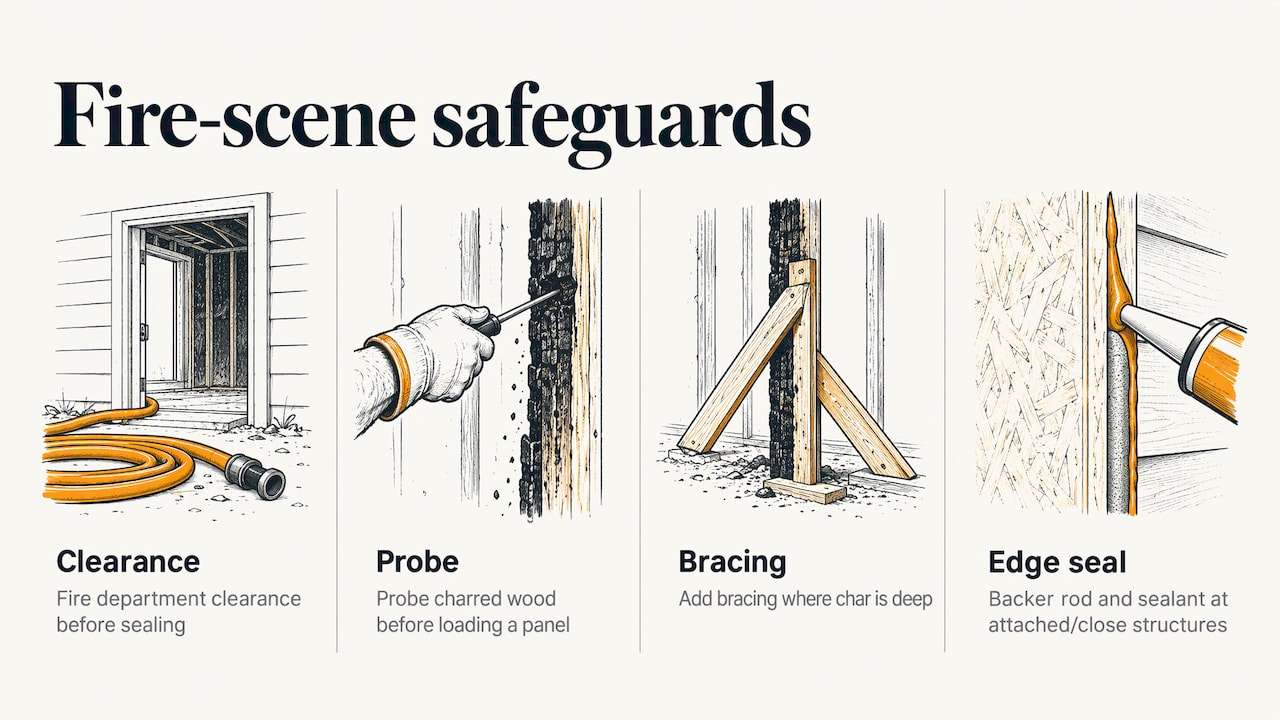
Fire changes the job in ways a window break from a storm does not. Industry guidance notes that charred framing may not hold fasteners reliably, so crews probe the wood before loading it with a panel, and add bracing where char is deep. Where something is still smoldering, the fire department must clear the site before sealing begins. Smoke odor can also be contained at panel edges with backer rod and sealant when structures are attached or close together.
This is why a general handyman with a sheet of plywood is a poor substitute. A crew that works fire scenes every week knows what a compromised stud looks like.
What board-up costs
Prices vary by region, season and urgency, and we do not publish a board-up price because every scene is different. For a benchmark, Homewyse’s January 2026 estimate starts at $237 to $286 per window opening for basic mid-range work with 15/32-inch exterior plywood, including labor, materials and debris disposal.
Fire damage often pushes costs higher. One industry source says emergency board-up typically costs a few hundred dollars for minor damage, while extensive damage with several openings, roof tarping and multi-story access can reach a couple thousand dollars.
What moves the price:
| Factor | Why it matters |
|---|---|
| Number of openings | Each window, door or hole needs its own cut panel |
| Size and height | Large storefront glass or second-story openings need more material and equipment |
| Roof damage | Tarping adds labor and safety requirements |
| Fire severity | Weakened framing needs probing and bracing |
| Access | Multi-story or cramped sites take longer |
| Timing | Night, weekend and holiday calls are urgent by nature |
Because board-up is a mitigation expense, it is normally part of your claim, not an out-of-pocket cost you carry alone. More on that next.
Board-up and your insurance claim
Board-up is more than a convenience. Nolo’s insurance guidance explains that every policy requires the insured to take reasonable steps to limit ongoing harm, called the duty to mitigate, and that includes boarding up open and accessible parts of the property. The standard homeowners forms (HO-3 and HO-5) carry a Duties After Loss clause, and failing to protect property can reduce or void coverage for later losses.
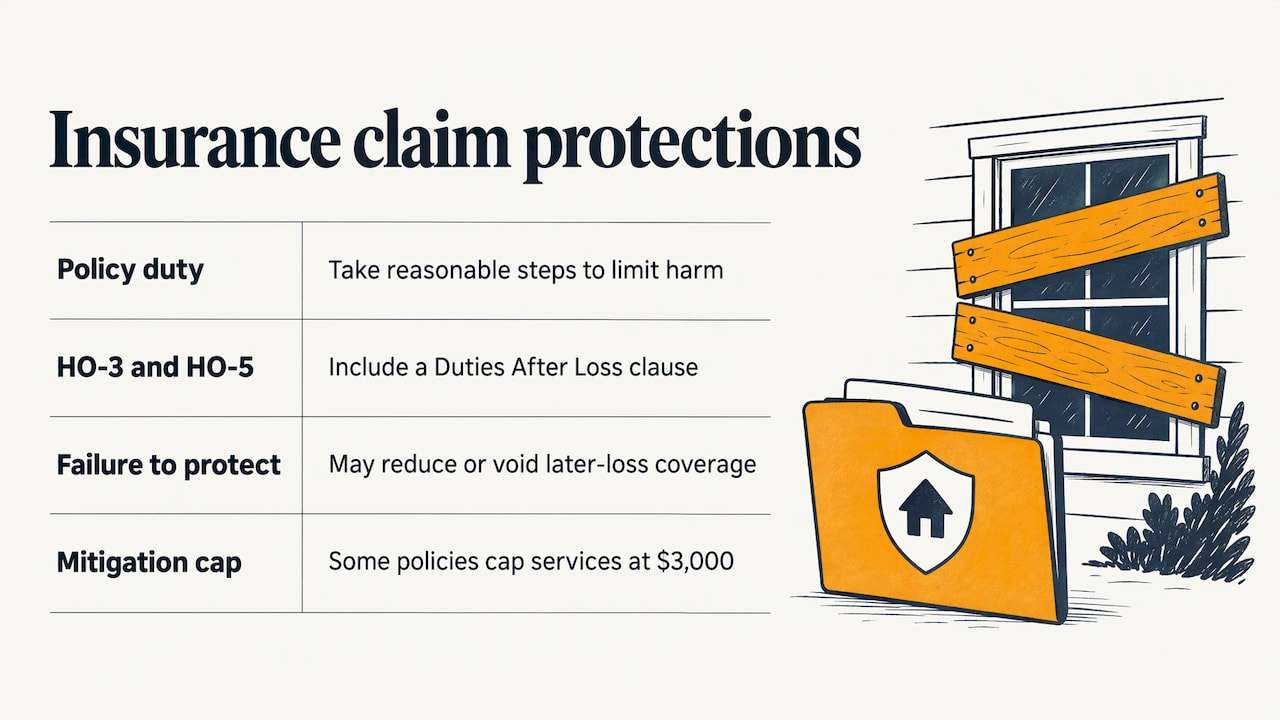
Some policies also limit what they pay for this stage. One adjuster firm notes that some policies cap Emergency Mitigation Services at $3,000. Read your declarations page or ask your agent what yours says.
What to document
- Photos and video first. Photograph every room and every damaged item before anything is moved, and preserve damaged items until the adjuster advises otherwise.
- A claim diary. The Washington State Insurance Department recommends saving all emails and paperwork and logging every conversation with the adjuster. Record the representative’s name, date and what was discussed.
- Receipts and invoices for the board-up, tarping and any hotel or storage costs.
- Policy citations. If an adjuster says something is excluded or limited, ask which policy provision they are relying on.
Board-up is also not permanent repair. Per the Insurance Repair Authority, it only arrests ongoing damage and does not restore structure or weatherproofing, and insurers look at whether the protection was proportionate to the exposure. Emergency steps are generally appropriate, but permanent restoration should usually wait until the damage is documented and the insurer has had a chance to inspect. Our insurance claims assistance team coordinates directly with carriers so the paperwork keeps pace with the work.
What to do after the boards go up
A sealed building is safe from intruders, not finished. A sensible sequence:
- Notify police and your insurer. The Bridgeport Fire Department’s handbook advises telling the police the site will be vacant.
- Protect the pipes. If the home will be uninhabitable for a long stretch in cold weather, the Cottage Grove guide recommends keeping the thermostat at 55°F or higher to avoid frozen, burst pipes. North Texas freezes are rare but real, so do not skip this in winter.
- Discard exposed food and medicine. The same handbook says not to eat, drink or take medication that was exposed to heat, smoke, soot or water.
- Schedule a full damage assessment. Soot, smoke odor and the firefighting water all keep working on the structure.
- Plan the restoration. Water from hoses can lead to mold within days, so drying and testing belong early in the plan.
That is where the rest of the job begins. Our fire damage restoration covers cleaning and mitigation, and our water damage restoration team handles drying out what the hoses soaked. If belongings must leave the building, contents pack-out moves them out for cleaning and storage. When the structure is ready, reconstruction and build-back rebuilds it.
Residential versus commercial board-up
Homeowners mostly worry about safety and the insurance claim. Business owners and property managers carry an extra problem: a business with broken storefront glass cannot open, and an unsecured commercial space is a liability. Larger openings, multiple tenants and after-hours access all complicate the job. We serve both, and our commercial restoration page explains how we work with owners and managers who need a building secured and reopened quickly.
How to choose a board up provider
Whoever you call, a few questions separate a careful crew from a rushed one:
- Will they arrive in your area at night and on weekends, and what window will they give you?
- Do they use exterior-grade plywood and bolted bracing, not scraps or thin sheathing?
- Will they photograph the work and give you an itemized invoice you can hand to the adjuster?
- Can they continue into cleaning, drying and rebuilding, or do you have to find a second contractor?
- Do they work directly with your insurance company?
One team doing board-up, mitigation and rebuild means fewer handoffs and one set of records.
Our perspective
Most people call about board-up at the worst hour of their year, usually after midnight, usually with a fire truck still on the street. What they need is not a lecture. They need the building closed, the claim protected and one phone number to call.
We treat board-up as the first day of the restoration, not a standalone errand. The panels, the photos and the invoice all feed the claim, and the same crew that seals the windows can stay to handle water, smoke, contents and the rebuild. That continuity is why we built our service around rapid response and full-service support from mitigation to reconstruction in Dallas-Fort Worth.
Our advice is simple: secure the building first, document everything, and talk to your adjuster early. We handle the insurance coordination so you do not have to chase it while your life is upended.
Dustin
Get your property secured in DFW
If you have fire, storm or break-in damage in Tarrant, Dallas, Ellis or Johnson County, we can secure the building and carry on into restoration. Our certified staff coordinate directly with your insurer, and we serve homes, businesses and rental properties.
Start at our emergency restoration page or see all of our restoration services. If you are in Arlington, Waxahachie or Midlothian, we have a local page for you.
FAQ
What does it mean to board up a house?
It means covering broken or open windows, doors and other openings with solid panels, usually exterior-grade plywood, to keep out weather and intruders. It is a temporary measure. Permanent repairs follow once damage is documented and the insurer has inspected.
How much does it cost to board up a window?
Homewyse’s January 2026 figures start at about $237 to $286 per opening for basic work. Fire scenes with several openings, roof tarping or hard access can reach a couple thousand dollars in total. Ask for an itemized quote so you can give it to your adjuster.
How do I board up a house after a fire?
First wait until the fire department says it is safe to approach. Then call a professional, because fire-weakened framing may not hold fasteners and active smoldering must be cleared first. The U.S. Fire Administration standard calls for 1/2-inch exterior CDX plywood with 2-by-4 bracing and carriage bolts.
Does insurance cover emergency board-up?
Board-up is generally treated as emergency mitigation, and most policies require you to do it. Coverage terms and limits vary, and some policies cap emergency mitigation, so confirm yours with your agent or adjuster. Keep photos, receipts and your claim diary.
Sources
- Home Fire Recovery, Lakewood Fire Department
- Emergency Board Up After Fire, Fire Damage Aid
- Board Up Procedures, U.S. Fire Administration
- Board Up/Securement Specifications, City of Phoenix
- Emergency Board-Up Done Right, Restoration Intel
- Cost to Boardup Window, Homewyse
- Insurance claims after a fire, Washington State Insurance Department
- After the Fire or Disaster, Nolo
- House Fire Insurance Claim, VIP Adjusting
- Duties After Property Loss, Pandit Law
- Emergency Board-Up and Tarping Services in Insurance Claims
- After the Fire handbook, Bridgeport Fire Department